Topic

financial upgradation

8 articlesLatest 1 hour ago
Employer Cannot Deny MACP for APARs Lost Due to Its Own Lapse | Screening Committee Must Assess on Available Records per DoPT Norms : CAT Ernakulam

Employer Cannot Deny MACP for APARs Lost Due to Its Own Lapse | Screening Committee Must Assess on Available Records per DoPT Norms : CAT Ernakulam

CAT Ernakulam ruled that the Administration's failure to maintain APARs during an employee's study leave cannot justify withholding MACP arrears from 2004. The Tribunal held that FR-24 mandates annual increments as a matter of course unless withheld through due process, and directed the Screening Committee to evaluate the claim on whatever records exist. The decision protects government servants from losing financial upgradation due to administrative lapses.


Natural Justice Mandate | Financial Upgradation Benefits Cannot Be Withdrawn Post-Retirement Without Notice: MP HC
Case Law Analysis
|Madhya Pradesh High Court

Natural Justice Mandate | Financial Upgradation Benefits Cannot Be Withdrawn Post-Retirement Without Notice: MP HC

MP High Court rules that unilateral withdrawal of Second Kramonnati (financial upgradation) benefits after retirement, without prior notice or hearing, violates principles of natural justice and constitutional rights. The court directed restoration of the petitioner’s pay scale and refund of recovered retiral dues with interest, reinforcing protections against arbitrary administrative actions affecting pensioners.

Automatic Advancement Scheme | Qualification Not Required for SAPP Scales Under G.O. Ms. No. 96 : AP HC
Case Law Analysis
|Andhra Pradesh High Court

Automatic Advancement Scheme | Qualification Not Required for SAPP Scales Under G.O. Ms. No. 96 : AP HC

The Andhra Pradesh High Court ruled that under the Automatic Advancement Scheme, qualification is not a prerequisite for granting Special Adhoc Promotion Post (SAPP) scales, directing the grant of SAPP-II benefits to a retired employee with 24 years of service. The judgment reinforces that financial upgradation under G.O. Ms. No. 96 and G.O. Ms. No. 68 is a statutory entitlement, not a promotional post requiring qualifications.

FR 15(a) | Service Prior to Unilateral Transfer Must Be Counted for ACP/MACP Financial Upgradation: CAT Ernakulam
Case Law Analysis
|Central Administrative Tribunal

FR 15(a) | Service Prior to Unilateral Transfer Must Be Counted for ACP/MACP Financial Upgradation: CAT Ernakulam

CAT Ernakulam rules that employees unilaterally transferred under FR 15(a) retain entitlement to ACP/MACP financial upgradation based on cumulative service, including pre-transfer tenure. The judgment protects government employees from benefit erosion due to administrative transfers, reinforcing continuity in career progression under service law.

Assured Career Progression Scheme | Financial Upgradation Based Solely on Service Tenure, Not Educational Qualifications : Bombay HC
Case Law Analysis
|Bombay High Court

Assured Career Progression Scheme | Financial Upgradation Based Solely on Service Tenure, Not Educational Qualifications : Bombay HC

Bombay High Court rules that employees under the Assured Career Progression (ACP) scheme are entitled to financial upgradation upon completing the stipulated service tenure, irrespective of educational qualifications. The judgment clarifies that governing resolutions conditioning upgradation on service duration alone must be honored, protecting employees from arbitrary denial of benefits.

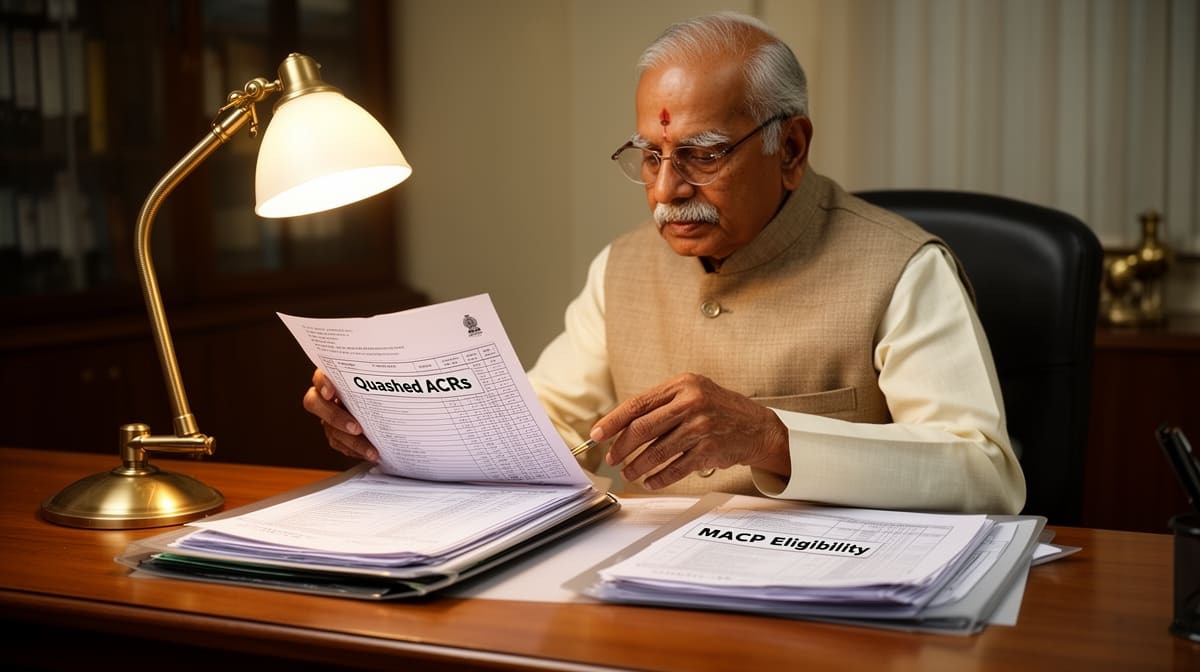
MACP Scheme | Quashed ACRs Cannot Be Reused to Deny Financial Upgradation: CAT Ernakulam
Case Law Analysis
|Central Administrative Tribunal

MACP Scheme | Quashed ACRs Cannot Be Reused to Deny Financial Upgradation: CAT Ernakulam

The Central Administrative Tribunal holds that administrative authorities cannot rely on ACRs previously set aside by court order to deny financial upgradation under the MACP Scheme, reinforcing that service benefits must be assessed on legally valid records alone. This protects public employees from retrospective penalization based on invalidated evaluations and strengthens the doctrine of consistency in administrative decision-making.