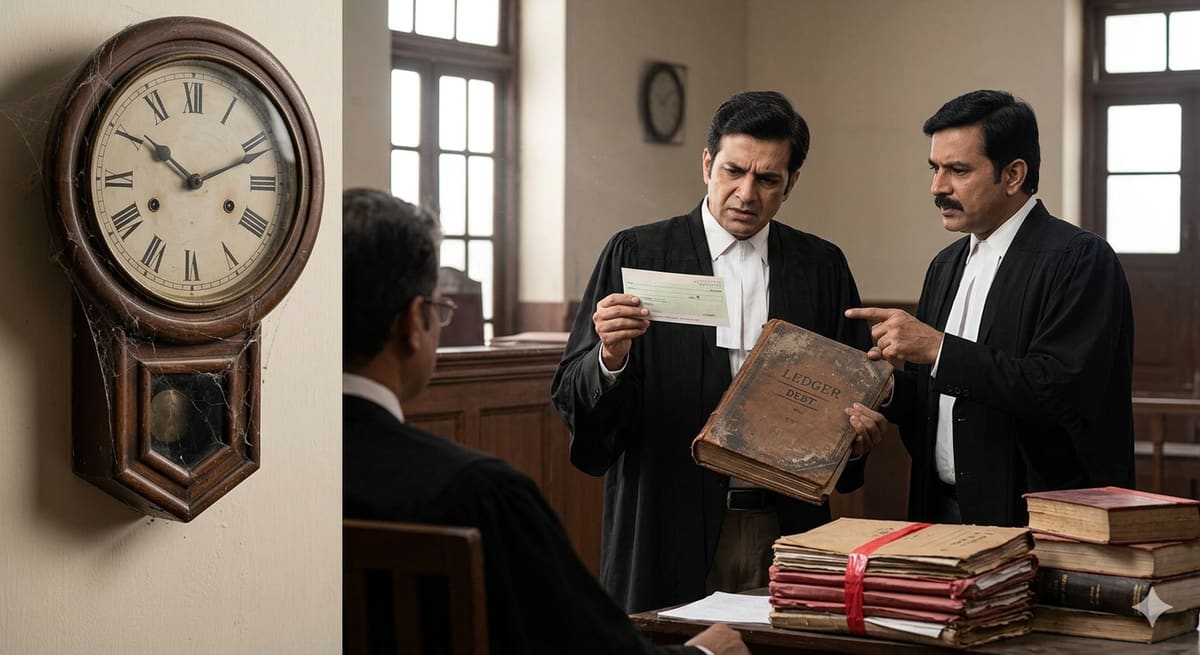
The Punjab and Haryana High Court has delivered a decisive ruling that a civil suit for recovery of a loan is barred if the lender lacks a valid license under the Punjab Registration of Money Lenders Act, 1938, even when the borrower admits the loan's existence. This judgment reinforces statutory compliance as a non-negotiable threshold for maintainability, overturning concurrent findings of lower courts that had decreed the suit on the basis of a promissory note and will.
Background & Facts
The Dispute
The plaintiff, Narinder Singh, filed a civil suit seeking recovery of Rs. 9,92,835 from the defendant, Kirpal Singh, based on a promissory note and receipt dated 18.09.2007 executed by the defendant in favor of Khem Singh, the plaintiff’s father. Khem Singh died on 03.09.2008, and the plaintiff claimed entitlement to the debt through a will dated 12.07.2008. The defendant admitted borrowing Rs. 8,50,000 but contended that the amount had been repaid on 08.04.2008, evidenced by a written acknowledgment from Khem Singh, which stated that the original promissory note and receipt were lost and no legal action would be initiated if found.
Procedural History
- 2009: Suit filed by plaintiff in the Court of Additional Civil Judge (Senior Division), Kharar.
- 2012: Trial Court decreed the suit for principal amount plus interest at 9% per annum from 19.09.2007.
- 2015: First Appellate Court dismissed the appeal with costs.
- 2026: Second Appeal heard by the Punjab and Haryana High Court.
Relief Sought
The plaintiff sought recovery of the loan amount with interest, relying on the promissory note, receipt, and the will. The defendant sought dismissal of the suit on grounds of non-compliance with the Punjab Money Lenders Act, 1938, lack of probate or succession certificate, non-joinder of legal heirs, and fabrication of documents.
The Legal Issue
The central question was whether a civil suit for recovery of a loan is maintainable under the Code of Civil Procedure when the lender, though deceased, was an unlicensed money lender under Section 3 of the Punjab Registration of Money Lenders Act, 1938, and the plaintiff failed to obtain a succession certificate under Section 214 of the Indian Succession Act, 1925.
Arguments Presented
For the Appellant
The appellant argued that Khem Singh, the original lender, was a regular money lender as admitted by the plaintiff in his deposition, and therefore required a license under Section 3 of the Punjab Money Lenders Act, 1938. Since no license was produced, the suit was statutorily barred. Further, the plaintiff failed to obtain a succession certificate under Section 214 of the Indian Succession Act, which is mandatory for recovery of debts from debtors of deceased persons. The will was unregistered, unproved, and suspiciously timed before the testator’s accidental death. The appellant also contended that the promissory note and receipt produced by the plaintiff were fabricated, as they lacked Khem Singh’s signature, contrary to the scribe’s testimony.
For the Respondent
The respondent argued that probate was unnecessary because the plaintiff derived title from a will, not from intestate succession. He contended that the defendant had admitted the loan and the execution of the promissory note, rendering the licensing issue irrelevant. He further argued that the witnesses to the repayment receipt (Ex.D1) were not cross-examined, so their affidavits could not be relied upon. The respondent also claimed that the plaintiff’s mother and sisters had consented to his sole entitlement, making joinder of legal heirs unnecessary.
The Court's Analysis
The Court conducted a rigorous analysis of statutory mandates and evidentiary standards. It held that Section 3 of the Punjab Registration of Money Lenders Act, 1938 is a mandatory bar to suit maintainability, irrespective of admission by the defendant. The Court emphasized that the plaintiff’s own testimony as PW1 confirmed Khem Singh’s regular lending activity, thereby triggering the statutory prohibition.
"It is admitted fact on record that Khem Singh did not possess a money lending license. Admittedly, respondent has never placed on record any money lending license obtained by his father Khem Singh."
The Court further held that Section 214 of the Indian Succession Act is a procedural precondition for recovery of debts from a debtor of a deceased person. The plaintiff’s reliance on an unregistered will was insufficient to bypass this requirement. The Court noted that the will was not proved under Section 68 of the Indian Evidence Act, as no attesting witness was examined, and the widow’s testimony did not establish due execution.
The Court also found that the trial court’s failure to frame an issue on repayment (Ex.D1) was a material irregularity. The appellant had discharged the initial burden of raising a plausible defense by producing a stamped document bearing Khem Singh’s signature, which matched his signature on a verified sale deed. The burden then shifted to the plaintiff to disprove it, which he failed to do.
The Court rejected the lower courts’ reasoning that joinder of legal heirs was unnecessary due to the will, noting that no issue on the will’s validity was framed, and the power of attorney presented did not mention the will. The findings of the lower courts were held to be perverse, contrary to evidence, and legally unsustainable.
The Verdict
The appellant won. The Court held that the suit was not maintainable due to non-compliance with Section 3 of the Punjab Registration of Money Lenders Act, 1938 and Section 214 of the Indian Succession Act, 1925, and that the plaintiff failed to prove the will or establish title to the debt. The impugned decrees were set aside and the suit dismissed.
What This Means For Similar Cases
Licensing Compliance Is Jurisdictional
- Practitioners must verify whether the original lender held a valid license under the Punjab Money Lenders Act before filing or defending a recovery suit.
- Admission of loan by the defendant does not cure non-compliance with Section 3 - it is a jurisdictional bar.
- Courts must raise this issue suo motu if evidence suggests regular lending activity.
Succession Certificate Is Mandatory for Debt Recovery
- No court can decree a claim for debt of a deceased person unless the claimant produces a succession certificate, probate, or letters of administration under Section 214.
- A will alone, even if unchallenged, is insufficient to establish representative title.
- Failure to obtain a succession certificate renders the suit non-maintainable, regardless of the will’s authenticity.
Burden of Proof Shifts After Prima Facie Defense
- When a defendant produces credible documentary evidence of repayment (e.g., stamped receipt with matching signature), the burden shifts to the plaintiff to disprove it.
- Courts cannot dismiss such evidence solely on the ground that witnesses were not cross-examined if the document itself is authenticated by other means.
- Failure to frame specific issues on key defenses (e.g., repayment, validity of will) renders findings liable to be set aside in second appeal.