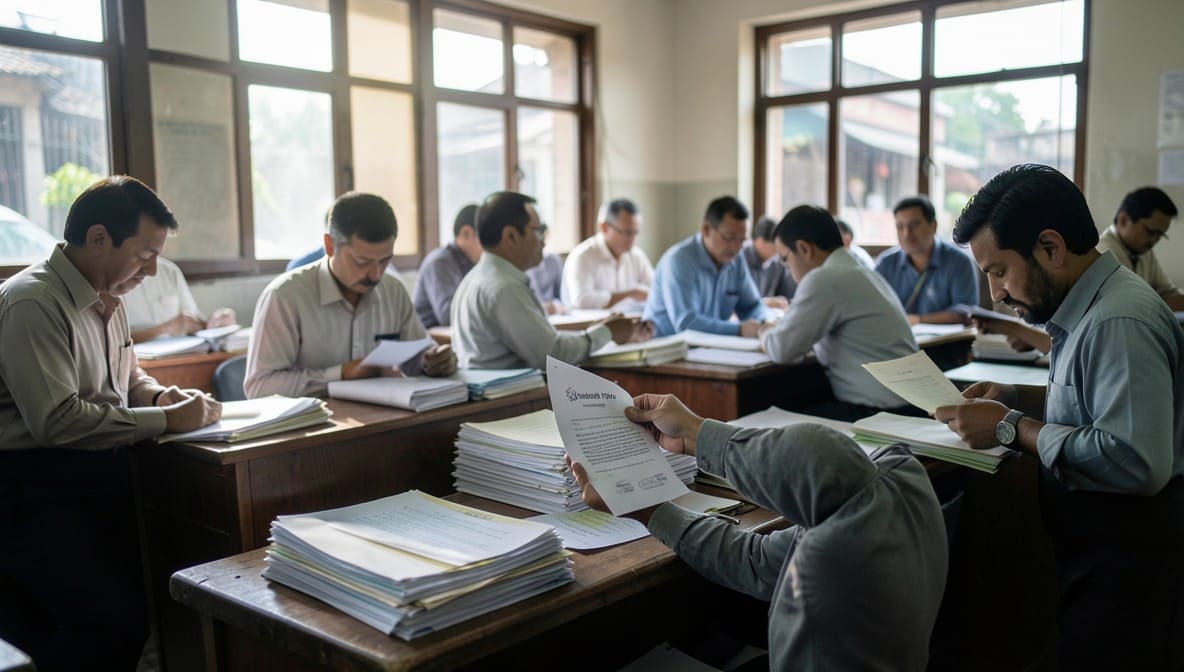
The Andhra Pradesh High Court has reaffirmed that the length of delay is irrelevant when the cause for delay falls within the four corners of sufficient cause under Section 5 of the Limitation Act, 1963. In a significant ruling, the Court set aside a lower court’s dismissal of a 1,813-day delay in seeking to set aside an ex parte decree, emphasizing that substantial justice must override rigid procedural timelines when no negligence or mala fides are established.
Background & Facts
The Dispute
The dispute arose from a partition suit filed by plaintiffs against three defendants, including the petitioner, Velpula Ramachandraiah, who had purchased a major portion of the suit property via a registered sale deed dated 21.06.2008 - well before the suit was filed in 2011. The petitioner claimed that after receiving summons, he approached the plaintiffs and defendant Nos. 1 and 2, leading to a panchayat where they promised to withdraw the suit concerning the sold property. Relying on this assurance, he did not actively participate in the proceedings.
Procedural History
- 2011: Original suit (O.S. No. 77/2011) filed for partition of property.
- 18.07.2013: Ex parte preliminary decree passed against defendant No. 3, who remained absent.
- 2015: Plaintiffs filed applications for appointment of Advocate-Commissioner and final decree.
- 2018: Defendant No. 3 filed I.A. No. 304/2018 seeking condonation of 1,813-day delay to set aside the ex parte decree under Order IX Rule 13 CPC read with Section 5 of the Limitation Act.
- 08.07.2025: Trial Court dismissed the application, holding that no sufficient cause was shown for the delay.
- 2025: Civil Revision Petition filed before the Andhra Pradesh High Court.
Relief Sought
The petitioner sought condonation of delay to file an application under Order IX Rule 13 CPC to set aside the ex parte preliminary decree, arguing that his non-appearance was due to a bona fide understanding with the plaintiffs, not negligence or mala fides.
The Legal Issue
The central question was whether Section 5 of the Limitation Act, 1963 permits condonation of an exceptionally long delay (1,813 days) in filing an application under Order IX Rule 13 CPC when the cause for delay, though inadequately documented, falls within the four corners of sufficient cause and no negligence or mala fides are attributable to the applicant.
Arguments Presented
For the Petitioner
Counsel relied on Mool Chandra v. Union of India and K. Subbarayudu v. Special Deputy Collector, arguing that the length of delay is immaterial if the cause is genuine and within the four corners of sufficient cause. He emphasized that the petitioner acted in good faith based on a panchayat promise, and that his substantial property rights were at stake. He invoked the principle that Section 5 must be construed liberally to advance substantial justice, citing State of Nagaland v. Lipok and N.Balakrishnan v. M. Krishnamurthy.
For the Respondent
Counsel for the plaintiffs contended that the petitioner had received summons and was fully aware of the suit’s pendency. The delay of over five years, they argued, was unexplained and inexcusable. They relied on State of Nagaland v. Lipok to assert that sufficient cause is a condition precedent, and that the petitioner’s failure to pursue the matter despite knowing the proceedings constituted negligence. They also cited Municipal Council, Ahmednagar v. Shah Hyder Beig to argue that courts must not condone delays without clear, credible justification.
The Court's Analysis
The Court undertook a detailed examination of the jurisprudence on Section 5 of the Limitation Act, distinguishing between mere delay and the presence of sufficient cause. It noted that while the petitioner’s explanation was not meticulously documented, the factual matrix revealed a plausible, non-negligent basis for non-appearance: a panchayat-based assurance from the plaintiffs to withdraw the suit.
"It is not the length of delay that would be required to be considered while examining the plea for condonation of delay, it is the cause for delay which has been propounded which has to be examined."
The Court emphasized that the petitioner’s rights over the property were not merely procedural but substantive - he held a registered sale deed, had his name mutated in revenue records, obtained a Pattadar Pass Book, and secured a crop loan against the property. To allow the ex parte decree to stand without adjudicating his claim would result in irreparable injustice.
The Court rejected the Trial Court’s mechanical approach, which focused solely on the duration of delay without probing the underlying circumstances. It held that liberal construction of Section 5 is mandatory when no mala fides or inaction attributable to the applicant is established. The Court further clarified that the burden is not to prove the cause beyond doubt, but to demonstrate that the delay arose from a cause that, in the peculiar circumstances, could reasonably be deemed sufficient.
The judgment reaffirmed that courts must place themselves in the shoes of the litigant and assess whether the cause, however informally presented, was genuine and beyond the party’s control.
The Verdict
The petitioner won. The Andhra Pradesh High Court allowed the revision petition, set aside the Trial Court’s order, and condoned the 1,813-day delay in filing the application under Order IX Rule 13 CPC. The Court held that sufficient cause under Section 5 of the Limitation Act may be established even without formal documentation if the circumstances, viewed liberally, justify the delay to prevent injustice.
What This Means For Similar Cases
Sufficient Cause Trumps Duration of Delay
- Practitioners must now argue that Section 5 is not a mechanical timer but a tool for equity.
- Courts cannot dismiss applications solely on the basis of delay exceeding five years if the cause is plausible and non-negligent.
- Oral assurances, community resolutions (like panchayats), or reliance on third-party promises may constitute sufficient cause if corroborated by conduct.
Substantive Rights Override Procedural Lapses
- When a party holds registered title, revenue records, or financial interests tied to the property, courts must prioritize adjudication on merits.
- Applications under Order IX Rule 13 CPC should not be dismissed summarily where property rights are at stake.
- Judges must assess whether denying relief would cause irreparable harm, even if the explanation for delay is imperfect.
Liberal Construction Is Mandatory, Not Discretionary
- The phrase "sufficient cause" must be interpreted generously, as mandated by State of Nagaland v. Lipok and Mool Chandra.
- Courts must avoid rigid, formulaic approaches and instead adopt a justice-oriented lens.
- Legal practitioners should frame delay applications by focusing on the litigant’s position, not just the calendar days elapsed.