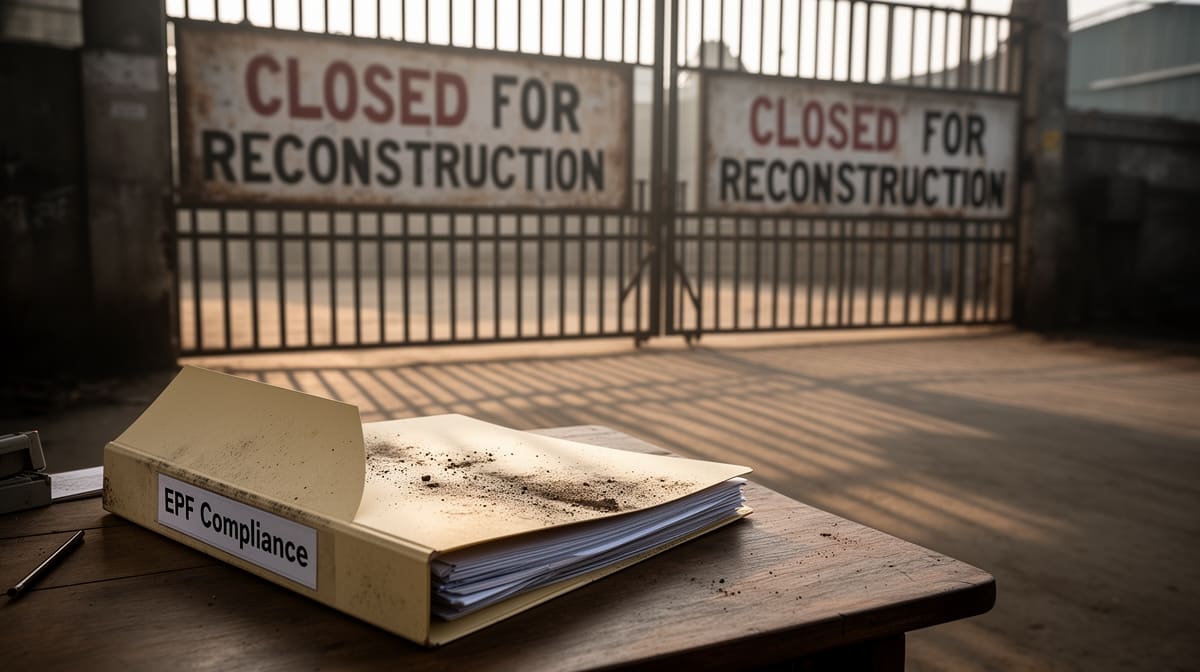
The Bombay High Court has affirmed that a statutory right of appeal is meaningless if the appellate forum is rendered non-functional due to administrative inaction. This judgment underscores that procedural safeguards enshrined in legislation cannot be reduced to paper promises, especially when they protect establishments from arbitrary financial penalties.
Background & Facts
The Dispute
The petitioner, Autocop Indian Pvt. Ltd., challenged an order passed under Sections 14B and 7Q of the Employees' Provident Funds and Miscellaneous Provisions Act, 1952, which imposed damages for delayed payment of provident fund dues and interest on such delays. These provisions carry significant financial consequences, potentially threatening the operational viability of small and medium enterprises.
Procedural History
- The Employer was issued a notice under Section 14B for non-payment of PF dues.
- An order levying damages and interest was passed by the Provident Fund Commissioner.
- The petitioner sought to file an appeal before the Appellate Authority under the Act.
- No Presiding Officer has been appointed to the Appellate Authority for an extended period.
- The petitioner was denied access to the statutory appellate forum despite its existence on paper.
- Faced with no functional remedy, the petitioner approached the High Court under Article 226.
Relief Sought
The petitioner sought a writ directing the Government to appoint a Presiding Officer to the Appellate Authority and, alternatively, to stay the enforcement of the impugned order pending appointment.
The Legal Issue
The central question was whether the right to statutory appeal under the Employees' Provident Funds Act becomes illusory and constitutionally untenable when the appellate forum remains non-functional due to the prolonged non-appointment of a Presiding Officer.
Arguments Presented
For the Petitioner
The petitioner relied on the principle that a statutory remedy must be effective and accessible, not merely theoretical. Citing State of Punjab v. Jalaj, the petitioner argued that when the appellate authority is vacant and no hearing can be conducted, the right to appeal ceases to exist in substance. The petitioner emphasized that Section 14B and Section 7Q impose civil liabilities akin to penalties, and denying access to appeal violates Article 14 and Article 21 by exposing employers to arbitrary enforcement.
For the Respondent
The respondent conceded the vacancy but contended that the appointment process was underway, with a committee constituted and final steps in progress. It argued that administrative delays, including amalgamation of functions and procedural formalities, justified the interim inaction. The respondent submitted that writ jurisdiction should not interfere where a statutory remedy exists, even if temporarily unworkable.
The Court's Analysis
The Court examined the structure of the EPF Act and found that the legislature intended a two-tier adjudicatory mechanism: first, the Commissioner determines liability; second, the Appellate Authority provides a check on excess or erroneous orders. The absence of a Presiding Officer renders this second tier inoperative. The Court held that a remedy which exists only on paper is no remedy at all.
"The statute contemplates a working appellate forum. The absence of a Presiding Officer renders the remedy illusory."
The Court rejected the argument that administrative difficulties excuse prolonged inaction. It emphasized that statutory rights cannot be suspended indefinitely due to bureaucratic inertia. The Court distinguished this from temporary delays, noting that the vacancy had persisted beyond reasonable timeframes, leaving affected parties with no recourse but to approach the High Court.
The Court further noted that the petitioner had already been heard at the original stage, and therefore, no interim relief was warranted. However, the systemic failure demanded institutional intervention.
The Verdict
The petitioner did not obtain direct relief on the merits, but the Court held that the statutory appeal mechanism under the EPF Act cannot remain suspended. The Government was directed to appoint a Presiding Officer within six months, restoring the appellate forum as a functional safeguard.
What This Means For Similar Cases
Statutory Appeals Cannot Be Illusory
- Practitioners may now invoke writ jurisdiction when statutory appellate forums are non-functional due to administrative delay.
- Courts will treat prolonged vacancies in appellate bodies as violations of procedural fairness under Article 14 and Article 21.
- Employers facing penalties under Section 14B or Section 7Q may seek interim stays if no appellate authority exists.
Administrative Delay Is Not a Legal Defense
- Government agencies must prioritize filling statutory posts critical to due process.
- Courts will not accept vague assurances of "future appointment" as justification for indefinite denial of remedy.
- The six-month deadline set here establishes a new benchmark for judicial intervention in similar cases under other statutes with appellate mechanisms.
Procedural Safeguards Are Non-Negotiable
- Section 14B and Section 7Q impose civil liabilities with quasi-penal consequences; thus, access to appeal is not discretionary.
- The judgment reinforces that substantive rights require procedural enablers - without a functioning appellate body, enforcement becomes arbitrary.
- Similar provisions in other labor laws (e.g., ESIC, Minimum Wages Act) may now be challenged on identical grounds if appellate authorities are vacant.