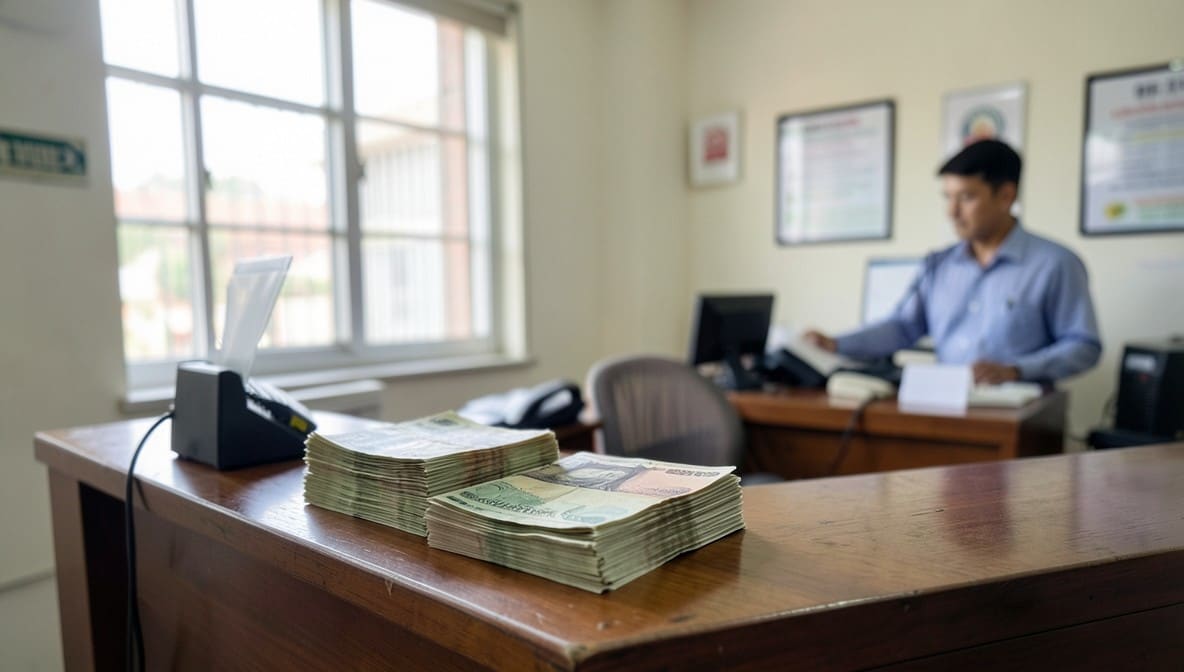
The Bombay High Court has affirmed that when law enforcement authorities seize cash prior to a statutory deposit deadline and retain it beyond that date, the petitioner cannot be penalized for failing to deposit it. The Court directed the Reserve Bank of India to exchange demonetised currency notes held in custody, recognizing that the delay was entirely attributable to state action.
Background & Facts
The Dispute
On 01.12.2016, the petitioner, Shri Girish Rameshchandra Malani, a 43-year-old businessman from Akola, was traveling to the Renuka Devi Temple in Mahur, carrying Rs.2,00,000 in cash, consisting of 400 currency notes of Rs.500 denomination. His vehicle was intercepted by a police patrol team at Keroli Naka during the municipal elections. The cash was seized as a precautionary measure and deposited at Mahur Police Station, with an entry made in the General Diary.
Key Facts
- The petitioner was carrying Rs.2,00,000 in Rs.500 notes on 01.12.2016
- The seizure occurred during election-related surveillance at Keroli Naka, Nanded district
- The Mahur Police Station intimated the Income Tax Department via official communication dated 01.12.2016
- The Income Tax Department reviewed the matter and concluded the amount was legitimate, with no further action required
- The cash was returned to the petitioner on 31.12.2016
- The petitioner had no access to the cash between 01.12.2016 and 31.12.2016
- The petitioner approached the Reserve Bank of India, Nagpur, in January 2017 seeking exchange of the notes
- He submitted written requests on 16.03.2017 and 27.04.2017, both of which were rejected
- The RBI cited Notification dated 12.05.2017, which required compliance with procedural conditions for exchange of seized notes
- The petitioner filed an affidavit on 20.03.2026 listing the serial numbers of all 400 notes
Procedural History
- 01.12.2016: Cash seized by Mahur Police at Keroli Naka
- 01.12.2016: Income Tax Department notified of seizure
- 08.11.2016: Government of India notified demonetisation of Rs.500 and Rs.1,000 notes
- 30.12.2016: Deadline for deposit of demonetised notes expired
- 31.12.2016: Cash returned to petitioner
- January 2017: Petitioner first approached RBI Nagpur for exchange
- 16.03.2017: First formal written request to RBI
- 27.04.2017: Second written request
- 06.06.2017: RBI Mumbai responded via email, referencing Notification dated 12.05.2017
- 12.05.2017: Government issued Specified Bank Notes (Deposit of Confiscated Notes) Rules, 2017
- 12.06.2018: Writ Petition No. 647 of 2018 filed before Bombay High Court, Nagpur Bench
- 16.04.2026: Court recorded prima facie observations favoring petitioner
- 22.04.2026: Judgment pronounced
Relief Sought
The petitioner sought a direction to the Reserve Bank of India to accept the Rs.2,00,000 in demonetised Rs.500 notes and provide equivalent value in legal tender, along with costs.
The Legal Issue
The central question was whether the Reserve Bank of India is obligated to exchange demonetised currency notes seized by law enforcement before the statutory deadline of 30.12.2016 and returned after that date, where the petitioner was not at fault for the delay and the serial numbers of the notes are now verifiably documented.
Arguments Presented
For the Petitioner
The petitioner’s counsel, Shri C.N. Deshpande, argued that the seizure and prolonged custody of the cash by police authorities rendered the petitioner incapable of depositing the notes within the statutory window. He relied on the Notification dated 12.05.2017, which permitted exchange of notes seized by law enforcement agencies on or before 30.12.2016, subject to conditions. He contended that the petitioner’s case squarely fell within this provision, as the notes were seized before the deadline and returned after. He cited Sunny s/o Ratansingh Mago v. Union of India, Kishor Ramesh Sohoni v. Union of India, and Ramesh Bapurao Potdar v. Union of India to show that courts have consistently granted relief in similar circumstances where the delay was attributable to state action.
For the Respondent
Shri R.M. Bhangde, counsel for the Reserve Bank of India, argued that the Specified Bank Notes (Cessation of Liabilities) Act, 2017 and the Specified Bank Notes (Deposit of Confiscated Notes) Rules, 2017 constitute a complete statutory code. He emphasized that Rule 2(a) of the 2017 Rules mandates that the serial numbers of seized notes must be noted by the law enforcement agency and explicitly mentioned in a court direction. He contended that the petitioner’s affidavit, though listing serial numbers, was not issued or authenticated by the police or a court, and therefore did not satisfy the statutory condition. He relied on Vivek Narayan Sharma v. Union of India to argue that the RBI has no independent power to exchange notes beyond the statutory framework.
The Court's Analysis
The Court acknowledged the statutory framework under the Specified Bank Notes (Cessation of Liabilities) Act, 2017 and the 2017 Rules, which require that serial numbers of seized notes be recorded by law enforcement and referenced in a court direction. However, the Court emphasized that statutory compliance cannot be enforced rigidly where the failure to comply is not attributable to the petitioner.
"The requirement of compliance with the conditions prescribed under the Rules cannot be applied in a rigid manner where such compliance itself was rendered impossible due to the act of the authorities. The petitioner cannot be placed in a disadvantageous position on account of an act for which he is not responsible."
The Court noted that the petitioner had no control over the currency between 01.12.2016 and 31.12.2016. The police, not the petitioner, were responsible for the delay. The Court further observed that the petitioner had now submitted a detailed affidavit dated 20.03.2026 listing the serial numbers of all 400 notes. This documentation, though not originally prepared by the police, was sufficient to satisfy the purpose of the Rule - to ensure traceability and prevent fraud.
The Court distinguished Vivek Narayan Sharma on the ground that it dealt with individuals who failed to deposit notes due to personal reasons, not due to state-induced custody. The Court also relied on its own prior decisions in Sunny s/o Ratansingh Mago and Kishor Ramesh Sohoni, where similar relief was granted under writ jurisdiction to prevent unjust enrichment of the state and to uphold the principle of natural justice.
The Court held that the statutory scheme was designed to accommodate genuine cases of delay, and the petitioner’s situation was precisely the kind of case contemplated by the 2017 Rules. The absence of a court direction was not fatal, as the court direction requirement was intended to ensure procedural integrity - an objective now fulfilled by the verified affidavit.
The Verdict
The petitioner succeeded. The Court directed the petitioner to tender the Rs.2,00,000 in demonetised Rs.500 notes, bearing the serial numbers listed in the affidavit dated 20.03.2026, to the Reserve Bank of India within one week of receiving the order. The RBI was directed to verify the notes against the affidavit and pay the equivalent value in legal tender. The entire process was to be completed within eight weeks from the date of the order. There was no order as to costs.
What This Means For Similar Cases
State-Caused Delay Cannot Be Used to Deny Statutory Relief
- Practitioners must argue that when state authorities seize cash before a statutory deadline and retain it beyond that date, the petitioner’s inability to deposit is not a legal defect but a consequence of state action
- Affidavits listing serial numbers, even if not prepared by police, may suffice if they are credible and corroborated by contemporaneous records
- Courts may relax strict compliance with procedural conditions under writ jurisdiction to prevent injustice
RBI’s Discretion Is Not Absolute - It Is Bound by Statutory Purpose
- The RBI cannot invoke technical non-compliance to deny exchange where the statutory objective of protecting genuine holders is clearly met
- The Vivek Narayan Sharma precedent does not bar relief where the delay is attributable to third-party (state) action, not the claimant’s negligence
- The 2017 Rules were designed to provide a safety valve - not a trap for victims of administrative delay
Writ Jurisdiction Can Rectify Administrative Failures
- Courts retain the power under Article 226 to grant equitable relief where statutory mechanisms fail due to state inaction
- This judgment reinforces that constitutional remedies are available to correct procedural injustices created by the state
- Future petitioners in similar situations should file affidavits with serial numbers immediately upon release of seized cash, and preserve all communication with authorities