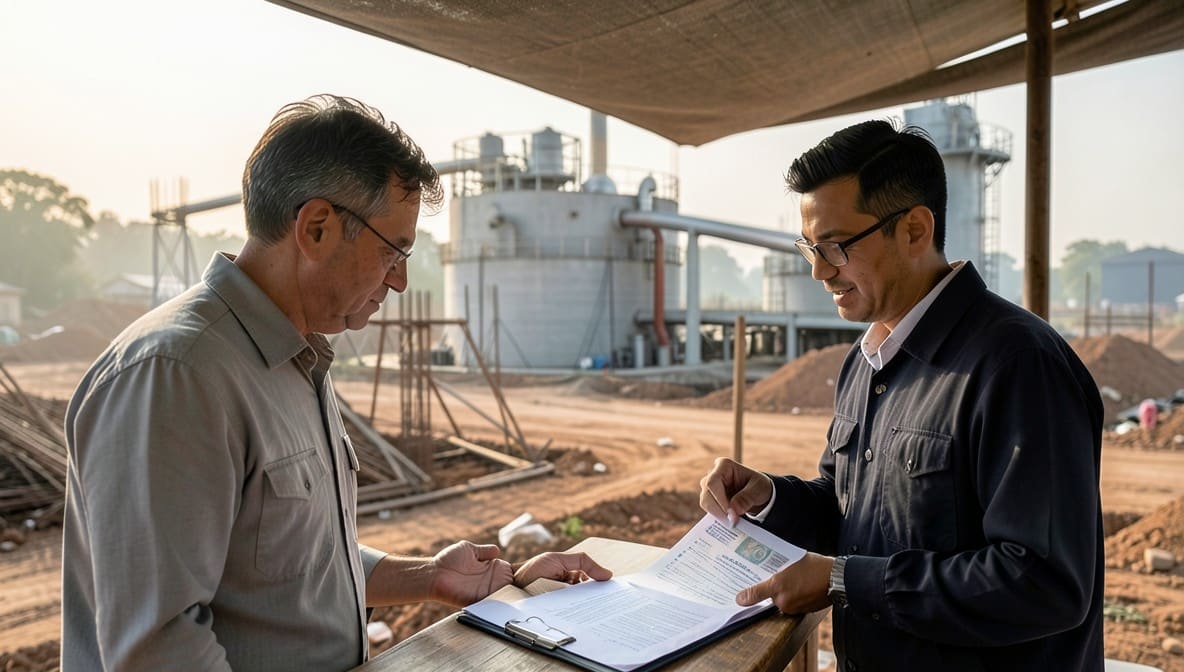
The Madras High Court has affirmed that a party’s failure to perform an essential reciprocal obligation under a commercial contract - specifically, providing legally enforceable access to a wind energy site - bars recovery of outstanding payments, even where the core equipment has been supplied and commissioned. This ruling reinforces the principle that specific performance and monetary relief are interdependent under the Specific Relief Act, 1963.
Background & Facts
The Dispute
The dispute arose from a commercial contract dated 09.11.2016 between M/s. Para Enterprises Pvt. Limited (plaintiff/appellant) and M/s. A.R. Dairy Food Private Limited (defendant/respondent) for the supply, erection, and commissioning of a P750/49-750 KW Wind Energy Generator. The total contract value was Rs. 3.85 crores. The appellant claimed a balance of Rs. 38,00,000 remained unpaid despite delivery and commissioning of the turbine. The respondent, however, withheld payment, asserting that the appellant had failed to provide a legally enforceable pathway for maintenance and servicing of the equipment, as explicitly required under the contract.
Key Facts
- The purchase order (Ex.A3) dated 09.11.2016 included an appendix with specific contractual obligations.
- Clause 2 of the appendix required the appellant to: (i) provide suitable land at the specified site; (ii) furnish an Encumbrance Certificate for the last 30 years; (iii) provide Patta copy up to the previous owner’s name; (iv) grant pathway rights for smooth movement of crane and vehicles; (v) bear registration expenses for the land in favor of the respondent; and (vi) bear OH line and O&M charges payable to TANGEDCO.
- The appellant executed a sale deed dated 21.10.2016 for 1.80 acres of land in Pirancheri Village, Tirunelveli District, but failed to secure exclusive or legally recognized access rights.
- The respondent repeatedly raised objections via email from 09.05.2018 onwards, citing lack of proper pathway.
- On 10.08.2017, the appellant admitted in writing that the pathway issue was unresolved and that resolving it would cost Rs. 3,00,000.
- On 06.07.2020, the appellant proposed an alternate route via private land and government poromboke land, which the respondent rejected as unlawful.
- The respondent’s witness confirmed that vehicles accessed the site via patta land, not the land provided by the appellant.
- The appellant issued legal notices on 24.09.2020, demanding payment of Rs. 38,00,000 plus 18% interest.
- The suit was filed on 27.07.2022.
Procedural History
- 09.11.2016: Purchase order executed.
- 21.10.2016: Sale deed executed for land in Pirancheri Village.
- 09.05.2018: First email from appellant demanding payment; respondent objects to pathway.
- 30.05.2018 to 06.07.2020: Series of emails exchanged on pathway access.
- 24.09.2020: Final legal notice issued by appellant.
- 27.07.2022: Suit filed in Commercial Court, Chennai (C.O.S. No. 413 of 2022).
- 27.07.2023: Trial Court dismissed the suit, holding appellant failed to perform reciprocal obligation.
- 16.02.2026: Appeal heard and reserved.
- 30.04.2026: Judgment pronounced.
The Parties' Positions
Appellant (Para Enterprises): Argued that the turbine was fully supplied, erected, and commissioned; that the pathway issue was minor and resolvable; that an alternate route was proposed; and that withholding payment was unjustified. Claimed Rs. 38,00,000 plus 18% interest.
Respondent (A.R. Dairy): Contended that Clause 2 of the purchase order was a material term; that the land provided lacked legal access; that proposed solutions involved encroachment on government land; and that failure to perform this essential obligation barred recovery under Section 16(c) of the Specific Relief Act.
Relief Sought
The appellant sought recovery of Rs. 38,00,000 as principal, interest at 18% per annum from the date of the plaint, and costs. The respondent sought dismissal of the suit with no payment.
The Legal Issue
The central question was whether a party who fails to perform an essential reciprocal obligation under a commercial contract - specifically, providing legally enforceable pathway rights for maintenance of equipment - can still claim recovery of the outstanding balance under the Specific Relief Act, 1963.
Arguments Presented
For the Appellant
The appellant’s counsel argued that the Wind Turbine Generator had been fully supplied, erected, and commissioned, and was operational. The pathway issue, they contended, was ancillary and could be resolved through an alternate route proposed in Ex.A13. They relied on the principle that substantial performance entitles a party to payment, and that the respondent had been using the turbine without hindrance. They further argued that Clause 2 did not mandate an exclusive pathway, only "pathway rights," and that the respondent’s refusal to accept the proposed route was unreasonable.
For the Respondent
The respondent’s counsel relied on Section 16(c) and Section 20 of the Specific Relief Act, 1963, arguing that the appellant had not proven readiness and willingness to perform an essential term of the contract. They cited Surinder Kaur v. Bahadur Singh (2019) 8 SCC 575, where the Supreme Court held that failure to perform a reciprocal promise disentitles a party to specific performance. They emphasized that without legal access, the turbine could not be maintained or serviced, rendering the entire contract purposeless. The proposed route via government poromboke land, they argued, was unlawful and could not constitute performance.
The Court's Analysis
The Court undertook a detailed examination of Clause 2 of the purchase order, which explicitly required the appellant to provide "pathway rights for smooth movement of crane and vehicles." The Court noted that this was not a mere convenience but a material condition integral to the operational viability of the wind turbine. The correspondence between the parties, particularly the appellant’s own admission on 10.08.2017 that the pathway issue was unresolved and required Rs. 3,00,000 to fix, demonstrated awareness of non-performance.
"The appellant had admitted in writing that the pathway provided was not conducive and that the solution involved encroachment on government land, which is clearly unlawful."
The Court further observed that the respondent’s witness confirmed access was being gained via patta land, not the land provided by the appellant, indicating that the appellant had not fulfilled its contractual obligation. The Court held that Section 16(c) of the Specific Relief Act mandates that a party seeking recovery must prove it has performed or been ready and willing to perform all essential terms. The provision of a lawful, accessible pathway was such a term.
The Court distinguished the Supreme Court’s decision in Surinder Kaur, noting that while that case involved non-payment of rent, the principle was analogous: failure to perform a reciprocal obligation defeats the right to enforce the contract. The Court emphasized that the discretion under Section 20 is not arbitrary and must be exercised on judicial principles. Here, enforcing payment would have conferred an unfair advantage on the appellant, who had not discharged its core obligation.
The Court rejected the appellant’s argument that the pathway was merely an ancillary term. It held that without legal access, the turbine could not be maintained, inspected, or repaired - rendering the entire commercial purpose of the contract unfulfilled. The proposed alternate route via poromboke land was not a valid substitute under law.
The Verdict
The appeal was dismissed. The Madras High Court confirmed the judgment and decree dated 27.07.2023 of the Principal Judge, Commercial Courts, Egmore, Chennai, dismissing the suit. The appellant is not entitled to recover the principal amount of Rs. 38,00,000, any interest, or costs. The Court held that the respondent was justified in withholding payment due to the appellant’s failure to perform an essential contractual obligation under Clause 2 of the purchase order.
What This Means For Similar Cases
Contractual Terms Must Be Literally and Lawfully Performed
- Practitioners must ensure that all contractual obligations, especially those relating to land access, infrastructure, or regulatory compliance, are not only documented but also lawfully executed.
- Vague or partial performance of material terms - even if the core product is delivered - will not suffice to claim payment.
Pathway and Access Clauses Are Material, Not Ancillary
- In energy, infrastructure, and industrial contracts, clauses requiring access, right-of-way, or land use permissions are not procedural formalities but essential conditions.
- Failure to secure legal access (e.g., through easement, patta, or government sanction) constitutes a material breach.
Section 16(c) of the Specific Relief Act Is a Powerful Defense
- Defendants in commercial disputes can invoke Section 16(c) to defeat claims where the plaintiff has not performed its reciprocal obligations.
- Emails and written admissions of non-performance are critical evidence to establish failure to be "ready and willing" to perform.
- Courts will not enforce payment where performance is incomplete or unlawful, even if the equipment is functional.
Evidence of Non-Performance Must Be Documented
- Parties must maintain a clear paper trail of objections, requests, and refusals regarding contractual obligations.
- Proposals to resolve issues via unlawful means (e.g., government land) will not be recognized as performance.
- The burden of proving readiness and willingness to perform rests squarely on the plaintiff.