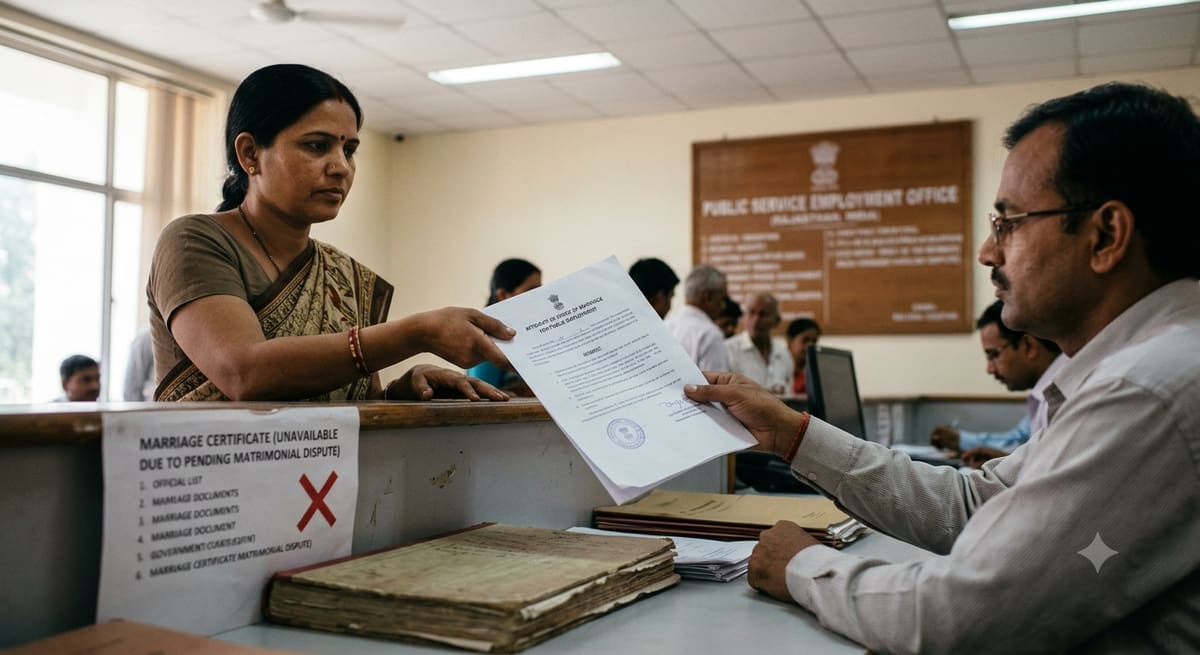
The Kerala High Court has clarified that the refusal to process a marriage registration under the Special Marriage Act, 1954, solely due to the absence of an Aadhaar card by a petitioner holding foreign citizenship, is legally untenable. This ruling affirms that statutory compliance under the Act must be assessed on its own terms, without imposing extraneous documentary conditions.
Background & Facts
The Dispute
The petitioners, Jeshurun Lallu Luke, a US citizen by naturalization, and Angel Celin Jose, an Indian citizen residing in Pathanamthitta, Kerala, sought to register their marriage under the Special Marriage Act, 1954. They submitted a notice of intended marriage to the Sub-Registrar Office at Adoor, Pathanamthitta. The respondents, including the Sub-Registrar and the Inspector General of Registration, declined to process the application on the ground that the 1st petitioner, being a US citizen, had not produced an Aadhaar card.
Key Facts
- The 1st petitioner was born in India on 16.04.2002 and holds Indian birth certificate (Exhibit P1)
- He acquired US citizenship through naturalization on 13.03.2023, as evidenced by Certificate of Naturalization No. 44104650 (Exhibit P2)
- The 2nd petitioner is an Indian citizen, born on 20.12.2002 (Exhibit P3), with a valid ration card (Exhibit P4) and Aadhaar card (Exhibit P5)
- The 1st petitioner is currently residing in Cary, North Carolina, USA, and is represented by his grandfather, Eapen Luke, through a valid Power of Attorney
- The petitioners submitted all other documents required under the Special Marriage Act, 1954, including proof of age, residence, and marital status
- The respondents refused to accept the notice on the sole ground that the 1st petitioner lacked an Aadhaar card
Procedural History
- 15.05.2026: Notice of intended marriage submitted to Sub-Registrar Office, Adoor
- 18.05.2026: Sub-Registrar returned the application, citing non-production of Aadhaar card by the 1st petitioner
- 20.05.2026: Petitioners filed a representation to the Inspector General of Registration, which was rejected
- 25.05.2026: Legal notice issued to the State of Kerala and concerned officials
- 01.06.2026: Writ Petition (WP(C) No. 18371 of 2026) filed before the High Court of Kerala at Ernakulam
Relief Sought
The petitioners sought a writ of mandamus directing the respondents to accept and process their notice of intended marriage under the Special Marriage Act, 1954, without insisting on the production of an Aadhaar card by the 1st petitioner.
The Legal Issue
The central question was whether the Special Marriage Act, 1954 requires the production of an Aadhaar card as a mandatory document for registration of marriage, particularly when one of the parties is a foreign citizen and does not possess an Aadhaar card.
Arguments Presented
For the Petitioner
The petitioners’ counsel argued that the Special Marriage Act, 1954, is a self-contained statute with a clearly enumerated list of documents required for marriage registration under Sections 5, 6, and 7. None of these provisions mention Aadhaar as a mandatory document. The insistence on Aadhaar is an unauthorized administrative imposition that violates the principle of statutory interpretation. The 1st petitioner’s US citizenship and absence of Aadhaar do not disqualify him from marrying under the Act, as the Act applies to persons of any religion or nationality. Reliance was placed on Puttaswamy v. Union of India to affirm that Aadhaar cannot be made mandatory for rights not statutorily linked to it.
For the Respondent
The Government Pleader contended that Aadhaar is a widely accepted identity document under the Aadhaar Act, 2016, and its production facilitates verification of identity and residence. He argued that the Sub-Registrar’s office, as a public authority, is entitled to seek reasonable documentation to prevent fraudulent marriages. He did not cite any statutory provision requiring Aadhaar under the Special Marriage Act but relied on administrative practice and the general utility of Aadhaar for identity verification.
The Court's Analysis
The Court undertook a strict textual analysis of the Special Marriage Act, 1954, and found no provision that mandates the production of an Aadhaar card for the registration of marriage. Sections 5, 6, and 7 specify the requirements as notice of intended marriage, affidavits, proof of age and residence, and other documents as may be prescribed by rules - none of which include Aadhaar.
"The Special Marriage Act, 1954, is a secular statute designed to facilitate marriage irrespective of religion, nationality, or domicile. To impose an additional condition not found in the statute is to legislate from the bench of administration."
The Court noted that the 1st petitioner has produced his US Certificate of Naturalization and Indian birth certificate, both of which are valid documents for establishing identity and age under the Act. The absence of an Aadhaar card, which is not issued to foreign citizens, cannot be a ground for rejection. The Court further held that the Power of Attorney holder, being the grandfather and duly authorized, is competent to submit the notice on behalf of the 1st petitioner, as the Act does not require personal appearance by both parties.
The Court rejected the argument that administrative convenience justifies imposing non-statutory conditions. It emphasized that the State cannot create new eligibility criteria under the guise of verification. The principle of expressio unius est exclusio alterius applies: where the legislature has specified the documents required, no others may be added.
The Verdict
The writ petition was allowed. The Court directed the 4th respondent, Sub-Registrar, Adoor, to accept the notice of intended marriage submitted by the petitioners under the Special Marriage Act, 1954, and to process it in accordance with law. The Court clarified that the notice submitted by the Power of Attorney holder is valid and must be processed without requiring an Aadhaar card from the 1st petitioner. The respondents were directed to complete the registration process within 30 days from the date of this order.
What This Means For Similar Cases
Aadhaar Is Not a Statutory Requirement for Marriage Registration
- Practitioners may now confidently challenge any refusal to process marriage notices under the Special Marriage Act on the ground of missing Aadhaar
- The ruling applies equally to NRIs, PIOs, and foreign nationals seeking to marry in India under the Act
- No additional documents beyond those specified in Sections 5 - 7 of the Act may be demanded
Citizenship Status Does Not Disqualify Under the Special Marriage Act
- Foreign citizens are eligible to marry under the Act provided they meet the age, consent, and non-impediment requirements
- Proof of foreign citizenship (e.g., passport, naturalization certificate) is sufficient for identity verification
- The Act’s secular character overrides any administrative preference for domestic ID systems
Power of Attorney Is Valid for Submission of Marriage Notices
- The Act does not mandate personal appearance by both parties
- A duly executed Power of Attorney holder may submit the notice on behalf of a non-resident party
- Sub-Registrar offices must accept such submissions without undue delay or additional conditions