The Madhya Pradesh High Court has clarified that when a court-appointed commissioner, such as a Tehsildar, requires police protection to perform statutory duties in land demarcation, the expense is a sovereign function of the State and cannot be shifted to the litigant. This ruling reinforces the principle that judicial processes must not impose financial burdens on parties for state obligations.
Background & Facts
The Dispute
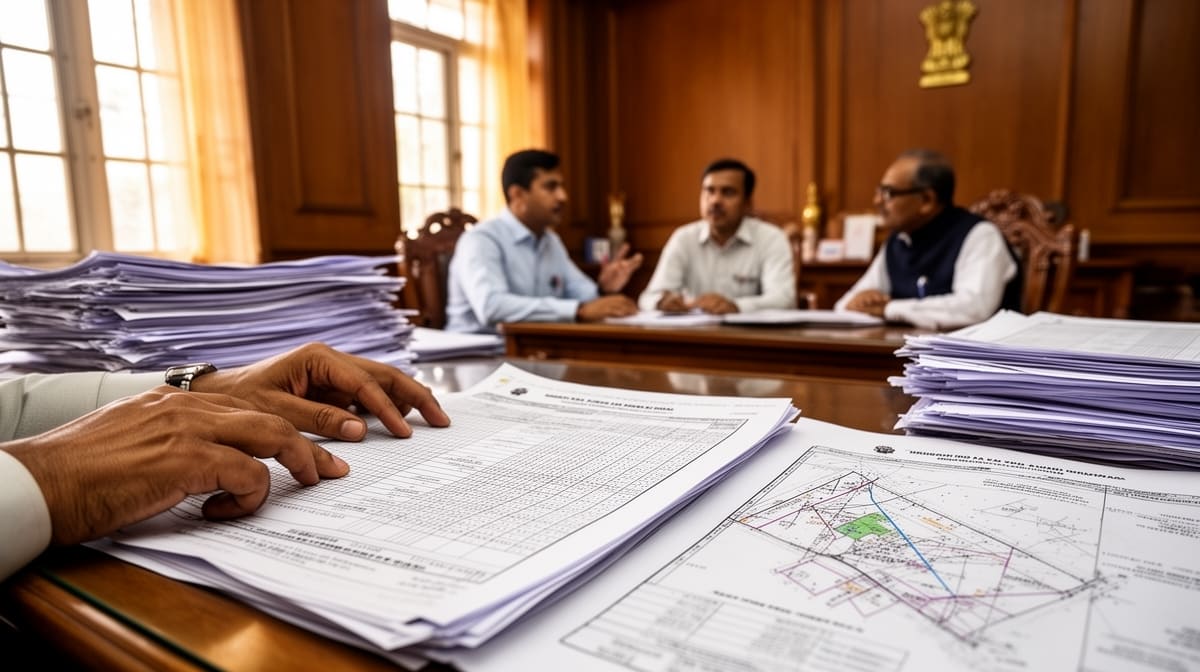
The dispute arose from a long-standing land boundary conflict between the heirs of the deceased Mehkal and the respondents Khushyal & Ors. The original civil suit, RCSA 14/2018, was dismissed on 02.04.2022. The appellate court, in Regular Civil Appeal No. 7/2025, set aside the trial court’s decree and remanded the matter with a specific direction to appoint a commission for demarcation of the disputed agricultural land to resolve the boundary controversy.
Key Facts
- The deceased Mehkal, through his legal representatives (Punaji and others), initiated proceedings for demarcation of agricultural land in Indore district
- The trial court appointed the Tehsildar as Commissioner to conduct the demarcation
- The Tehsildar, in discharge of his court-appointed duties, requested police protection for the demarcation process
- The Superintendent of Police submitted a daily bill of Rs. 21,939/- for police deployment
- The trial court directed the petitioner to bear this cost, citing the petitioner’s request for demarcation
- The petitioner challenged this direction through M.P. No. 1340/2026, which was disposed of with liberty to file an application before the trial court
Procedural History
- 02.04.2022: Trial Court dismissed Civil Suit No. RCSA 14/2018
- 2025: Regular Civil Appeal No. 7/2025 filed; Appellate Court set aside decree and remanded for demarcation
- 05.03.2026: Trial Court issued commission appointing Tehsildar as Commissioner
- March 2026: Tehsildar requested police protection; Superintendent of Police billed Rs. 21,939/- per day
- 10.03.2026: Trial Court ordered petitioner to pay police protection costs
- 15.03.2026: Petitioner filed M.P. No. 1340/2026 before the High Court seeking relief
- 18.03.2026: High Court disposed of M.P. No. 1340/2026 with liberty to approach trial court
- 21.04.2026: M.P. No. 2210/2026 filed under Article 227 challenging the trial court’s order
The Parties' Positions
Petitioner (Deceased Mehkal through LRs): Argued that police protection was sought by the Tehsildar, not by the petitioner. The petitioner merely sought judicial demarcation and had no role in requesting police assistance. Imposing costs on the petitioner was illegal and contrary to the principle that sovereign functions of the State cannot be monetized on litigants.
Respondent (State of Madhya Pradesh): Contended that since the petitioner initiated the demarcation process, any incidental costs - including police protection - must be borne by him. The State argued that the trial court’s order was a reasonable exercise of discretion.
Relief Sought
The petitioner sought setting aside of the trial court’s order dated 05.03.2026 directing payment of police protection costs, and a declaration that such expenses are the liability of the State.
The Legal Issue
The central question was whether the cost of police protection, sought by a court-appointed commissioner to perform a judicially mandated duty of land demarcation, constitutes a sovereign function of the State or a personal expense of the litigant.
Arguments Presented
For the Petitioner
The petitioner’s counsel relied on the principle that when a court appoints a commissioner to perform a judicial function, any ancillary support required - including police protection - is an incident of the State’s duty to facilitate judicial process. Citing State of U.P. v. Rameshwar Prasad, he argued that police acting in aid of a court order discharge a sovereign function, and the cost cannot be imposed on a litigant who merely seeks adjudication of rights. He emphasized that the petitioner never requested police protection; it was the Tehsildar’s administrative requirement.
For the Respondent
The State’s counsel contended that the petitioner, as the party initiating the demarcation, was responsible for all incidental expenses arising from the process. He argued that the trial court had the inherent power to allocate costs fairly and that the petitioner’s benefit from the demarcation justified the financial burden. He cited general principles of litigation cost allocation but did not cite any specific statutory or precedential authority.
The Court's Analysis
The Court undertook a structured analysis of the nature of the Tehsildar’s role and the legal character of police assistance. It observed that the Tehsildar was not acting in his administrative capacity but as a court-appointed Commissioner under the Code of Civil Procedure. The Court noted:
"Police protection has not been sought by the petitioner himself. In the considered view of this Court, it is the duty of the Tehsildar to perform the Commission as per direction of the Court and if he needs any protection then it will be deemed as sovereign function of the police to provide protection to the Tehsildar for performing his duties."
The Court distinguished between private disputes and the State’s obligation to ensure the execution of judicial orders. It held that the provision of police support to a court-appointed officer carrying out a judicial mandate is not a service rendered for the benefit of a private party, but an essential component of the State’s duty to uphold the rule of law. The Court further clarified that the trial court erred in treating the demand for police protection as a cost attributable to the petitioner’s litigation, rather than as an operational necessity of the judicial process.
The Court rejected the State’s argument that cost allocation was a matter of discretion, emphasizing that discretion must be exercised within legal boundaries. Where the law assigns a function to the State, the cost of its performance cannot be externalized onto a litigant absent statutory authority.
The Verdict
The petition was allowed. The High Court set aside the trial court’s order dated 05.03.2026 directing the petitioner to pay police protection costs. The Court held that police protection required for the Tehsildar in discharging his court-appointed duties is a sovereign function of the State, and the expenditure of Rs. 21,939/- per day, or any such cost incurred, shall be borne by the State of Madhya Pradesh. No payment shall be recovered from the petitioner.
What This Means For Similar Cases
Police Support in Judicial Commissions Is a State Obligation
- Practitioners may now confidently challenge any order requiring litigants to pay for police protection during court-ordered demarcations, surveys, or inspections
- Any demand for payment of police costs in civil proceedings involving court-appointed commissioners must be resisted on grounds of sovereign immunity and judicial process
- The burden of proof shifts to the State to show statutory authority before imposing such costs
Demarcation Proceedings Cannot Be Used to Shift Administrative Costs
- Courts must distinguish between costs arising from a litigant’s personal conduct and those arising from the execution of judicial orders
- Tehsildars, survey officers, or other commissioners acting under court direction are agents of the court, not the litigant
- Litigants should not be penalized financially for the State’s failure to provide adequate logistical support for judicial functions
Precedent for Other Judicial Functions
This judgment provides a strong precedent for similar situations involving:
- Court-appointed receivers requiring security
- Commissioners in partition suits requiring police escort
- Judicial officers conducting site inspections in land or environmental cases
In all such cases, the cost of police or administrative support must be borne by the State unless a specific statute provides otherwise.