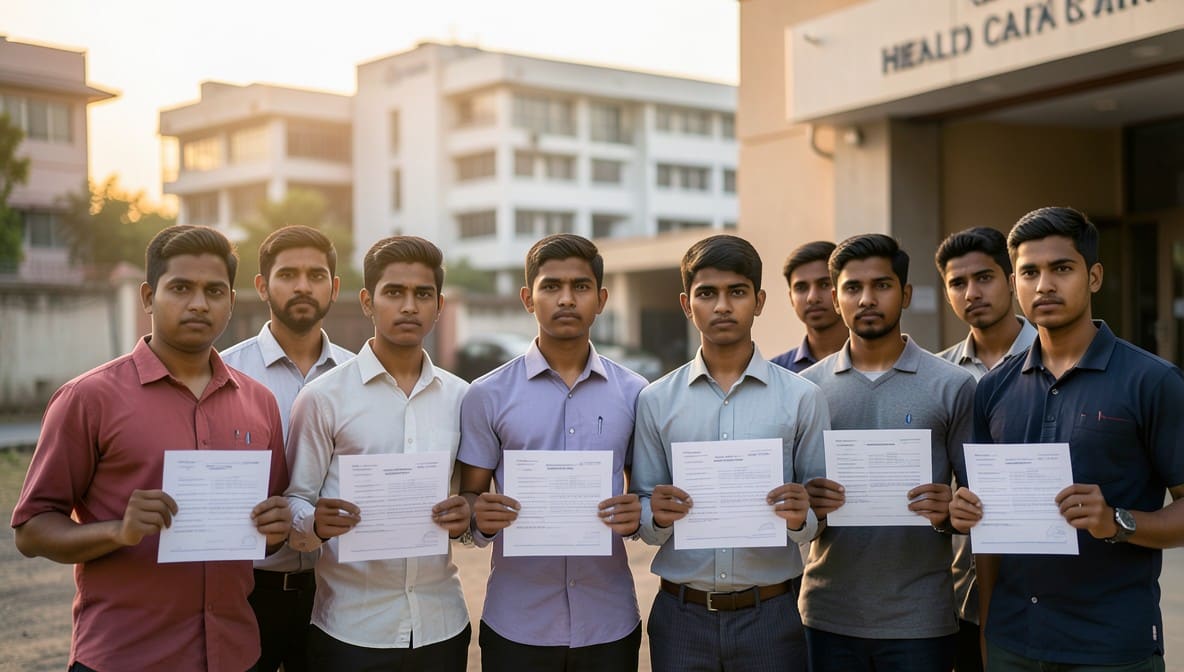
The Rajasthan High Court has reaffirmed that unsuccessful candidates in a recruitment process possess no enforceable right to claim appointment through a waiting list once its validity period expires. The judgment underscores the limited scope of judicial review in administrative decisions regarding public employment, particularly when statutory rules and circulars prescribe time-bound operation of reserve lists.
Background & Facts
The Dispute
The petitioners, comprising 21 candidates, participated in a recruitment process initiated by the Rajasthan Staff Selection Board pursuant to advertisement dated 06.09.2021 for 3896 vacancies of Village Development Officer (VDO), later increased to 5396 posts vide corrigendum dated 24.02.2022. Despite appearing in both preliminary and main examinations, the petitioners failed to secure marks above the cut-off threshold for their respective categories and were not included in the final select list.
Key Facts
- Advertisement dated 06.09.2021 invited applications for 3896 VDO posts
- Corrigendum dated 24.02.2022 increased vacancies to 5396 posts
- Results declared in phases between 25.11.2022 and 18.05.2023
- Batch of writ petitions (S.B. Civil Writ Petition No. 11616/2022) challenged the answer key, leading to re-evaluation of specific questions and revised merit lists
- Division Bench judgment dated 13.10.2025 set aside the Single Judge’s order dated 07.06.2023
- Impugned order dated 23.04.2025 merged unfilled vacancies into subsequent recruitment cycles (2024-25 and 2025-26)
- Interim order dated 05.01.2024 directed status quo during pendency of appeals
Procedural History
- 06.09.2021: Advertisement issued for VDO recruitment
- 24.02.2022: Corrigendum increasing vacancies to 5396 posts
- 25.11.2022 to 18.05.2023: Results declared in phases
- 07.06.2023: Single Judge disposed of writ petitions, directing re-evaluation
- 05.01.2024: Division Bench passed interim order maintaining status quo
- 13.10.2025: Division Bench set aside Single Judge’s order
- 23.04.2025: Respondents issued impugned order merging vacancies
- February 2026: Present writ petition filed under Article 226
The Parties' Positions
Petitioners:
- Contended that respondents arbitrarily merged unfilled vacancies into subsequent recruitment cycles, violating Articles 14 and 16 of the Constitution
- Argued that respondents were obligated to operate a waiting list under circulars dated 18.10.2021 and 27.12.2021
- Asserted that impugned order violated interim directions dated 05.01.2024
- Claimed legitimate expectation based on inter-departmental communications
Respondents:
- Raised preliminary objections regarding delay and laches (petition filed nearly 10 months after impugned order)
- Contended non-joinder of necessary parties (selected candidates in subsequent recruitment)
- Argued petitioners had no vested right to appointment or waiting list operation
- Relied on circular dated 27.12.2021, which limited waiting list operation to six months from result declaration
- Asserted that 98% of advertised posts were already filled, leaving no scope for further appointments
Relief Sought
The petitioners sought:
- Quashing of the impugned order dated 23.04.2025
- Direction to respondents to issue and operate a waiting/reserve list for unfilled vacancies
- Appointment against vacancies arising from non-joining of selected candidates
The Legal Issue
The central question was whether unsuccessful candidates in a recruitment process possess an enforceable right to demand issuance and operation of a waiting list beyond the prescribed validity period, and whether the respondents’ decision to merge unfilled vacancies into subsequent recruitment cycles was arbitrary or contrary to statutory rules.
Arguments Presented
For the Petitioners
- Relied on Rajasthan Public Service Commission, Ajmer v. Yati Jain & Others (2026 SCC OnLine SC 80) to argue that respondents were obligated to fill all advertised vacancies
- Contended that circulars dated 18.10.2021 and 27.12.2021 mandated preparation and operation of a reserve list
- Argued that respondents were estopped from merging vacancies due to consistent representations regarding waiting list issuance
- Asserted that impugned order violated interim order dated 05.01.2024, which restrained further appointments
- Claimed legitimate expectation based on administrative deliberations and correspondence
For the Respondents
- Contended petitioners had no vested right to appointment, as mere participation in selection process confers no enforceable right
- Relied on circular dated 27.12.2021, which limited waiting list operation to six months from result declaration (25.11.2022 to 18.05.2023)
- Argued that 98% of posts were already filled, leaving no scope for further appointments
- Submitted that impugned order was passed after disposal of appeals on 13.10.2025, rendering interim order ineffective
- Raised delay and laches, as petition was filed 10 months after impugned order and after subsequent recruitment process had progressed
- Contended non-joinder of necessary parties, as selected candidates in subsequent recruitment were not impleaded
The Court's Analysis
The Court conducted a detailed examination of the legal principles governing recruitment processes, particularly the scope of rights conferred upon unsuccessful candidates and the validity of waiting lists.
"It is trite law that mere participation in a selection process does not confer any vested or enforceable right to appointment. Even inclusion of a candidate in a select list or waiting list does not create an indefeasible right to be appointed. The Constitution Bench of the Hon'ble Supreme Court in Shankarsan Dash v. Union of India, (1991) 3 SCC 47, authoritatively held that a candidate whose name appears in the select list/waiting list acquires no indefeasible right to appointment and the State is not bound to fill up all the vacancies."
The Court relied extensively on Rajasthan Public Service Commission, Ajmer v. Yati Jain & Others (2026 SCC OnLine SC 80), which elucidated the limited scope of rights conferred upon wait-listed candidates:
"A waiting list prepared in service matters by the competent authority is a list of eligible and qualified candidates who in order of merit are placed below the last selected candidate... A candidate in the waiting list in the order of merit has a right to claim that he may be appointed if one or the other selected candidate does not join. But once the selected candidates join and no vacancy arises due to resignation etc. or for any other reason within the period the list is to operate under the rules or within reasonable period where no specific period is provided then candidate from the waiting list has no right to claim appointment to any future vacancy which may arise unless the selection was held for it."
The Court emphasized that waiting lists are not perennial sources of recruitment and their operation is time-bound, as reiterated in Surinder Singh v. State of Punjab and Rakhi Roy v. High Court of Delhi. The respondents demonstrated that the six-month validity period for the waiting list had expired (25.11.2022 to 18.05.2023), rendering any direction for its revival impermissible in law.
The Court also rejected the petitioners’ argument of legitimate expectation, holding that such expectation must be founded on a legal right or consistent past practice, neither of which existed in this case. The statutory framework and circulars did not mandate waiting list operation beyond the prescribed period.
Addressing the violation of interim order, the Court held that the interim order dated 05.01.2024 merely restrained further appointments during pendency of appeals and did not create any right in favour of the petitioners. Upon disposal of appeals on 13.10.2025, the interim order stood vacated, and respondents were within their authority to take administrative decisions, including merging vacancies.
The Court further noted the delay and laches on the petitioners’ part, as the impugned order was passed on 23.04.2025, whereas the writ petition was filed in February 2026, after the subsequent recruitment process had substantially progressed. Entertaining the petition at this stage would prejudice third-party candidates who had already been selected.
The Verdict
The Court dismissed the writ petition, holding that the petitioners failed to establish any enforceable right to appointment or waiting list operation. The respondents’ decision to merge unfilled vacancies into subsequent recruitment cycles was upheld as an administrative decision not amenable to judicial interference in the absence of arbitrariness, mala fide intent, or statutory violation.
What This Means For Similar Cases
Waiting Lists Are Time-Bound, Not Perpetual
- Statutory rules and circulars prescribe a validity period for waiting lists (e.g., six months from result declaration)
- Courts cannot direct revival of expired waiting lists, as they are not perennial sources of recruitment
- Unsuccessful candidates have no enforceable right to claim appointment beyond the prescribed period
Administrative Discretion in Recruitment Processes
- The State retains discretion to decide the number of posts to be filled, even if vacancies exist
- Judicial review is limited to cases of arbitrariness or statutory violation; courts cannot direct filling of vacancies in a particular manner
- Mere participation in a selection process does not confer a right to appointment or waiting list operation
Delay and Laches Can Defeat Remedy
- Writ jurisdiction is discretionary; relief can be denied on grounds of delay if it prejudices third parties
- Petitioners must approach courts promptly after impugned orders; belated challenges may be dismissed even on merits
- Subsequent recruitment processes may render relief infructuous if substantially progressed