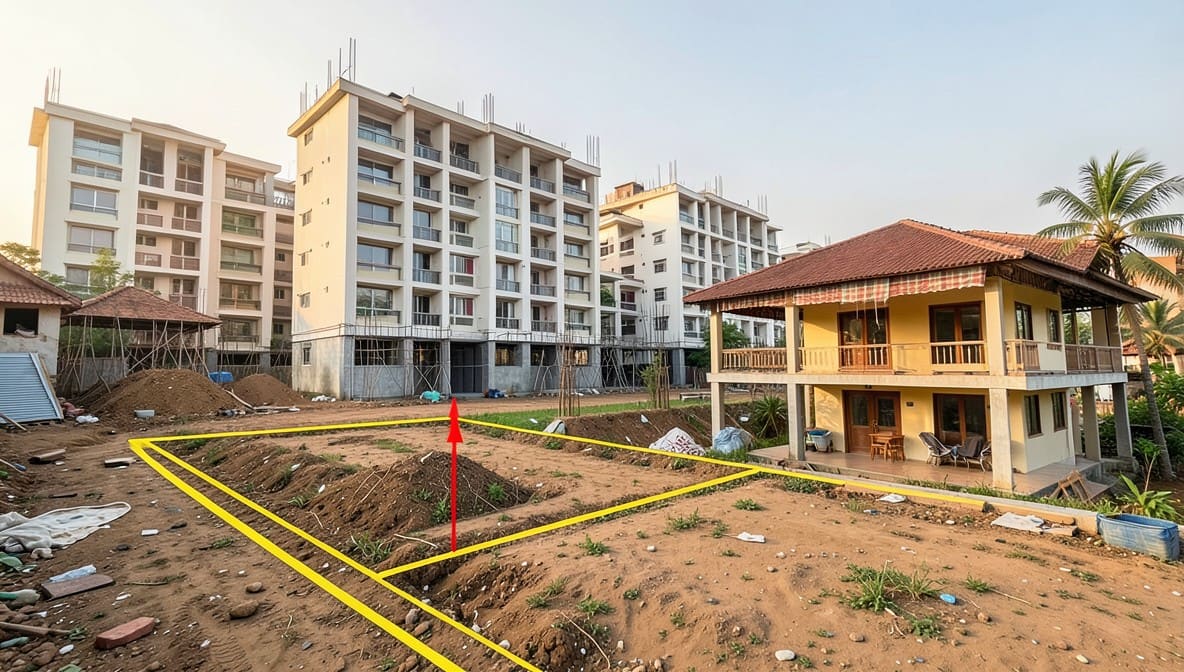
The Income Tax Appellate Tribunal, Cochin Bench, has clarified that eligibility for the 100% deduction under Section 80-IB(10) hinges on the housing project being constructed on a plot of land measuring at least one acre, and that this requirement applies only to the land directly allocated to the project - not the assessee’s total landholding. This ruling reinforces the statutory intent behind the incentive and sets a strict boundary for claimants seeking tax benefits under affordable housing provisions.
Background & Facts
The Dispute
The appellant, P.V. Hemalatha, an individual engaged in residential construction, claimed a deduction of ₹3,13,19,704 under Section 80-IB(10) of the Income Tax Act, 1961 for Assessment Year (AY) 2009-10, and a deduction of ₹4,682,455 for AY 2018-19, based on a housing project developed in Kozhikode, Kerala. The Revenue authorities disallowed the deduction on the ground that the project was not constructed on a plot of at least one acre, as mandated by clause (b) of Section 80-IB(10). The dispute centered on whether the total land owned by the appellant, including land used for her personal residence, could be aggregated to satisfy the one-acre requirement.
Key Facts
- The appellant acquired two survey plots: 44 cents in Survey No. 182/1 and 73.5 cents in Survey No. 185/1, aggregating to 117.5 cents (approximately 0.47 acres).
- A building permit dated 16.11.2005 was granted for a residential apartment complex on a total approved area of 4,755.22 sq. m. (approximately 1.17 acres).
- However, only 2,856 sq. m. (approximately 0.70 acre or 70.57 cents) of this area was approved for the housing project under the Kozhikode Corporation’s sanctioned plan.
- The remaining 1,899.53 sq. m. (approximately 0.47 acre) was designated for a second phase, which was not developed at the time of the project’s completion.
- The appellant constructed a 4,000 sq. ft. (approximately 372 sq. m.) bungalow for her personal residence on the undeveloped portion of the land.
- The housing project was completed with a certificate dated 10.10.2008.
- For AY 2015-16, the appellant was granted a deduction under Section 80-IB(10) after limited scrutiny, but this was not a full assessment and did not involve the same factual scrutiny as the impugned years.
- In AY 2018-19, the appellant sold Flat No. 10F under an agreement dated 17.05.2017, which referenced construction only on Survey No. 185/1, confirming the project’s limited footprint.
Procedural History
- 23.09.2009: Original return filed for AY 2009-10 declaring income of ₹1,426,500.
- 13.10.2009: Revised return filed declaring income of ₹2,412,180, claiming deduction of ₹3,13,19,704 under Section 80-IB(10).
- 08.11.2011: Assessment completed under Section 143(3) allowing the deduction.
- 16.10.2025: CIT(A) order issued, upholding revision under Section 263 and disallowing the deduction.
- 23.03.2015: Original assessment order under Section 143(3) read with Section 263 disallowing the deduction.
- 12.06.2025: Appeal filed before CIT(A) challenging the disallowance.
- 16.10.2025: CIT(A) dismissed the appeal, holding the project was on only 0.70 acre.
- 23.03.2026: Hearing held before ITAT Cochin.
- 16.06.2026: ITAT order pronounced dismissing both appeals.
Relief Sought
The appellant sought reversal of the disallowance of ₹3,13,19,704 for AY 2009-10 and ₹4,682,455 for AY 2018-19, and restoration of the deduction under Section 80-IB(10), relying on the CIT v. Vandana Properties judgment.
The Legal Issue
The central question was whether the minimum one-acre plot requirement under Section 80-IB(10)(b) is satisfied if the housing project is constructed on less than one acre, but the assessee’s total landholding - including land used for a personal residence - exceeds one acre.
Arguments Presented
For the Appellant
The appellant relied on the CIT v. Vandana Properties (2012) 19 taxmann.com 316 (Bombay HC) judgment, arguing that the provision only requires the housing project to be on a plot of at least one acre, irrespective of whether other structures exist on the same land. She contended that the law does not prohibit the coexistence of a personal residence on the same landholding and that the approved plan’s total area (4,755.22 sq. m.) should be considered. She further argued that the AY 2015-16 assessment, which allowed the deduction, should be binding by principle of consistency.
For the Respondent
The Revenue contended that the statutory requirement is not met if the housing project itself is not constructed on a plot of at least one acre. The approved plan allocated only 2,856 sq. m. (0.70 acre) to the housing project, while the remaining area was used for a personal bungalow. The Revenue emphasized that Section 80-IB(10) requires the project to be on a plot of land dedicated to the housing development, and land used for non-project purposes cannot be included. The AY 2015-16 assessment was dismissed as limited scrutiny, not a full adjudication.
The Court's Analysis
The Tribunal undertook a detailed statutory interpretation of Section 80-IB(10)(b), which mandates that the deduction is available only if "the project is on the size of a plot of land which has a minimum area of one acre." The Court emphasized that the phrase "the project is on" directly ties the area requirement to the land parcel on which the housing project is physically constructed and approved by the local authority.
"The law requires this particular plot of land, dedicated to the housing project, to measure not less than one acre. It does not refer to the entire contiguous landholding of the assessee, especially if parts of that land are not integral to the approved housing project."
The Tribunal distinguished CIT v. Vandana Properties by noting that while that case held that the plot need not be vacant and could include common amenities, it did not hold that land used for a separate, non-project structure (such as a personal residence) could be aggregated to meet the one-acre threshold. The Court observed that the appellant herself conceded that the housing project was constructed on only 70.57 cents (0.70 acre), and that the balance land was used for her bungalow.
The Tribunal further rejected the reliance on the AY 2015-16 assessment, noting that it was subject to limited scrutiny and did not involve a full examination of the plot area requirement. The Court held that each assessment year must be judged on its own merits, and prior allowances do not create a binding precedent.
The Tribunal concluded that the statutory condition is not met unless the housing project itself is situated on a plot of at least one acre, and that the inclusion of land used for unrelated purposes cannot satisfy this condition.
The Verdict
The appellant’s appeals were dismissed. The ITAT confirmed the disallowance of the deduction of ₹3,13,19,704 for AY 2009-10 and ₹4,682,455 for AY 2018-19 under Section 80-IB(10). The Tribunal held that the housing project was constructed on only 70.57 cents (0.70 acre) of land, which is below the statutory minimum of one acre, and therefore the deduction was not admissible.
What This Means For Similar Cases
The Plot Must Be Dedicated Exclusively to the Housing Project
- Practitioners must now verify that the land parcel approved by the local authority for the housing project itself meets the one-acre threshold, excluding any land used for personal residences, commercial structures, or non-project purposes.
- Merely owning a larger landholding does not satisfy the requirement if the approved project footprint is below one acre.
Approved Plans Trump Total Landholding
- The sanctioned plan issued by the municipal or corporation authority is the decisive document for determining the project’s plot area.
- Any deviation from the approved plan, such as using part of the land for a personal bungalow, disqualifies the project from claiming the deduction.
Prior Allowances Are Not Binding
- An earlier assessment allowing the deduction under limited scrutiny does not create a precedent for subsequent years.
- Each assessment must be independently evaluated based on the facts and approvals applicable to that year.