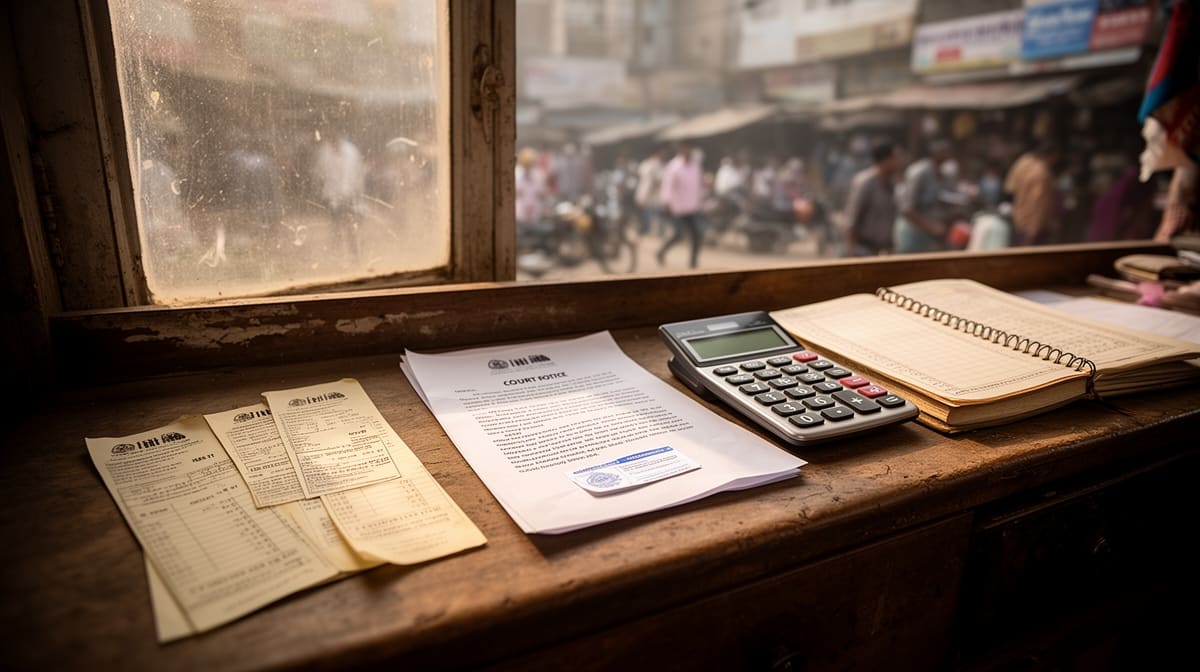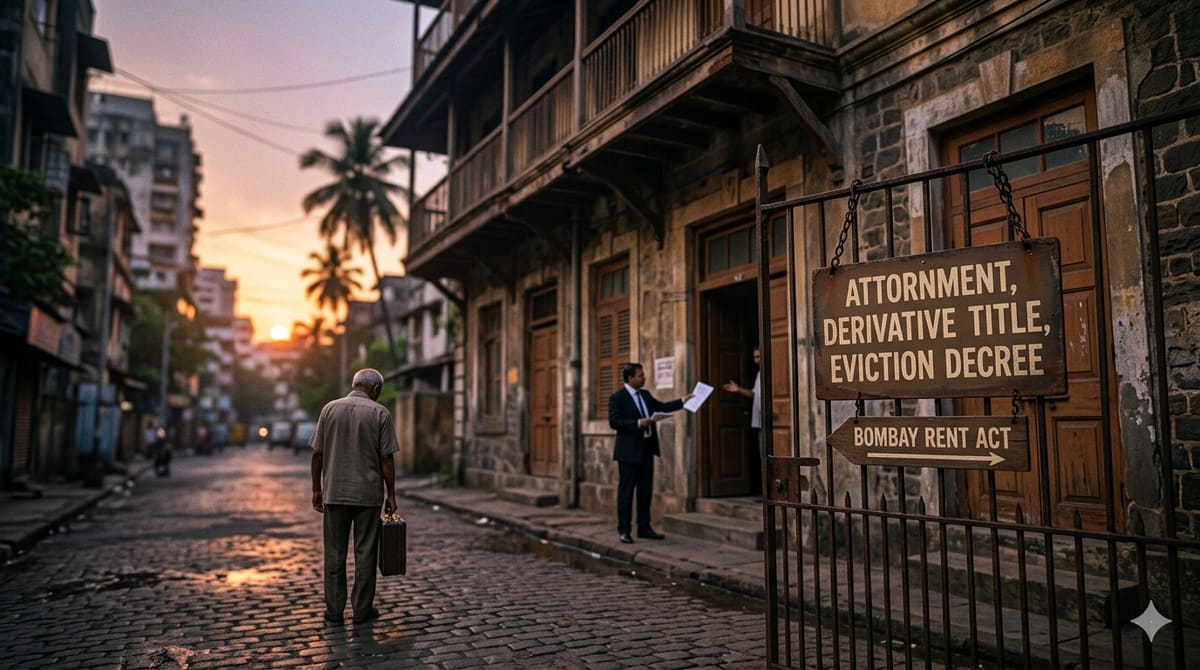
The Bombay High Court has clarified that a tenant’s deposit of rent in a pending standard rent application under Section 11(3) of the Bombay Rents, Hotel and Lodging House Rates (Control) Act, 1947, constitutes valid compliance with a notice of demand under Section 12(2), thereby extinguishing the landlord’s cause of action for eviction. This ruling resolves a long-standing conflict in judicial interpretation and reinforces tenant protections under the Act.
Background & Facts
The Dispute
The dispute centers on whether a tenant’s deposit of arrears of rent into a standard rent application filed under Section 11(3) of the Bombay Rent Act, following a notice of demand under Section 12(2), satisfies the legal requirement for compliance with the notice. If so, the landlord cannot maintain a suit for eviction on the ground of non-payment of rent.
Key Facts
The petitioners, legal heirs of the original tenant Babu Mathu Gaikwad, were facing eviction proceedings initiated by the respondents, legal heirs of the landlord Gulabchand Tarachand Bora.
The landlord served a notice of demand for arrears of rent under Section 12(2) of the Bombay Rent Act.
Within one month of service of the notice, the tenant filed an application under Section 11(3) for fixation of standard rent.
The tenant deposited the entire amount of rent demanded in the pending standard rent application.
The landlord proceeded to file a suit for eviction under Section 12(3), alleging non-compliance with the notice of demand.
The trial court and appellate courts granted eviction decrees, relying on the precedent in Pannalal Khivraj Dugad v. Janardhan Gopal Deshpande.
The learned Single Judge, while dismissing the writ petition, referred two questions of law to a larger Bench due to apparent conflict with Narhar Damodar Wani v. Narmadabai T. Nave.
Procedural History
Date of notice of demand: Not explicitly stated, but deposited within one month of service.
Date of standard rent application filing: Within one month of service of notice under Section 12(2).
Date of deposit in standard rent application: Full amount deposited as directed under Section 11(3).
Date of eviction suit filing: After deposit in standard rent application.
Date of trial court decree: Eviction granted.
Date of appellate court confirmation: Eviction upheld.
Date of writ petition filing: Before Bombay High Court.
Date of Single Judge referral: 28 April 2010.
Date of larger Bench hearing: 08 May 2026.
The Parties' Positions
For the Petitioners (Tenant’s Heirs)
Argued that deposit of rent in the standard rent application under Section 11(3) constitutes payment within the meaning of Section 12(1) and compliance with Section 12(2).
Relied on Narhar Damodar Wani to assert that once the tenant pays or tenders the demanded amount, the landlord has no cause of action to file an eviction suit.
Contended that Section 12(3)(b) is only triggered if there is no prior compliance with Section 12(2), which was satisfied by the deposit in the Section 11 proceeding.
Emphasized that Explanation I to Section 12 deems the tenant ready and willing to pay upon filing the Section 11 application and depositing the amount ordered by the Court.
For the Respondents (Landlord’s Heirs)
Relied on Pannalal Khivraj Dugad to argue that deposit in a standard rent application does not constitute compliance with Section 12(2).
Asserted that Section 12(3)(b) requires deposit in the eviction suit itself, not in a separate proceeding.
Claimed that the landlord’s right to institute a suit arises upon expiry of the one-month notice period, regardless of the tenant’s actions in a different forum.
Argued that allowing deposit in Section 11 proceedings to bar eviction would undermine the landlord’s statutory right to seek possession.
Relief Sought
The petitioners sought quashing of the eviction decrees, declaration that the deposit in the standard rent application constituted valid compliance with Section 12(2), and dismissal of the landlord’s suit for eviction on the ground of non-payment.
The Legal Issue
The central questions were: (i) Whether deposit of the amount demanded in a standard rent application under Section 11(3) constitutes valid compliance with a notice of demand under Section 12(2)? and (ii) Whether, in such a case, there is no cause of action for filing an eviction suit under Section 12(3)(b)?
Arguments Presented
For the Petitioner
The petitioners relied on Narhar Damodar Wani v. Narmadabai T. Nave, where the Division Bench held that if the tenant pays or tenders the entire amount demanded under Section 12(2), the landlord is disabled from filing a suit for possession. They argued that Section 12(1) prohibits eviction so long as the tenant pays or is ready and willing to pay, and that deposit in the Court under Section 11(3) satisfies this condition. They emphasized that Explanation I to Section 12 explicitly deems the tenant ready and willing upon filing the Section 11 application and depositing the ordered amount. The petitioners contended that Section 11(3) is not a mere procedural step but a statutory mechanism to resolve disputes and ensure payment, and that treating such deposit as non-compliance would render Section 12(1) and Explanation I meaningless.
For the Respondent
The respondents relied on Pannalal Khivraj Dugad v. Janardhan Gopal Deshpande, which held that deposit in a standard rent application does not amount to compliance with Section 12(2). They argued that Section 12(3)(b) requires payment or tender in the eviction suit itself, and that allowing deposit in a separate proceeding would create forum shopping and undermine the landlord’s right to seek possession. They contended that Section 11(3) is a mechanism for fixing rent, not for discharging liability under Section 12(2), and that the landlord’s right to sue arises upon expiry of the notice period, irrespective of the tenant’s actions in another forum.
The Court's Analysis
The Court undertook a detailed textual and contextual analysis of Sections 11 and 12 of the Bombay Rent Act. It emphasized that Section 12(1) operates as a blanket prohibition: a landlord cannot recover possession so long as the tenant pays or is ready and willing to pay the standard rent. Section 12(2) imposes a mandatory pre-condition: no suit for possession may be filed until one month after service of a written notice of demand.
"The tenant has been given one month's time during which he must pay the rent which is demanded by a notice under section 12(2) and if he does not pay that rent or the amount due, then the consequences specified in clauses (a) and (b) follow... If the tenant pays the arrears demanded by the notice under section 12(2), then the landlord is not entitled to file a suit for possession on the ground of arrears in respect of which he has to give or has given a notice under section 12(2)."
The Court held that the term "pays" in Section 12(1) is not limited to direct payment to the landlord. It includes payment made to the Court under statutory authority, as contemplated by Section 11(3). The Court rejected the distinction drawn in Pannalal Khivraj Dugad between deposit in a Section 11 proceeding and deposit in an eviction suit, noting that such a distinction would render Explanation I otiose.
The Court further relied on Narhar Damodar Wani, which established that once the tenant complies with Section 12(2), the landlord’s cause of action is extinguished. The Court observed that Section 12(3)(b) is a remedial provision applicable only when the landlord has a valid cause of action. If the tenant has already complied with Section 12(2), there is no occasion to invoke Section 12(3)(b).
The Court also cited Mohanlal Gokulchandji v. Khimraj Bhagaji and Mohan Laxman Hede v. Noormohamed Adam Shaikh to reinforce that the requirement of "regular" payment under Section 12(3)(b) does not demand mathematical precision, but reasonable punctuality. This supports the view that compliance with a Court-ordered deposit under Section 11(3) is sufficient.
The Court concluded that the legislative scheme is coherent: Section 11 provides the mechanism to resolve disputes over rent, and Section 12 protects tenants who comply with the process. To hold otherwise would defeat the very purpose of the Rent Act.
The Verdict
The petitioners succeeded. The Court answered both referred questions in the affirmative. It held that deposit of the amount demanded in a standard rent application under Section 11(3) constitutes valid compliance with a notice of demand under Section 12(2). Consequently, there is no cause of action for filing a suit for eviction on the ground of arrears of rent. The eviction decrees against the tenant’s heirs are set aside. The landlord is barred from maintaining any suit for possession based on the arrears covered by the deposit. The matter is remanded to the Single Judge for further proceedings consistent with this judgment.
What This Means For Similar Cases
Deposit in Section 11 Application Bars Eviction Suit
Practitioners must now treat any deposit made by a tenant in a pending Section 11 application as a complete compliance with Section 12(2), extinguishing the landlord’s right to sue for eviction on non-payment grounds.
Landlords who file eviction suits after such a deposit risk dismissal on grounds of no cause of action.
Tenants should promptly file Section 11 applications and deposit the demanded amount within one month of receiving notice to secure protection.
Section 12(3)(b) Is Not a Separate Compliance Mechanism
Section 12(3)(b) applies only when there is no prior compliance with Section 12(2). If the tenant has already deposited under Section 11(3), Section 12(3)(b) is not triggered.
Courts must not require tenants to make duplicate deposits in eviction suits if they have already complied with Section 11(3).
The burden shifts to the landlord to prove that the tenant failed to deposit the amount ordered under Section 11(3), not merely that the deposit was not made in the eviction suit.
Judicial Discretion in Payment Compliance Remains Intact
Courts retain discretion to accept late or irregular deposits under Section 12(3)(b) if they are made in good faith and accepted by the Court, as affirmed in Mohanlal Gokulchandji.
The requirement of "regular" payment does not demand clock-like precision, but reasonable punctuality, as held in Mohan Laxman Hede.
Tenants who make deposits under Section 11(3) and subsequently default on future installments may still face eviction, but only for defaults occurring after compliance with Section 12(2) has been established.