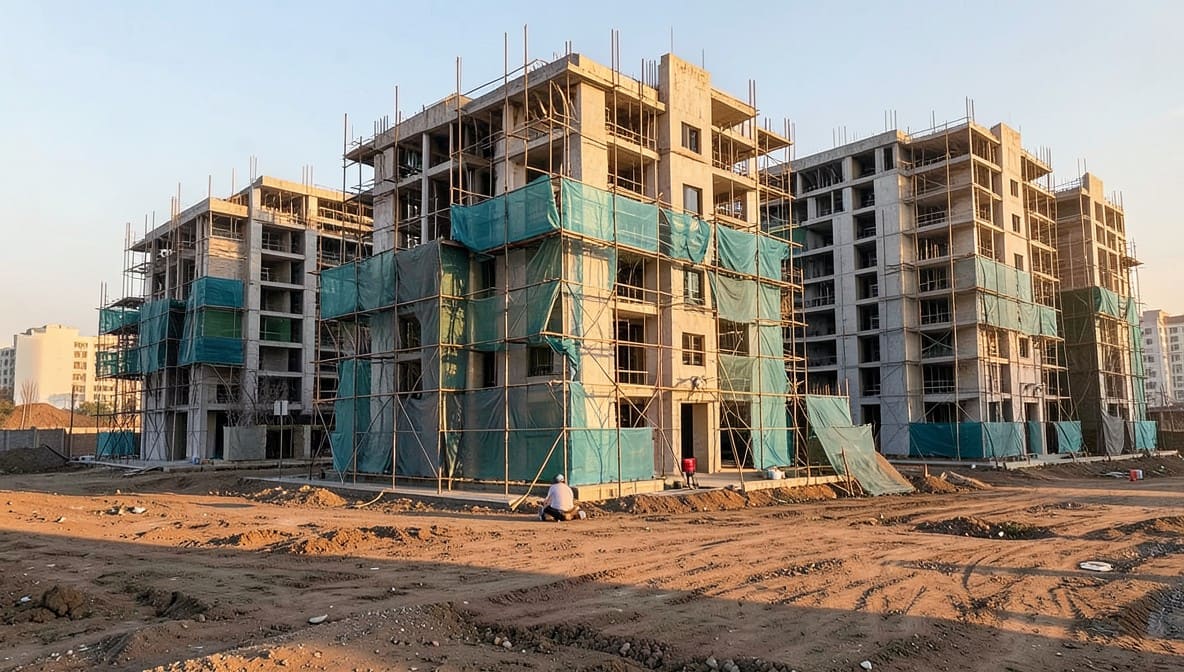
The National Company Law Appellate Tribunal has clarified that the filing of individual affidavits by a majority of homebuyers authorizing a welfare association to initiate corporate insolvency proceedings under Section 7 of the Insolvency and Bankruptcy Code, 2016, is sufficient to establish financial debt and default, even where minor discrepancies exist in a small subset of affidavits. This ruling reinforces the procedural flexibility afforded to financial creditors in collective insolvency actions involving multiple homebuyers.
Background & Facts
The Dispute
The dispute arose from the alleged default by Sumer Radius Realty Pvt. Ltd. (Corporate Debtor) in delivering residential units under a real estate development project known as Avenue 54 in Mumbai. The Avenue 54 Welfare Association, representing homebuyers who had paid consideration for units, filed a Section 7 application under the Insolvency and Bankruptcy Code, 2016 (IBC), seeking initiation of Corporate Insolvency Resolution Process (CIRP). The Corporate Debtor challenged the maintainability of the application on grounds of lack of proper authorization by individual homebuyers.
Key Facts
- The Corporate Debtor had sold a total of 152 residential units in the Avenue 54 project.
- The Avenue 54 Welfare Association filed the Section 7 application (C.P. (IB) No. 284 of 2024) on behalf of homebuyers.
- The Corporate Debtor contended that the application was not authorized by individual homebuyers, as required under the IBC.
- The National Company Law Tribunal (NCLT), Mumbai Bench, dismissed the Corporate Debtor’s objections on 12.09.2025 and admitted the Section 7 application.
- The Corporate Debtor appealed to NCLAT in CA(AT)(Ins.) No. 1572 of 2025 and CA(AT)(Ins.) No. 1573 of 2025.
- On 26.11.2025, NCLAT dismissed the appeals but directed the Avenue 54 Welfare Association to file individual affidavits from homebuyers confirming their identity and authorization of the application.
- The NCLAT specified that the affidavits must be filed within seven days of its order.
- Subsequently, 98 homebuyers filed individual affidavits authorizing the Avenue 54 Welfare Association.
- The Adjudicating Authority (NCLT) considered these affidavits and, by order dated 15.05.2026, admitted the Section 7 application.
- The Appellant challenged this admission order before NCLAT, alleging discrepancies in nine of the 98 affidavits regarding names and unit allotment details.
Procedural History
- 2024: C.P. (IB) No. 284 of 2024 filed by Avenue 54 Welfare Association under Section 7 IBC.
- 12.09.2025: NCLT, Mumbai, dismissed Corporate Debtor’s application to dismiss the Section 7 petition.
- 26.11.2025: NCLAT dismissed appeals filed by Corporate Debtor but directed filing of individual homebuyer affidavits within seven days.
- December 2025: 98 homebuyers filed individual affidavits authorizing the Avenue 54 Welfare Association.
- 15.05.2026: NCLT admitted Section 7 application, finding compliance with NCLAT’s direction and establishing financial debt and default.
- 29.05.2026: NCLAT heard appeal against the 15.05.2026 order and dismissed it.
The Parties' Positions
Appellant (Corporate Debtor): Argued that the affidavits filed by 98 homebuyers were insufficient due to discrepancies in nine affidavits - including mismatched names and unit numbers - rendering the authorization defective. Contended that the NCLAT’s earlier direction required strict compliance and that the Adjudicating Authority erred in admitting the application despite these irregularities.
Respondent (Avenue 54 Welfare Association): Maintained that 98 out of 152 units (over 64%) had validly authorized the association through affidavits, satisfying the threshold for financial creditor status under Section 7. Argued that minor discrepancies in nine affidavits did not affect the overall validity of the application, especially since the remaining affidavits were uncontested and properly executed.
Relief Sought
The Appellant sought quashing of the NCLT’s order dated 15.05.2026 admitting the Section 7 application, and a direction to reject the application on grounds of non-compliance with the NCLAT’s directive on affidavits.
The Legal Issue
The central question was whether minor discrepancies in a subset of affidavits filed by homebuyers to authorize a collective application under Section 7 of the IBC invalidate the entire application, when a clear majority of homebuyers have provided valid authorization.
Arguments Presented
For the Appellant
The Appellant contended that the NCLAT’s order dated 26.11.2025 imposed a mandatory condition requiring strict compliance with the filing of error-free affidavits. It argued that the presence of discrepancies in nine affidavits - including mismatched names and unit numbers - rendered the authorization process legally defective. Relied on the principle that procedural compliance under the IBC must be exacting, especially where the rights of corporate debtors are at stake. Cited In re: Essar Steel India Ltd. to argue that the integrity of the CIRP process demands rigorous adherence to procedural safeguards.
For the Respondent
The Respondent countered that the purpose of the affidavits was to establish individual consent and authorization, not to create a forensic audit of every document. It submitted that 98 out of 152 units (64.5%) had validly authorized the application, which exceeds the threshold required under Section 7 for a financial creditor to initiate CIRP. Argued that the NCLT correctly appreciated that minor discrepancies in nine affidavits did not undermine the collective intent of the majority. Emphasized that the IBC is a remedial statute meant to protect homebuyers as financial creditors, and technical objections should not defeat substantive rights.
The Court's Analysis
The NCLAT examined the nature of the affidavits filed and the purpose behind its earlier direction. It noted that the requirement for individual affidavits was introduced to address concerns about the legitimacy of collective representation by a welfare association, not to impose an impossible standard of perfection.
"The issue was framed by the Adjudicating Authority as issue no. 11 which has been answered in favour of homebuyers. The Financial Creditor pointing out discrepancies with regard to 9 affidavits, however, it does not have any affect on the maintainability of the application filed by the Respondent under Section 7."
The Tribunal held that the Adjudicating Authority had correctly concluded that the filing of 98 affidavits constituted sufficient compliance with its earlier direction. It emphasized that the IBC does not require every single homebuyer to file an affidavit - only that the financial creditor establish the existence of a financial debt and default by a sufficient number of creditors.
The Tribunal further observed that the discrepancies in nine affidavits were not material to the overall validity of the application. The names and unit numbers in question did not indicate fraud or misrepresentation, but rather typographical or clerical errors, which are common in large-scale real estate transactions. The NCLAT declined to elevate technical imperfections into jurisdictional defects.
It also rejected the Appellant’s argument that the Supreme Court’s grant of liberty to raise objections in a prior proceeding altered the legal standard. The Tribunal clarified that liberty to raise objections does not equate to a re-litigation of issues already decided on merits.
The Verdict
The appeal was dismissed. The NCLAT upheld the NCLT’s order dated 15.05.2026 admitting the Section 7 application. The Corporate Insolvency Resolution Process (CIRP) against Sumer Radius Realty Pvt. Ltd. was permitted to proceed. The Tribunal confirmed that the filing of 98 individual affidavits by homebuyers out of 152 sold units satisfied the requirements of Section 7 of the IBC, and minor discrepancies in nine affidavits did not invalidate the application.
What This Means For Similar Cases
Authorization Through Majority Affidavits Is Sufficient
- Practitioners may now rely on collective authorization by a majority of homebuyers (even if not 100%) to initiate CIRP under Section 7 IBC.
- A threshold of over 60% authorized units, as in this case, is likely to be deemed sufficient absent evidence of systemic fraud.
- Welfare associations or representative bodies can proceed with affidavits from a substantial portion of affected homebuyers without needing every single unit to be accounted for.
Minor Discrepancies Do Not Invalidate CIRP Initiation
- Typographical errors, mismatched spellings, or unit number inconsistencies in affidavits will not be grounds to reject a Section 7 application if the overall intent and authorization are clear.
- Adjudicating Authorities must distinguish between material defects (e.g., forged signatures, non-existent buyers) and clerical errors.
- Legal teams should focus on demonstrating the authenticity of the majority of affidavits rather than attempting to invalidate the entire application on technicalities.
Procedural Flexibility Under IBC Is Upheld
- The NCLAT reaffirmed that the IBC is a remedial statute designed to protect homebuyers as financial creditors.
- Courts and tribunals are expected to adopt a purposive interpretation, avoiding hyper-technical objections that delay or derail CIRP.
- Future applicants should ensure affidavits are properly executed and notarized, but need not achieve perfection - sufficiency of authorization is the key standard.