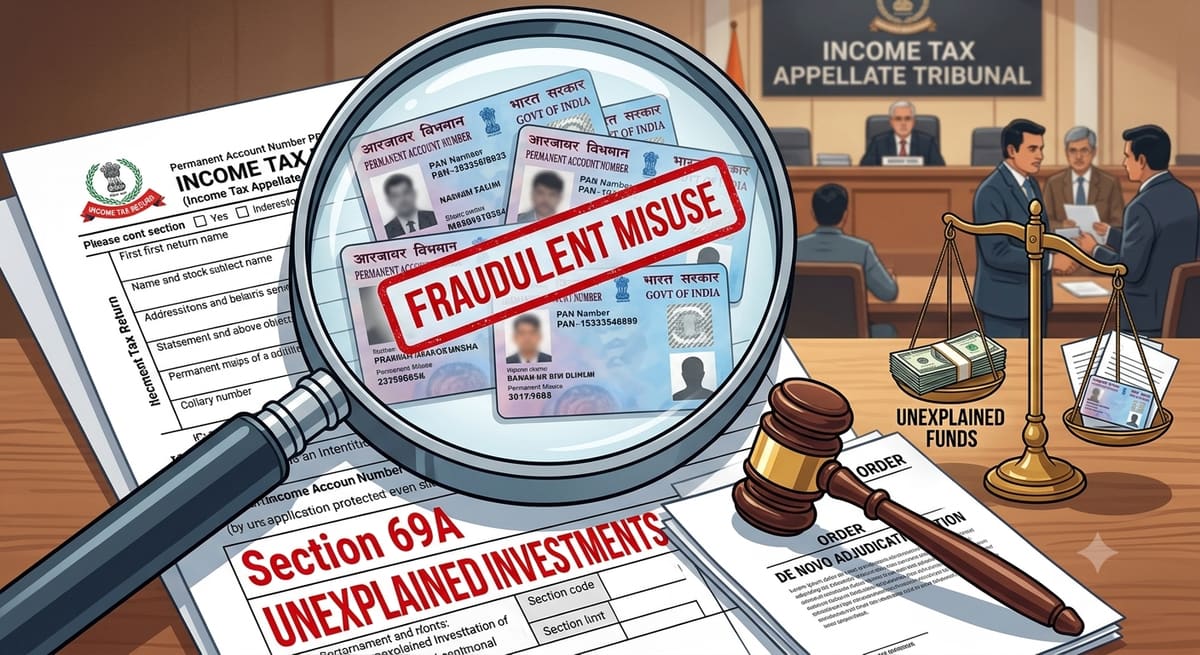
The Income Tax Appellate Tribunal (ITAT), Delhi, has set a precedent for cases involving fraudulent misuse of Permanent Account Numbers (PAN) by directing denovo adjudication of reassessment proceedings under Section 69A of the Income Tax Act, 1961. The Tribunal emphasized the need for fairplay and justice, particularly when third parties exploit dormant PANs to evade tax detection, and suggested assessing only 1% commission income in such cases.
Background & Facts
The Dispute
The appellant, Rely Travel Company, a partnership firm established vide Partnership Deed dated 09.05.2014, was engaged in travel facilitation services. The firm filed its income tax returns up to the assessment year (AY) 2017-18 but failed to dissolve the firm or surrender its PAN after ceasing operations. During AY 2018-19, the firm’s PAN was fraudulently misused by Pound Wise Forex Private Limited and its employee, Mr. Dinesh Kumar, to issue foreign currency transactions against cash receipts, thereby evading tax detection.
Key Facts
The appellant’s PAN (AARFR0160P) was misused to purchase foreign currency worth Rs. 1,04,42,410 during AY 2018-19.
The appellant received alleged commission income of Rs. 3,205 under Section 194H of the Income Tax Act.
The firm was inoperative during AY 2018-19, with no financial transactions or bank activity.
The fraud came to light after the Income Tax Department initiated reassessment proceedings under Section 147 of the Act.
The appellant filed an FIR with the Economic Offences Wing on 30.06.2023, after the reassessment order dated 27.03.2023 was passed.
The Economic Offences Wing confirmed similar complaints against Pound Wise Forex Private Limited from other defunct travel companies.
Procedural History
26.03.2022: Notice under Section 148 issued to the appellant for reopening assessment.
27.03.2023: Reassessment order passed under Section 147 r.w.s. 144, adding Rs. 1,04,42,410 as unexplained investment under Section 69A and Rs. 3,205 as commission income.
22.08.2025: Appeal dismissed by the National Faceless Appeal Centre (NFAC), upholding the additions.
11.05.2026: Hearing before ITAT Delhi.
29.06.2026: ITAT order pronounced, remanding the case for denovo adjudication.
Relief Sought
The appellant sought:
Quashing of the reassessment order dated 27.03.2023 and the appellate order dated 22.08.2025.
Exclusion of the alleged unexplained investment and commission income from taxable income.
Assessment of only 1% commission income, as done in the appellant’s case for AY 2019-20.
The Legal Issue
The central question was whether Section 69A of the Income Tax Act permits the addition of unexplained investments and commission income in the hands of an assessee when the PAN was fraudulently misused by third parties without the assessee’s knowledge or involvement.
Arguments Presented
For the Appellant
The appellant’s PAN was misused by Pound Wise Forex Private Limited and its employee, Mr. Dinesh Kumar, to conduct fraudulent transactions.
The firm was inoperative during AY 2018-19, with no bank transactions or business activity.
The appellant had no knowledge of the reassessment proceedings until demand notices were served.
An FIR was lodged with the Economic Offences Wing on 30.06.2023, and similar complaints were confirmed against the fraudulent entity.
For AY 2019-20, the Learned Assessing Officer (AO) had assessed only 1% of the transactions as commission income, demonstrating inconsistency in the department’s approach.
For the Respondent
The Learned AO contended that the appellant failed to cooperate during reassessment proceedings, justifying the additions under Section 69A.
The appellant’s failure to file returns for AY 2018-19 despite receiving notice under Section 148 was cited as grounds for completing the assessment under Section 144.
The department relied on the principle that unexplained investments must be taxed in the hands of the PAN holder, regardless of third-party involvement.
The Court's Analysis
The ITAT examined the submissions and the evidence on record, particularly the FIR lodged with the Economic Offences Wing and the reassessment order for AY 2019-20. The Tribunal observed:
"Considering the aforesaid facts, we are inclined to restore this appeal to the file of the Learned AO for denovo adjudication in accordance with law in the interest of justice and fairplay, to decide based on the final outcome of the FIR lodged with Economic Offences Wing or in the alternative assess only the commission income @ 1% as was done in the case of the Assessee for Assessment Year 2019-20."
The ITAT emphasized that the appellant’s PAN was misused without its knowledge, and the department’s failure to consider the FIR and similar complaints against the fraudulent entity warranted a fresh adjudication. The Tribunal also noted the inconsistency in the department’s approach, wherein only 1% commission income was assessed for AY 2019-20, suggesting that a similar approach could be adopted for AY 2018-19.
The Verdict
The ITAT partly allowed the appeal for statistical purposes and remanded the case to the Learned AO for denovo adjudication. The Tribunal directed the AO to:
Reassess the appellant’s tax liability based on the final outcome of the FIR lodged with the Economic Offences Wing.
Alternatively, assess only 1% of the transactions as commission income, consistent with the approach adopted for AY 2019-20.
Ensure compliance with the principles of justice and fairplay in light of the fraudulent misuse of the appellant’s PAN.
What This Means For Similar Cases
Fraudulent PAN Misuse Requires Denovo Adjudication
Burden of Proof Shifts to the Department: When an assessee alleges fraudulent misuse of its PAN, the Income Tax Department must conduct a thorough investigation, including examining FIRs and complaints against third parties, before making additions under Section 69A.
Inconsistent Departmental Approach: Practitioners can argue for parity in assessment, citing cases where the department has adopted a lenient approach (e.g., assessing only 1% commission income).
Limits of Strict Liability Under Section 69A
Knowledge and Involvement Matter: The judgment underscores that Section 69A cannot be applied mechanically. The assessee’s lack of knowledge or involvement in fraudulent transactions must be considered.
Evidence of Fraud is Crucial: Assessees must provide concrete evidence, such as FIRs or complaints, to substantiate claims of PAN misuse. Mere denial of transactions may not suffice.
Practical Takeaways for Taxpayers
Monitor PAN Usage: Taxpayers, especially dormant entities, must periodically monitor their PAN usage to detect unauthorized transactions.
Cooperate with Authorities: While non-cooperation can lead to adverse orders under Section 144, assessees must balance this with the risk of fraudulent misuse claims being dismissed without evidence.
Leverage FIRs and Complaints: In cases of fraud, assessees should proactively file complaints with law enforcement agencies and use these as evidence during reassessment proceedings.