The Gauhati High Court recently addressed a critical jurisdictional question under Section 63 of the Right to Fair Compensation and Transparency in Land Acquisition, Rehabilitation and Resettlement Act, 2013 (RFCTLARR Act). While upholding a trial court's interim order restraining compensation disbursement in a land acquisition case, the Court clarified that civil courts retain limited jurisdiction to adjudicate disputes involving partition deeds that form the basis of compensation claims. The judgment underscores the need for expeditious disposal of title suits where land acquisition compensation is stalled due to pending property disputes.
Background & Facts
The Dispute
The case arises from a long-standing property dispute between legal heirs of Torab Ali, a landowner in Sribhumi, Assam. The original suit, Title Suit No. 105/2017, was filed by Jamila Khatun and others (plaintiffs) against Ilias Uddin and others (defendants) for declaration of right, title, and interest, recovery of khas possession, and injunction. The plaintiffs claimed to be legal heirs of Torab Ali, asserting inheritance through his two sons, Siraj Uddin and Abdul Hoque. The petitioner, Abdul Hamid, is the son of Siraj Uddin.
Key Facts
- Ownership Claim: The plaintiffs asserted ownership over land described in Schedule 1 and Schedule 2 of the plaint, inherited from Torab Ali.
- Partition Deed Challenge: The defendants filed a written statement-cum-counter claim on 07.08.2017, challenging Partition Deed No. 2978 dated 19.05.2004 and Swarnalipi dated 15.11.1981, alleging forgery and seeking cancellation of these documents.
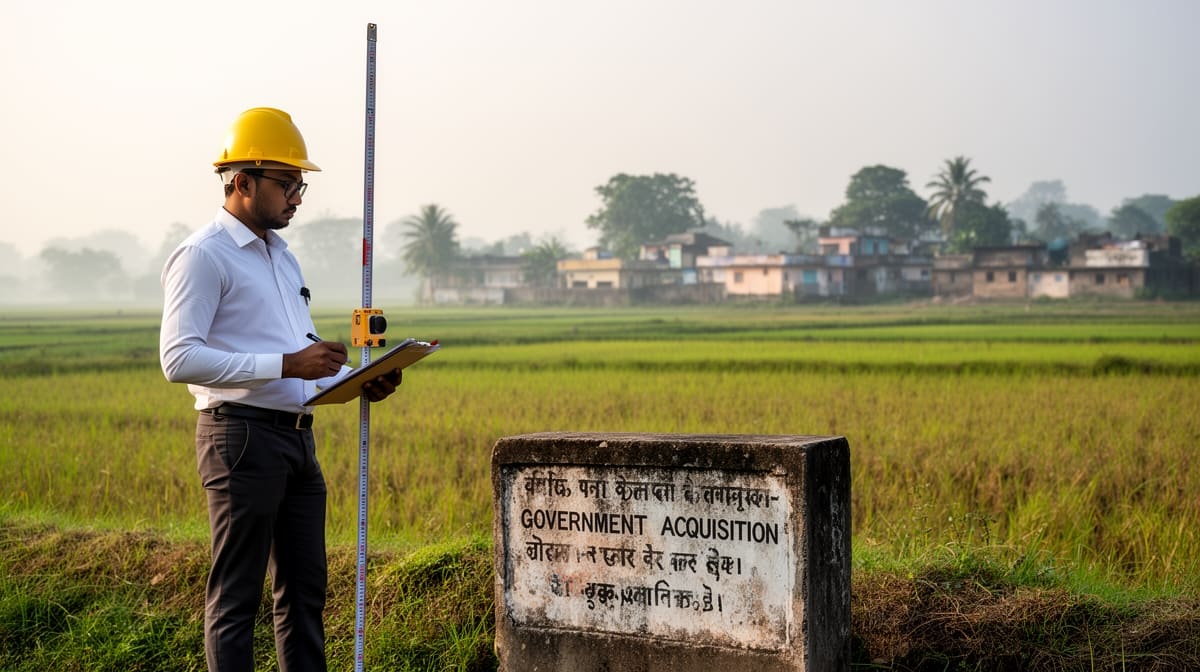
- Acquisition of Land: The land under Dag No. 293, Patta No. 288, and Final Khatian No. 135 of Mouza-Lakarkhai was acquired by the Government under the Bharatmala Project. The petitioner, Abdul Hamid, claimed to be the exclusive possessor of this land, mutated in his name based on the disputed Partition Deed No. 2978.
- Compensation Dispute: The defendants filed Petition No. 363 dated 28.02.2025 during the pendency of the title suit, seeking a direction to the Deputy Commissioner, Sribhumi, to refrain from disbursing compensation for the acquired land, arguing that the land fell under the disputed partition deed.
Procedural History
- 15.03.2017: Title Suit No. 105/2017 filed before the Civil Judge (Jr. Div.) No. 3, Sribhumi.
- 07.08.2017: Defendants filed written statement-cum-counter claim challenging the partition deed and seeking cancellation of the same.
- 28.02.2025: Defendants filed Petition No. 363 seeking restraint on compensation disbursement. The trial court passed an ex parte order restraining the Deputy Commissioner from disbursing compensation.
- 25.03.2025: Petitioner (as a third party) filed a petition under Section 151 CPC seeking vacation of the order dated 28.02.2025, arguing that the acquired land was not part of the title suit.
- 27.03.2025: Plaintiffs filed a supporting petition, reiterating that the acquired land was not the subject matter of the suit.
- 23.04.2025: Defendants filed written objections to the petitions.
- 29.04.2025: Trial court rejected both petitions, upholding the restraint order.
- Present Proceeding: The petitioner filed the current Civil Revision Petition (CRP(IO)/240/2025) challenging the orders dated 28.02.2025 and 29.04.2025.
Relief Sought
The petitioner sought:
- Quashing of the orders dated 28.02.2025 and 29.04.2025 passed by the trial court.
- A direction to the Deputy Commissioner to disburse the compensation amount for the acquired land.
- Recognition of the petitioner’s exclusive possession and ownership of the acquired land, which was mutated in his name based on the disputed partition deed.
The Legal Issue
The central question before the Court was whether a civil court has jurisdiction under Section 63 of the RFCTLARR Act, 2013 to restrain disbursement of compensation for acquired land when the dispute pertains to the validity of a partition deed that forms the basis of the compensation claim. Additionally, the Court examined whether the trial court’s order violated principles of natural justice by passing an ex parte restraint without hearing the affected third party.
Arguments Presented
For the Petitioner
- Jurisdictional Bar: The petitioner argued that Sections 63 and 64 of the RFCTLARR Act, 2013 bar civil courts from entertaining disputes relating to land acquisition matters, including compensation disbursement. The trial court lacked jurisdiction to pass the impugned orders.
- Non-Involvement of Acquired Land: The acquired land (Dag No. 293, Patta No. 288, Khatian No. 135) was not described in the plaint or counter-claim, and thus, was not the subject matter of the title suit. The trial court erred in restraining compensation disbursement.
- Violation of Natural Justice: The petitioner, as an affected third party, was not impleaded or heard before the order dated 28.02.2025 was passed, violating principles of natural justice.
- Exclusive Possession: The petitioner was in exclusive possession of the acquired land at the time of acquisition, as evidenced by a possession certificate issued by the Circle Officer, Karimganj.
- Prejudice: The petitioner, now landless due to the acquisition, was deprived of his rightful compensation due to the trial court’s order.
For the Respondents
- Subject Matter of Suit: The respondents argued that the acquired land fell under the disputed Partition Deed No. 2978 dated 19.05.2004, which was under challenge in the title suit. The trial court rightly restrained compensation disbursement to prevent prejudice to the defendants.
- Locus Standi: The petitioner, as a third party, lacked locus standi to challenge the trial court’s order, as the dispute over the partition deed was pending adjudication.
- Conversion of Dag: The respondents claimed that the old Dag No. 252 was converted to Dag No. 293, which fell under the disputed partition deed. Thus, the acquired land was indirectly part of the title suit.
The Court's Analysis
The Court undertook a detailed analysis of the jurisdictional scope of Section 63 of the RFCTLARR Act, 2013, which bars civil courts from entertaining disputes relating to land acquisition matters. The Court observed:
"As per Section 63 and 64 of the Act, 2013 there is a bar of Civil Court to entertain any dispute relating to land acquisition and in respect of which the Collector or the authority is empowered by the said Act and no injunction can also be granted by any other Court in such matters and under Section 64 of the said Act, the person aggrieved to any acquisition proceeding filed a case of Reference."
However, the Court distinguished the present case from a direct challenge to acquisition proceedings or compensation awards. The dispute here pertained to the validity of a partition deed that formed the basis of the petitioner’s claim to the acquired land. The Court noted:
"But here in the instant case, the situation is different as it is not a case of any challenge against the order of acquisition or compensation so awarded by the Government. It is the case wherein the challenge was made regarding the disbursement of money only in the context that the land which is acquisitioned by the Government falls under the partition deed which is under challenge and on the basis of which only the petitioner got his name mutated over the land in question."
The Court held that while Section 63 bars civil courts from adjudicating disputes directly relating to acquisition or compensation, it does not preclude courts from examining ancillary disputes, such as the validity of a partition deed, which indirectly affect compensation disbursement. The Court emphasized that the trial court’s order was not a direct interference with acquisition proceedings but a restraint on disbursement pending resolution of the partition deed dispute.
The Court also addressed the violation of natural justice, noting that the petitioner, as an affected third party, was not heard before the order dated 28.02.2025 was passed. However, the Court observed that the trial court had subsequently considered the petitioner’s arguments in its order dated 29.04.2025, thereby rectifying the procedural lapse.
On the merits of the dispute, the Court noted that the partition deed was the subject matter of the title suit, and the acquired land fell under the same deed. While the respondents failed to produce documentary evidence proving the conversion of Dag No. 252 to Dag No. 293, the Court observed that the mutation of the acquired land in the petitioner’s name was based solely on the disputed partition deed. Thus, the trial court’s concern about potential prejudice to the defendants was not unfounded.
The Verdict
The Gauhati High Court dismissed the civil revision petition, upholding the trial court’s orders dated 28.02.2025 and 29.04.2025. However, the Court directed the trial court to dispose of Title Suit No. 105/2017 within a reasonable period, considering the petitioner’s status as a landless person post-acquisition. The Court also permitted the petitioner to file an appropriate application for impleadment as a party in the title suit.
What This Means For Similar Cases
Civil Courts Retain Limited Jurisdiction Over Land Acquisition Disputes
- Ancillary Disputes: While Section 63 of the RFCTLARR Act bars civil courts from entertaining direct disputes relating to land acquisition or compensation, courts retain jurisdiction to adjudicate ancillary disputes, such as the validity of partition deeds, mutations, or other documents that form the basis of compensation claims. Practitioners should argue that such disputes are not barred under Section 63, as they do not directly challenge acquisition proceedings.
- Third-Party Rights: Courts may intervene to protect the rights of third parties affected by acquisition proceedings, even if they are not formal parties to the original suit. However, third parties must establish a direct interest in the dispute, such as exclusive possession or mutation based on disputed documents.
Expeditious Disposal of Title Suits Critical for Compensation Disbursement
- Prejudice to Landowners: Delays in resolving title disputes can result in significant prejudice to landowners, particularly when their land is acquired, and compensation is withheld. Courts are likely to direct expeditious disposal of such suits where acquisition compensation is stalled due to pending disputes.
- Impleadment of Affected Parties: Third parties affected by acquisition-related disputes should seek impleadment in the original suit to protect their interests. Courts may permit impleadment where the third party demonstrates a direct stake in the outcome of the dispute.
Documentary Evidence Key in Partition Deed Disputes
- Burden of Proof: Parties challenging partition deeds or mutations must produce documentary evidence to substantiate their claims. In this case, the respondents failed to prove the conversion of Dag No. 252 to Dag No. 293, weakening their argument that the acquired land fell under the disputed partition deed.
- Mutation Records: Mutation records based on disputed documents may not suffice to establish ownership or possession. Parties must be prepared to challenge the validity of underlying documents in court to protect their claims to compensation or property.