The Delhi Bench of the Income Tax Appellate Tribunal has clarified that partial utilization of sale proceeds for residential construction, even when delayed due to judicial stay orders, suffices for claiming exemption under Section 54F of the Income Tax Act, provided funds are properly earmarked in a Capital Gains Account Scheme and no diversion is proven.
Background & Facts
The Dispute
The appellant, Deepika Sharma, sold her 50% share in a residential plot jointly owned with her husband, Mr. Rakesh K. Sharma, in the financial year 2022-23. The total sale consideration for the property was Rs. 7,77,50,000, of which her share was Rs. 3,88,50,000. She claimed full exemption under Section 54F of the Income Tax Act, 1961, by investing the proceeds in the purchase and construction of a new residential house. The Assessing Officer (AO) disallowed the entire exemption, holding that no documentary evidence proved actual construction or full utilization of funds.
Key Facts
- The property was originally purchased in 2003-04 jointly by the appellant and her husband for Rs. 5,00,050 (including stamp duty).
- The property was sold on 15.07.2022 for Rs. 7,77,50,000 (jointly), with the appellant’s share being Rs. 3,88,50,000.
- The sale proceeds were deposited in a Capital Gains Account Scheme (CGAS) with Canara Bank, account number 1101011194860, held in the name of the husband, with the appellant as nominee.
- On 20.02.2023, Rs. 7,77,50,000 was credited to the CGAS account.
- On 06.10.2023, Rs. 76,23,362 was transferred via RTGS to Anaiah Constructions Pvt. Ltd. for construction work.
- A Construction Contract Agreement dated 24.06.2021 was executed between the appellant, her husband, and Anaiah Constructions Pvt. Ltd.
- No final completion certificate, payment receipts, or bills from the contractor were submitted.
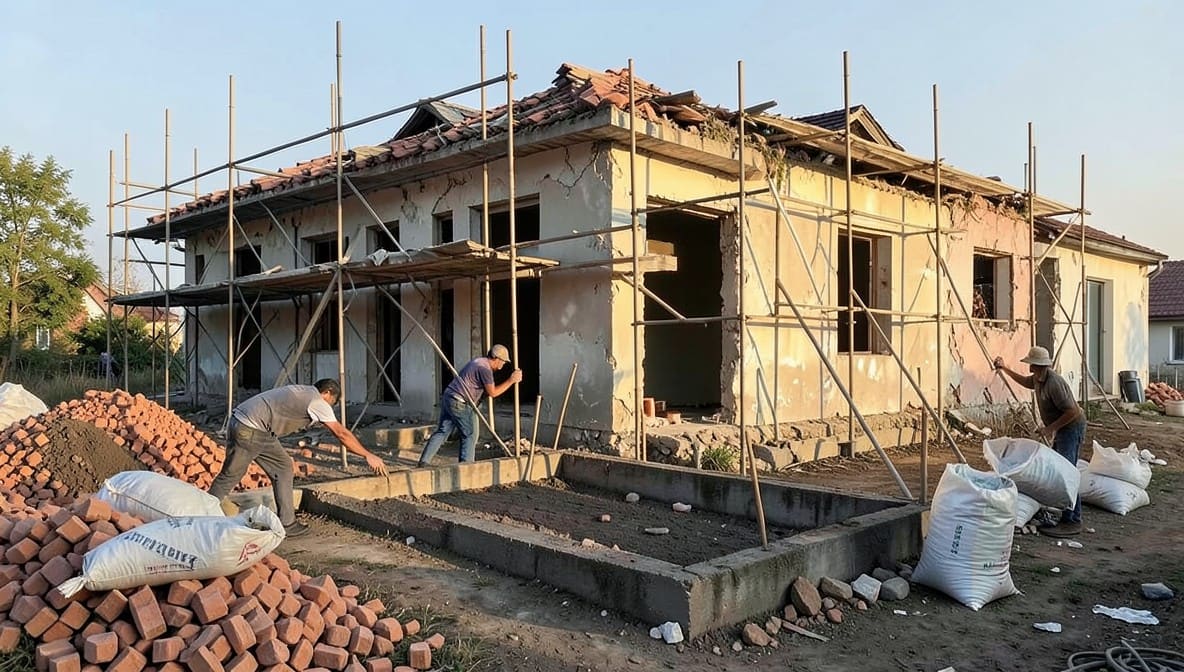
- Construction was halted due to stay orders from the Hon’ble High Court and Supreme Court.
- The appellant’s husband, similarly situated, was granted full exemption under Section 54F by the AO in his assessment order dated 05.02.2025.
- The appellant submitted no evidence of cost of improvement (Rs. 6,70,946 claimed under Section 48) beyond self-declaration.
Procedural History
- 15.07.2022: Sale of jointly owned property.
- 31.07.2023: Filing of ITR for A.Y. 2023-24 declaring income of Rs. 23,58,990 and claiming Rs. 3,74,12,994 exemption under Section 54F.
- 19.06.2024: Notice under Section 143(2) issued for scrutiny.
- 05.08.2024: Notice under Section 142(1) seeking details of property, cost of acquisition, improvement, and investment.
- 17.02.2025: Second notice under Section 142(1) demanding specific evidence for cost of improvement and Section 54F claim.
- 24.02.2025: Show cause notice issued proposing addition of Rs. 3,80,83,940 (Rs. 6,70,946 under Section 48 + Rs. 3,74,12,994 under Section 54F).
- 18.03.2025: Assessment order passed by AO disallowing entire exemption and cost of improvement.
- 18.06.2025: Order of Ld. CIT(A) dismissing appeal.
- 25.03.2026: Hearing before ITAT Delhi.
- 29.04.2026: Judgment pronounced by ITAT Delhi.
Relief Sought
The appellant sought deletion of the addition of Rs. 3,80,83,940, allowing the full exemption under Section 54F and the indexed cost of improvement under Section 48, on grounds of partial investment, judicial delay, and consistency with her husband’s assessment.
The Legal Issue
The central question was whether Section 54F of the Income Tax Act permits exemption for long-term capital gains when the assessee has deposited the entire sale proceeds in a Capital Gains Account Scheme and partially utilized funds for construction of a residential house, despite the construction being incomplete due to court-imposed stay orders, and no evidence of final completion being submitted.
Arguments Presented
For the Appellant
The appellant’s counsel argued that:
- The entire sale proceeds were deposited in the CGAS account, fulfilling the statutory requirement of earmarking.
- A substantial portion (Rs. 76,23,362) was paid to the contractor for construction, demonstrating bona fide intent to invest.
- The delay in construction was due to judicial stay orders from the High Court and Supreme Court, which were beyond the assessee’s control.
- The AO had already granted identical exemption to the appellant’s husband, who was a joint owner and co-investor, making the disallowance arbitrary and violative of the principle of consistency.
- Section 54F does not mandate full completion of construction, only that the amount be used for purchase or construction of a residential house.
For the Respondent
The Departmental Representative contended that:
- No proof of actual construction completion was submitted - no final bills, payment receipts, or completion certificates.
- The CGAS account was in the husband’s name, and the appellant was only a nominee, raising questions about her direct control over funds.
- The cost of improvement claim under Section 48 lacked documentary support.
- Partial expenditure does not satisfy the statutory condition of investment for exemption under Section 54F.
- The husband’s exemption cannot be a precedent for the appellant’s claim, as each assessment is independent.
The Court's Analysis
The Tribunal examined the legislative intent behind Section 54F, which aims to encourage reinvestment of capital gains into residential property. It noted that the provision does not require the construction to be fully completed at the time of filing the return, but only that the amount be utilized for the purpose of construction or purchase.
"The fact that construction was halted due to judicial stay orders cannot be held against the assessee, especially when the funds were not diverted and remained in the CGAS account."
The Tribunal emphasized that the appellant had deposited the full sale proceeds in the CGAS account, and Rs. 76,23,362 had been paid to the contractor - a clear indication of application of funds toward the intended purpose. The absence of completion certificates was attributed to external legal impediments, not lack of intent.
The Tribunal further held that the AO’s treatment of the appellant’s husband - granting full exemption under identical circumstances - created a prima facie case of discrimination. The principle of consistency in tax administration requires similar treatment for co-owners in identical factual positions.
Regarding the cost of improvement under Section 48, the Tribunal noted that while the appellant failed to substantiate the claim, the deletion of the entire addition under Section 54F rendered the issue of cost of improvement moot, as the capital gain was fully exempted.
The Verdict
The appeal was allowed. The Tribunal deleted the addition of Rs. 3,80,83,940 made by the AO and affirmed by the CIT(A). The deduction under Section 54F was allowed in full for the appellant’s share of Rs. 3,88,50,000. The AO was directed to allow the exemption, treating the partial expenditure of Rs. 76,23,362 as sufficient compliance with Section 54F, given the judicial delay and proper fund earmarking. The issue of cost of improvement under Section 48 was not adjudicated further as it became redundant.
What This Means For Similar Cases
Partial Construction Is Sufficient Under Section 54F
- Practitioners can now argue that partial expenditure on construction, even if incomplete, qualifies for exemption if funds are deposited in CGAS and the delay is due to circumstances beyond the assessee’s control.
- The burden shifts to the revenue to prove diversion or misuse of funds - mere non-completion is not grounds for disallowance.
Consistency Between Joint Owners Must Be Maintained
- If one co-owner is granted exemption under identical facts, denying it to another co-owner without objective justification violates Article 14 of the Constitution.
- Tax officers must ensure uniformity in treatment of joint property owners in similar assessments.
CGAS as a Safe Harbor for Delayed Projects
-
Depositing sale proceeds in CGAS remains a critical compliance step, even when construction is delayed.
-
Payment to contractors, even without final bills, can serve as evidence of intent if supported by bank records and agreements.
-
Always file CGAS deposit proof and construction agreement at the time of return filing.
-
If construction is delayed due to litigation, submit certified copies of court orders as evidence.
-
Avoid relying solely on nominee status in CGAS - joint account holders should be co-applicants where possible.