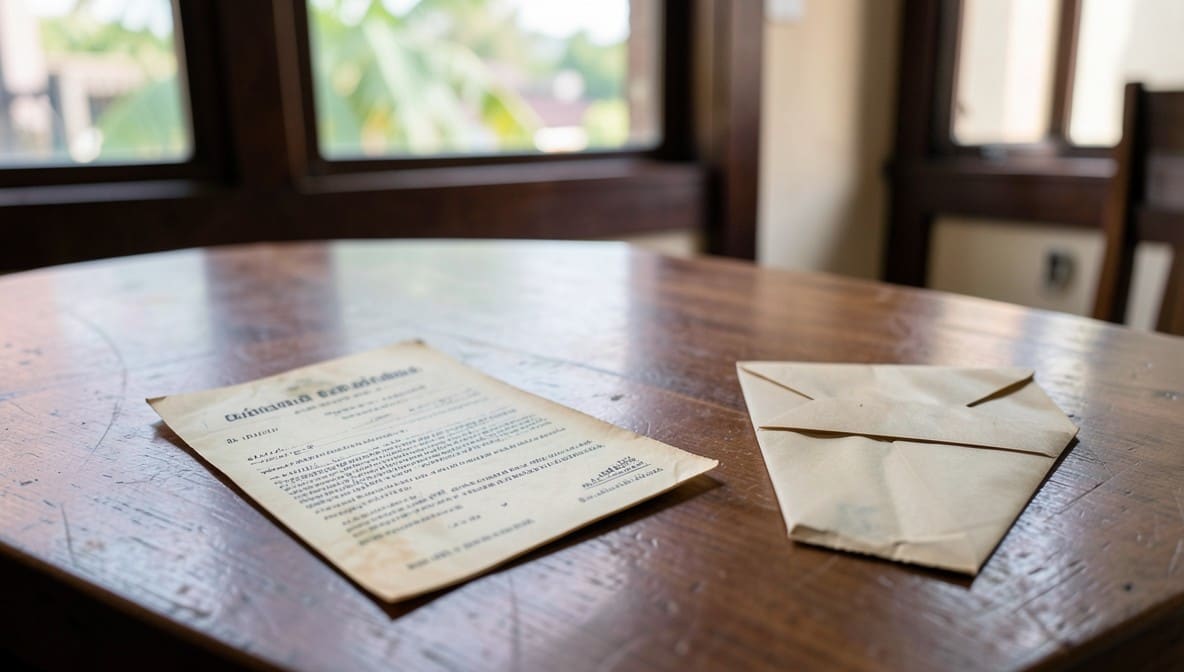
The Andhra Pradesh High Court has clarified that a document executed as security for a loan, with a conditional obligation to execute a sale deed upon default, does not constitute a valid agreement of sale under the Specific Relief Act. The Court overturned the first appellate court’s decree for specific performance, holding that the parties never intended a vendor-vendee relationship, and the plaintiff’s remedy lies in a money decree.
Background & Facts
The Dispute
The plaintiffs filed Original Suit No. 50 of 1994 before the Senior Civil Judge, Gudur, seeking specific performance of an agreement dated 31.08.1991 (Ex.A-21), alleging that the defendant had borrowed Rs. 1,70,000 and agreed to execute a registered sale deed in their favour if the amount was not repaid by 30.08.1993. The defendant denied the validity of the document, contending it was a fabricated usufructuary mortgage, not a sale agreement, and that the property was subject to ceiling laws.
Key Facts
- The document Ex.A-21, dated 31.08.1991, recites that the defendant borrowed Rs. 1,70,000 from the plaintiffs and agreed to repay it within two years.
- It further states that if repayment failed, the defendant would execute a registered sale deed in favour of the plaintiffs over the suit property.
- The market value of the property was estimated at Rs. 4,00,000, making the alleged sale price grossly inadequate.
- The suit property was under the Andhra Pradesh Land Reforms (Ceiling on Agricultural Holdings) Act, 1973, with the Government having taken possession on 24.01.1984 under a Land Reforms Tribunal order dated 28.11.1982.
- The plaintiffs issued a legal notice on 26.02.1994; the defendant replied on 05.03.1994, denying the validity of Ex.A-21.
- The suit was filed on 17.02.1994, within the limitation period.
- The plaintiffs examined three witnesses: P.W.1 (handwriting expert), P.W.2 (husband of plaintiff No.1), and P.W.3 (attesting witness).
- The defendant examined two witnesses and submitted documents including government possession records (Ex.B-1 to Ex.B-4, Ex.X-1 to Ex.X-11).
Procedural History
- 17.02.1994: Original Suit (O.S. No. 50 of 1994) filed before Senior Civil Judge, Gudur.
- 17.11.2004: Trial Court dismissed the suit, holding Ex.A-21 was not a valid agreement of sale and was void under Section 17 of the A.P. Land Reforms Act.
- 07.06.2011: First Appellate Court (III Additional District Judge, Nellore) allowed the appeal, set aside the trial court’s decree, and granted specific performance.
- 23.07.2012: Second Appeal (S.A. No. 1250 of 2011) admitted by the High Court with two substantial questions of law.
- 27.11.2025: Additional substantial questions framed by the High Court regarding Section 114 of the Indian Evidence Act and applicability of Section 17 of the Land Reforms Act.
- 15.04.2026: Judgment pronounced by Justice V. Gopala Krishna Rao.
The Parties' Positions
Plaintiffs (Respondents in Appeal): Argued that Ex.A-21 was a valid agreement of sale, that they had proved its execution through expert and attesting witness testimony, and that they were ready and willing to perform their part. Relied on R.Kandaswamy, Parswanath Saha, and Janardan Das to support their claim for specific performance.
Defendant (Appellant in Appeal): Contended that Ex.A-21 was not an agreement of sale but a loan security instrument. Argued that no vendor-vendee relationship existed, that the document was void under Section 17 of the A.P. Land Reforms Act, and that the first appellate court erred in reversing the trial court’s factual findings. Relied on Lourdu Mari David, Vidhyadhar, and Pawan Kumar Dutt to support the argument that the document was a mortgage.
Relief Sought
The plaintiffs sought specific performance of the agreement and execution of a sale deed. The defendant sought dismissal of the suit. In the second appeal, the appellant sought reversal of the first appellate court’s decree and restoration of the trial court’s dismissal order.
The Legal Issue
Whether a document executed as a security for a loan, containing a conditional obligation to execute a sale deed upon default, constitutes a valid agreement of sale under the Specific Relief Act, 1963, entitling the lender to specific performance?
Arguments Presented
For the Appellant/Petitioner
The appellant argued that Ex.A-21 was not an agreement of sale but a loan document with a default clause. The recitals clearly showed the defendant’s sole intention was to borrow money, not to sell property. The plaintiffs never intended to purchase the property; the sale clause was merely a collateral security. The Court must interpret the document as a whole, applying the golden rule of construction. The absence of an interest clause, the gross disparity in value, and the lack of mutual intent to sell negated any vendor-vendee relationship. The first appellate court erred in ignoring the bar under Section 17 of the A.P. Land Reforms Act, which rendered any alienation void. The Court also failed to apply Section 114 of the Indian Evidence Act, as the plaintiffs did not appear for cross-examination.
For the Respondent/State
The respondents argued that Ex.A-21 was a valid agreement of sale under Section 2(g) of the Indian Contract Act. They relied on R.Kandaswamy and Janardan Das to assert that readiness and willingness to perform were established through evidence and legal notice. They contended that Section 17 of the Land Reforms Act did not apply because the transaction was not an alienation but a mortgage, and that the expert and attesting witness testimony proved the document’s authenticity. They further argued that the first appellate court’s findings were factual and beyond interference under Section 100 CPC.
The Court's Analysis
The Court began by reaffirming the settled principle under Section 100 CPC that findings of fact by the first appellate court are final unless vitiated by error of law, perverse reasoning, or lack of evidence. However, the Court held that the first appellate court committed a legal error by mischaracterizing the nature of Ex.A-21.
"The very recitals in the suit document Ex.A-21 indicate that the defendant has no intention to sell the plaint schedule property to the plaintiffs and the plaintiffs have no intention to purchase the property as on the date of Ex.A-21."
The Court applied the golden rule of construction, examining the document as a whole. It noted that the document contained no mention of sale price, no mutual intent to transfer ownership, and no obligation on the plaintiffs to pay any consideration beyond the loan amount. The sale clause was purely conditional and arose only upon default. The relationship was therefore that of creditor and debtor, not vendor and vendee.
The Court further held that the first appellate court erred in applying precedents on specific performance (R.Kandaswamy, Parswanath Saha) which presuppose a valid contract of sale. These cases were inapplicable because they involved parties with mutual intent to buy and sell, which was absent here.
Regarding Section 17 of the A.P. Land Reforms Act, the Court observed that while the property was subject to ceiling laws, the primary defect lay not in the ceiling bar but in the absence of a valid sale agreement. The Court declined to decide the Section 17 issue on the merits, as the document’s nature as a loan security rendered the question academic.
On the evidentiary point under Section 114 of the Indian Evidence Act, the Court held that the plaintiffs had sufficiently proved Ex.A-21 through P.W.1 (expert), P.W.2 (husband), and P.W.3 (attesting witness). The evidence was consistent and corroborated. The failure of the plaintiffs to appear personally did not invalidate their case, as P.W.2 was a competent witness under Section 120.
The Court concluded that the first appellate court’s decree for specific performance was legally unsustainable. The plaintiffs were not entitled to specific performance because no contract of sale existed. Their remedy lay in a money decree for the principal amount with interest.
The Verdict
The second appeal is partly allowed. The decree of the first appellate court dated 07.06.2011 granting specific performance is set aside. The trial court’s dismissal of the suit is modified to decree a money claim. The appellant No.2, as legal representative of the deceased defendant, is directed to pay Rs. 1,70,000 to the plaintiffs with interest at 12% per annum from 31.08.1991 until the date of the decree, and thereafter at 6% per annum until realization. The payment shall be made from the estate of the deceased appellant No.1 in the hands of appellant No.2. There shall be no order as to costs. All pending applications are disposed of.
What This Means For Similar Cases
A Conditional Sale Clause Does Not Create a Sale Contract
- Practitioners must distinguish between security documents and sale agreements. A clause stating "if loan is not repaid, sale deed will be executed" does not transform a loan into a sale.
- Courts will examine the parties’ actual intent, not the document’s label. The absence of mutual consent to sell, absence of sale price, and lack of buyer’s obligation to pay are fatal to a claim for specific performance.
- In loan-backed documents, the plaintiff’s remedy is a money decree, not specific performance.
Evidence of Execution Must Be Corroborated, Not Assumed
- Expert testimony alone is insufficient; it must be corroborated by independent evidence (e.g., attesting witnesses, contemporaneous correspondence).
- The Court’s acceptance of P.W.2’s testimony as husband of plaintiff No.1 reinforces that close relatives can testify on transactions they have personal knowledge of, provided their evidence is credible and unchallenged.
Specific Performance Requires Genuine Vendor-Vendee Relationship
- Precedents on specific performance (R.Kandaswamy, Janardan Das) apply only where the parties intended to enter into a sale contract. These cannot be stretched to enforce security documents.
- Courts must scrutinize whether the plaintiff has demonstrated readiness and willingness to perform - a requirement that cannot be satisfied if the underlying contract is not a sale.
Land Ceiling Laws Are Not Always Dispositive
-
While Section 17 of the A.P. Land Reforms Act may void alienations, the Court declined to rule on its applicability because the transaction was not a sale to begin with. This signals that procedural defects in the nature of the contract may override substantive land law issues.
-
Practitioners should focus first on whether a valid contract exists before invoking statutory bars.