A landmark ruling by the Punjab and Haryana High Court has clarified that a seller who voluntarily executes an agreement to sell cannot later evade specific performance by raising defects in title or procedural irregularities. The judgment reinforces the principle that equitable relief under the Specific Relief Act cannot be defeated by the very party who induced the contract.
Background & Facts
The Dispute
The dispute arose from an agreement to sell dated 30.07.2009, wherein defendant No.1, Partap Singh, agreed to sell a shop in New Grain Market, Charkhi Dadri, to plaintiff Suresh Kumar for Rs.14,50,000. The plaintiff paid Rs.2,25,000 as earnest money and Rs.6,25,000 as advance, with the balance Rs.6,00,000 paid in installments by August 2012. Despite full payment, the defendant refused to execute the sale deed, prompting the plaintiff to issue legal notices and ultimately file a suit for specific performance and permanent injunction.
Procedural History
- 2009: Agreement to sell executed on 30.07.2009, attested by a notary and two witnesses.
- 2010: Allotment letter issued by Haryana State Agricultural Marketing Board on 03.12.2010, revising the sale consideration to Rs.10,50,000.
- 2012: Plaintiff paid final installment on 03.08.2012; issued legal notices on 30.08.2012 and 17.09.2012.
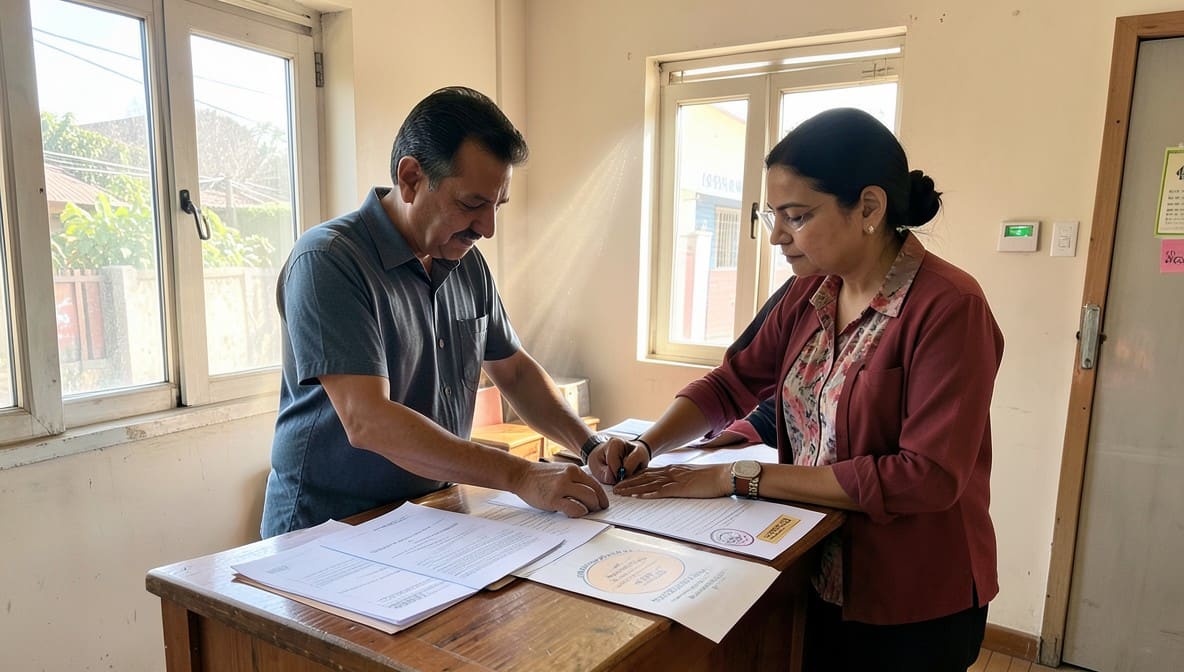
- 01.10.2012: Plaintiff appeared before Sub Registrar with all documents and funds; defendant failed to appear.
- 2013: Suit filed on 16.08.2013.
- 2018: Trial Court decreed the suit for specific performance.
- 2021: First Appellate Court dismissed the appeal.
- 2026: Second appeal filed before Punjab and Haryana High Court.
Relief Sought
The plaintiff sought specific performance of the agreement to sell and a permanent injunction restraining the defendants from alienating the shop. The defendants opposed the suit on grounds of fraud, non-joinder of parties, lack of readiness and willingness, and defective title.
The Legal Issue
The central question was whether a vendor who executes an agreement to sell can later defeat a suit for specific performance by asserting that he did not hold clear title at the time of execution, or by raising objections not pleaded in the written statement.
Arguments Presented
For the Appellant
The appellants contended that:
- The agreement to sell was void because the shop was not allotted until 03.12.2010, making the 30.07.2009 agreement impossible to perform.
- The total sale consideration stated in the agreement (Rs.8,25,000) was false; the actual amount was Rs.10,50,000, indicating fraud.
- The plaintiff failed to prove readiness and willingness, as legal notices were issued only after three years of payment.
- The Market Committee, as the allotting authority, was a necessary party not joined in the suit.
- Condition No.15 of the allotment letter prohibited transfer within five years, rendering the agreement void.
- Payments were made in cash without bank records, making them unreliable.
- The firm was a partnership, not proprietorship, and the suit was mis-pleaded.
For the Respondent
The respondent argued that:
- The agreement was duly executed, attested by a notary, and supported by witness testimony and handwriting analysis.
- The defendant admitted his signature on the agreement, negating the fraud claim.
- All payments were substantiated by original receipts (Ex.P2 to Ex.P8) in the plaintiff’s custody.
- The plaintiff appeared before the Sub Registrar with funds and affidavits, proving readiness and willingness.
- The vendor cannot raise title defects as a defence under Section 13(i)(a) of the Specific Relief Act, 1963.
- Objections like non-joinder and condition No.15 were not pleaded in the written statement and cannot be raised for the first time in appeal.
- Concurrent findings of two lower courts are binding in second appeal unless a substantial question of law arises.
The Court's Analysis
The Court undertook a meticulous review of evidence and legal principles. It emphasized that execution of an agreement to sell by a vendor estops him from later denying his capacity to transfer title. The Court relied on Mir Abdul Hakeem Khan v. Abdul Mannan Khadri to hold that a seller cannot set up a defect in his own title as a defence in a suit for specific performance.
"A person who executes an agreement to sell of a property cannot put forward, in a suit for specific performance by the purchaser, the defence that he did not have any title and it would only be for the purchaser to state that the vendor had no title or had a defective title."
The Court rejected the argument that the agreement was void due to the discrepancy in allotment dates and consideration. PW8, the Mandi Supervisor, testified that the shop was provisionally allotted on 29.07.2009 and formally confirmed on 03.12.2010, with revised pricing. This clarified that the agreement was validly entered into during the interim period.
The Court also dismissed the claim of fraud. The defendants alleged that signatures were obtained on blank papers, but failed to produce any evidence, particulars, or witnesses to substantiate this. The Court held that vague allegations of fraud, unsupported by evidence, are legally worthless.
Regarding readiness and willingness, the Court noted the plaintiff’s consistent conduct: payment of installments, production of original receipts, issuance of legal notices, and personal appearance before the Sub Registrar with funds and affidavits. The delay between payment and notice was explained as a reasonable attempt to secure voluntary compliance.
The Court further held that the Market Committee was not a necessary party, as no relief was sought against it. Similarly, Condition No.15 of the allotment letter could not be invoked by the defendants, as it was a restriction binding only on the allottee and the Committee.
The Court affirmed that concurrent findings of fact by two lower courts are sacrosanct in second appeals, and interference is permissible only for substantial errors of law or procedure, none of which were present here.
The Verdict
The appellant’s appeal was dismissed. The Court held that a vendor who executes an agreement to sell cannot later evade specific performance by raising title defects or unpleaded objections. The plaintiff’s readiness and willingness were duly established, and the decree for specific performance was upheld.
What This Means For Similar Cases
Vendor Cannot Raise Title Defects as Defence
- Practitioners must now argue that Section 13(i)(a) of the Specific Relief Act, 1963 bars a seller from denying title after entering into an agreement.
- Any defence based on defective title must be raised by the purchaser, not the vendor.
- In suits for specific performance, focus should be on proving execution and readiness, not on the vendor’s title瑕疵.
Unpleaded Objections Are Waived
- Objections such as non-joinder of parties, violation of allotment conditions, or mis-pleading of firm status must be raised in the written statement.
- Failure to plead these in the trial court bars raising them in appeal, especially in second appeals.
- Practitioners should conduct a thorough review of pleadings before filing appeals.
Cash Payments Are Not Per Se Invalid
-
Original receipts in the plaintiff’s custody, duly produced and unchallenged, are sufficient proof of payment.
-
Absence of bank records does not invalidate transactions if receipts are corroborated by witness testimony and not disputed by the defendant.
-
Courts will not presume fraud merely because payments were made in cash.
-
Practitioners should ensure original receipts are preserved and witnesses are examined to authenticate payment.
-
In cases involving cash transactions, affidavits of presence and notarized documents strengthen the case for readiness and willingness.