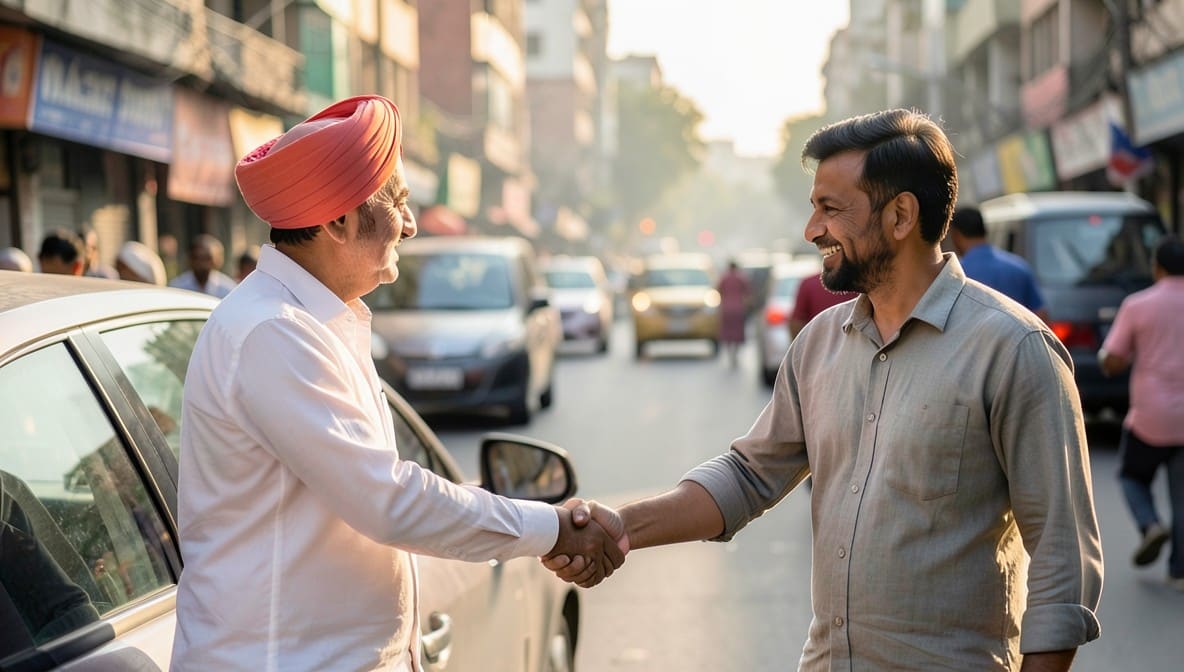
The Himachal Pradesh High Court has affirmed that criminal proceedings arising from non-heinous road accident offences may be quashed upon genuine compromise between parties, reinforcing the principle that not all criminal matters serve public interest when resolved amicably. This ruling clarifies the scope of inherent powers under Section 528 of the Bharatiya Nagrik Suraksha Sanhita, 2023, in cases devoid of societal harm.
Background & Facts
The Dispute
The petitioner, Tegu Ram, was named as the driver of a tipper truck bearing registration number HP-65-6611 involved in a collision with a car carrying Ms. Anju Thakur and her brother, Pushap Raj, on 27.06.2020 at approximately 05:30 p.m. near Paakhri, District Mandi, Himachal Pradesh. The complainant alleged that the petitioner was driving rashly and negligently, resulting in the car being struck and both occupants sustaining multiple injuries.
Key Facts
- The accident occurred on 27.06.2020 at 05:30 p.m. on a public road
- The complainant’s vehicle, HP-33B-1223, was hit by the petitioner’s tipper truck
- Both complainant and her brother suffered physical injuries requiring medical treatment
- The petitioner provided care and support during their recovery
- FIR No.89 of 2020 was registered at Police Station Padhar under Sections 279 (rash driving), 337 (causing hurt by act endangering life), and 338 (causing grievous hurt by act endangering life) of the Indian Penal Code
- A chargesheet was filed by the police following investigation
- The complainant and her brother later expressed willingness to compromise
Procedural History
- 27.06.2020: Accident occurred
- 27.06.2020: FIR No.89 of 2020 registered at Police Station Padhar
- Post-investigation: Chargesheet submitted to the competent court
- Before trial commenced: Parties entered into a written compromise
- 09.04.2026: Court directed the State to file a status report; no report was filed
- 19.04.2026: Complainant and her brother appeared in person, affirmed compromise on oath before the Court
- 20.04.2026: Petition under Section 528 of Bharatiya Nagrik Suraksha Sanhita, 2023, heard and decided
The Parties' Positions
For the Petitioner: Argued that the compromise was voluntary, genuine, and free from coercion; that the injuries had healed; that the complainants had no objection to quashing; and that continuation of proceedings served no public interest.
For the Respondents (State): Did not file a status report but, through Additional Advocate General, conceded that no useful purpose would be served by continuing proceedings, given the complainants’ unequivocal stance and the remote likelihood of conviction.
For Respondent No.2 (Complainant): Ms. Jyotsna Gupta, Advocate, affirmed on oath that the compromise was entered into voluntarily, without pressure, and that the complainants had no objection to the petitioner’s acquittal.
Relief Sought
The petitioner sought quashing of FIR No.89 of 2020 and all consequential proceedings pending before the trial court, on the ground of compromise between the parties.
The Legal Issue
Can a criminal FIR under Sections 279, 337, and 338 IPC be quashed under Section 528 of the Bharatiya Nagrik Suraksha Sanhita, 2023, when the parties have arrived at a genuine compromise, and the offences are neither heinous nor against public order?
Arguments Presented
For the Petitioner
The petitioner relied on the principles laid down in Narinder Singh v. State of Punjab (2014) 6 SCC 466 and Gian Singh v. State of Punjab (2012) 10 SCC 303, arguing that offences under Sections 279, 337, and 338 IPC are not offences of moral turpitude or societal gravity. He emphasized that the compromise was voluntary, the complainants had recovered fully, and the petitioner had provided care during treatment. He contended that continuing proceedings would amount to abuse of process and defeat the purpose of reconciliation.
For the Respondent/State
The Additional Advocate General conceded that the complainants’ statements on oath rendered the prospect of conviction remote. He submitted that no public interest would be served by continuing the prosecution, especially since the State had not filed a status report and the complainants had unequivocally withdrawn their desire to prosecute. He supported the quashing of proceedings as a just and proportionate outcome.
The Court's Analysis
The Court undertook a detailed review of the Supreme Court’s jurisprudence on quashing of criminal proceedings under inherent powers. It noted that while Narinder Singh and Gian Singh held that quashing is impermissible in cases involving heinous offences like murder, rape, or dacoity, the Court also recognized exceptions for offences with predominantly civil character.
"The power conferred under Section 482 Cr.P.C. is to be distinguished from the power which lies in the Court to compound the offences under Section 320 Cr.P.C. No doubt, under Section 482 Cr.P.C., the High Court has inherent power to quash criminal proceedings even in those cases which are not compoundable and where the parties have settled the matter between themselves, however, this power is to be exercised sparingly and with great caution."
The Court observed that Sections 279, 337, and 338 IPC are not offences of moral depravity or societal threat. They are typically the result of momentary lapses in driving conduct, often arising from negligence rather than malice. The Court further cited Dimpey Gujral v. Union Territory (2013) 11 SCC 497, which held that continuation of proceedings in personal disputes where compromise exists amounts to abuse of process.
The Court emphasized that the complainants appeared in person, affirmed the compromise on oath, and explicitly stated they had no objection to the petitioner’s acquittal. The State did not oppose the quashing, and the chargesheet had not yet led to trial. The Court concluded that the social cost of continuing the proceedings outweighed any potential benefit, particularly where the victim had forgiven and the accused had shown remorse through care and cooperation.
The Verdict
The petition was allowed. The Court quashed FIR No.89 of 2020 registered under Sections 279, 337, and 338 IPC at Police Station Padhar, District Mandi, and set aside all consequential proceedings pending before the trial court. The accused, Tegu Ram, was acquitted of all charges. All pending applications were disposed of.
What This Means For Similar Cases
Compromise Can End Non-Heinous Criminal Proceedings
- Practitioners may now confidently seek quashing of FIRs under IPC Sections 279, 337, 338, 323, 324, and similar minor offences where genuine compromise exists
- Voluntary, sworn statements of the complainant are critical evidence of authenticity
- The State’s silence or non-opposition strengthens the petition, especially when conviction prospects are low
Judicial Discretion Must Be Grounded in Social Impact
- Courts must assess whether the offence is personal or societal in nature
- Offences arising from traffic accidents, domestic altercations, or minor property disputes are more likely to qualify for quashing
- The burden is on the petitioner to demonstrate absence of coercion, full recovery, and absence of public interest in prosecution
Procedural Efficiency Over Formal Punishment
- Where no trial has commenced and chargesheet is filed, quashing prevents unnecessary judicial burden
- Courts should prioritize reconciliation over punitive formalism in low-gravity cases
- This approach aligns with the spirit of the Bharatiya Nagrik Suraksha Sanhita, 2023, which emphasizes restorative justice