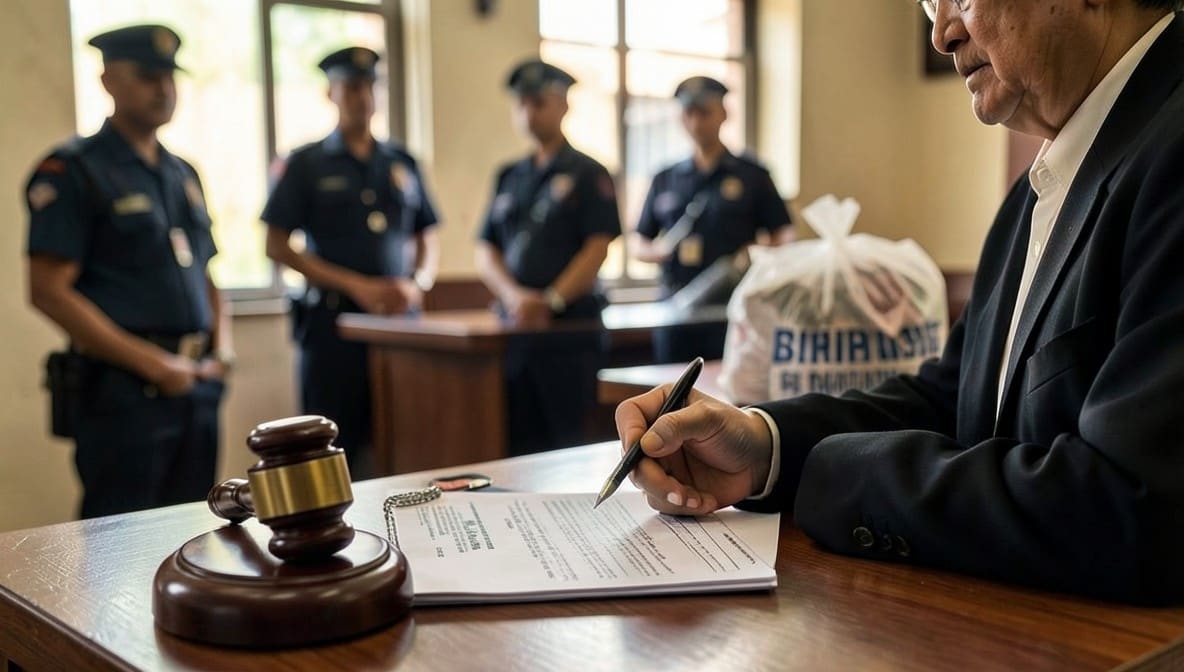
The Allahabad High Court has reaffirmed that procedural non-compliance under Section 50 of the NDPS Act, even in cases involving substantial quantities of narcotics, renders detention unjustified in the absence of a fair trial framework. This ruling underscores that statutory safeguards for accused persons cannot be overridden by the severity of the alleged offence.
Background & Facts
The Dispute
The applicant, Naved, was arrested on 22.04.2026 in connection with Case Crime No. 171 of 2026, registered at Police Station Meerganj, District Bareilly, under Sections 8, 21, and 29 of the Narcotic Drugs and Psychotropic Substances Act, 1985 (NDPS Act). The case stems from the recovery of 350 grams of smack from his exclusive and separate possession. The applicant has been in judicial custody since the date of arrest.
Key Facts
- The alleged recovery of 350 grams of smack occurred on or before 22.04.2026
- The memo of recovery does not bear the signature of the gazetted officer allegedly present during the seizure
- The applicant has no prior criminal record
- The prosecution claims compliance with Section 50 of the NDPS Act, asserting the presence of a gazetted officer
- The applicant contends that the absence of the gazetted officer’s signature renders the recovery invalid and violates mandatory procedural safeguards
Procedural History
- 22.04.2026: Arrest of applicant and seizure of 350 grams of smack
- 23.04.2026: First production before Magistrate; remand ordered
- 15.05.2026: Chargesheet filed by Police Station Meerganj
- 18.05.2026: Bail application filed before the High Court under Section 483 of the Bharatiya Nagarik Suraksha Sanhita, 2023
- 18.05.2026: Hearing conducted before the High Court
- 18.05.2026: Order passed granting bail
Relief Sought
The applicant sought release on bail pending trial, arguing that the failure to comply with Section 50 of the NDPS Act vitiated the legality of the recovery, that he had no criminal antecedents, and that the trial would face prolonged delays due to court pendency.
The Legal Issue
The central question was whether the failure to obtain the signature of the gazetted officer in the memo of recovery under Section 50 of the NDPS Act constitutes a fatal procedural defect warranting bail, even when the quantity of narcotics recovered is substantial and Section 37 imposes stringent conditions for bail.
Arguments Presented
For the Applicant
The learned counsel argued that Section 50 of the NDPS Act mandates strict compliance: the recovery of narcotic substances must be conducted in the presence of a gazetted officer, and the officer’s signature on the recovery memo is not optional but mandatory. The absence of the signature, despite the presence of the officer, renders the recovery legally invalid. Reliance was placed on State of Punjab v. Baldev Singh and Kalsan Singh v. State of Punjab, which held that non-compliance with Section 50 is a ground for acquittal or bail. It was further submitted that the applicant has no criminal history and undertakes to abide by all conditions of bail.
For the Respondent
The learned Additional Government Advocate contended that the recovery was conducted in the presence of a gazetted officer and that the omission of the signature was a mere technical irregularity, not a substantive violation. It was argued that the quantity of smack (350 grams) falls well above the commercial quantity threshold under Section 21, triggering the stringent bail conditions under Section 37 of the NDPS Act, and that the court should not interfere with the investigation.
The Court's Analysis
The Court examined the statutory mandate of Section 50 of the NDPS Act, which requires that any search and seizure be conducted in the presence of a gazetted officer and that the officer’s signature be affixed to the recovery memo. The Court noted that the prosecution’s own record acknowledges the presence of a gazetted officer but admits the absence of his signature. The Court held that the signature is not a formality but a statutory safeguard to ensure transparency and prevent fabrication.
"The absence of the gazetted officer’s signature on the recovery memo is not a mere procedural lapse; it is a failure to comply with a mandatory condition designed to protect the rights of the accused."
The Court distinguished State of Punjab v. Baldev Singh, where the Supreme Court held that non-compliance with Section 50 vitiates the entire prosecution case, and applied the principle that such defects cannot be cured by subsequent affidavits or oral testimony. The Court further observed that while Section 37 of the NDPS Act imposes restrictions on bail, it does not eliminate the court’s duty to examine procedural fairness. The Court emphasized that the right to a fair trial includes adherence to statutory procedures, and that the applicant’s lack of criminal history and the prolonged nature of trial proceedings further supported the grant of bail.
The Verdict
The bail application was allowed. The applicant, Naved, is released on bail upon furnishing a personal bond of Rs. 50,000 with two sureties each in the like amount. He must comply with five conditions: (i) no intimidation of witnesses, (ii) no tampering with evidence, (iii) personal appearance at key trial stages, (iv) no adjournment requests when witnesses are present, and (v) presence before the trial court on all dates. Breach of any condition shall result in cancellation of bail. The Court clarified that this order does not prejudge the merits of the case.
What This Means For Similar Cases
Procedural Compliance Is Non-Negotiable in NDPS Cases
- Practitioners must challenge recoveries where the gazetted officer’s signature is missing, regardless of the quantity of narcotics
- Oral testimony by police officers cannot substitute for a signed recovery memo under Section 50
- Courts must treat Section 50 violations as jurisdictional defects, not technicalities
Section 37 Does Not Override Fundamental Fairness
- Even in cases involving commercial quantities, bail cannot be denied solely on the basis of quantity if procedural rights are violated
- The burden shifts to the prosecution to prove strict compliance with Section 50
- Courts must balance stringent bail conditions under Section 37 with the accused’s right to a fair and lawful investigation
Delay in Trial Supports Bail in Narcotics Cases
- Pendency of trials in lower courts is a legitimate factor in bail applications under Section 483 B.N.S.S.
- Courts may grant bail where trial delays are systemic and the accused has no prior record
- Applicants should document court delays and submit affidavits on pendency to strengthen bail pleas