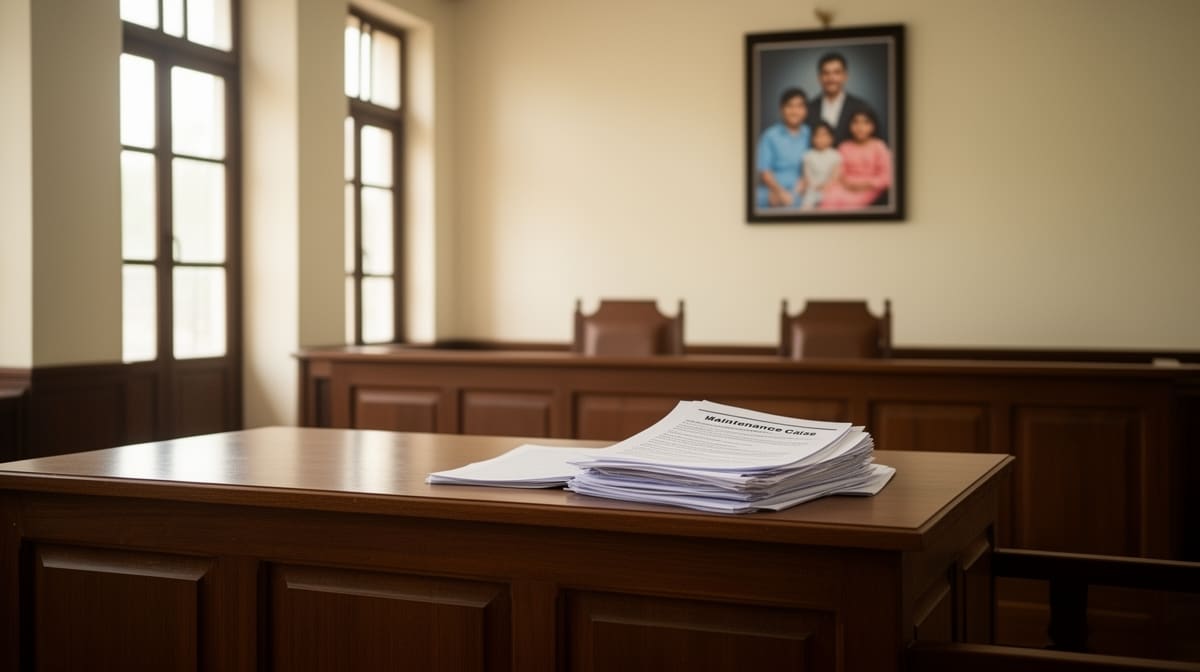
A landmark ruling by the Jammu & Kashmir High Court clarifies that a wife’s statutory right to maintenance under Section 488 CrPC is extinguished if she is living separately by mutual consent, even if the marriage remains legally undissolved. The judgment balances the rigour of statutory bars with equitable relief, setting a critical precedent for matrimonial disputes where informal settlements precede later claims.
Background & Facts
The Dispute
The petitioner, Sarita Devi, and respondent, Mohan Singh, were married in 1990 and had one son. In 1995, after allegations of bigamy, the parties entered into a compromise wherein the petitioner accepted ₹10,000 as full and final settlement, withdrew all pending proceedings, and executed a customary divorce deed (farkhatnama). Thereafter, they lived separately for over a decade.
Procedural History
- 1995: Parties compromised all proceedings; petitioner accepted ₹10,000 as full settlement and withdrew complaints under Sections 494 and 488 CrPC.
- 2003: Petitioner filed maintenance petition for minor son, describing herself as divorced.
- 2007: Maintenance for son enhanced to ₹1,000/month.
- 2007: Petitioner filed fresh complaint under Section 494 IPC; FIR registered but respondent discharged under Section 403 CrPC.
- 2008: Petitioner filed new Section 488 CrPC petition without disclosing prior compromise.
- 2011: Chief Judicial Magistrate dismissed petition, holding marriage dissolved by mutual consent.
- 2012: Sessions Court set aside dismissal and remanded for fresh adjudication, directing framing of issue on customary divorce.
- 2013: Parties settled before Lok Adalat for ₹2.5 lakhs; petitioner later challenged it in writ, leading to its setting aside.
- 2020: Chief Judicial Magistrate granted maintenance at ₹2,000/month with 10% annual enhancement.
- 2020: Principal Sessions Judge reversed the order, holding separation was by mutual consent under Section 488(5) CrPC.
Relief Sought
The petitioner sought restoration of the maintenance order. The respondent sought dismissal of the maintenance claim and confirmation that no liability arose due to consensual separation.
The Legal Issue
The central question was whether Section 488(5) CrPC bars a wife from claiming maintenance if she is living separately by mutual consent, even when the marriage has not been legally dissolved by decree or proved custom.
Arguments Presented
For the Petitioner
The petitioner relied on Shail Kumari Devi v. Krishan Bhagwan Pathak and Vijay Kumari v. Ashwani Kumar to argue that statutory rights to maintenance cannot be waived by private agreement, as they are founded on public policy. She contended that customary divorce was not proved, the marriage remained subsisting, and the Revisional Court exceeded its jurisdiction by reappreciating evidence instead of correcting legal errors.
For the Respondent
The respondent relied on Popat Kashinath Bodke v. Kamalabai Popat Bodke and Vitthal Hiraji Jadhav v. Harnabai Vitthal Jadhav to argue that the petitioner’s consistent conduct - accepting settlement, describing herself as divorced, and remaining separated for over a decade - established mutual consent separation. He submitted that Section 488(5) CrPC operates independently of legal dissolution and that the petitioner was estopped from re-agitating her claim.
The Court's Analysis
The Court examined the interplay between statutory bars under Section 488(5) CrPC and the doctrine of estoppel by conduct. It affirmed that while customary divorce was not proved and the marriage remained legally intact under the J&K Hindu Marriage Act, 1980, the petitioner’s conduct constituted clear admissions of consensual separation.
"These are not isolated statements but consistent representations forming part of judicial record."
The Court emphasized that admissions in judicial proceedings are substantive evidence under Narayan Bhagwantrao Gosavi Balajiwale v. Gopal Vinayak Gosavi. The petitioner’s repeated assertions of being divorced in multiple court proceedings, coupled with her failure to seek restitution of conjugal rights or maintenance for herself for over a decade, established a pattern of acquiescence.
The Court distinguished between dissolution of marriage and separation by mutual consent. Citing Manju Ramchandani v. Manish Ramchandani and Dharampal v. Shakun Bai, it held that while an informal agreement cannot dissolve a statutory marriage, it is admissible to prove the nature of separation. The bar under Section 488(5) CrPC applies irrespective of whether the marriage is legally terminated.
The Court further clarified the limits of revisional jurisdiction: a revisional court may interfere with a positive maintenance order only if it is perverse or illegal. Here, the findings were based on documentary evidence and judicial admissions, not speculative reappreciation.
"The petitioner cannot be permitted to approbate and reprobate by asserting divorce in earlier proceedings and later claiming desertion."
Despite dismissing the petition, the Court invoked its inherent powers under Section 482 CrPC to prevent destitution. It noted the petitioner’s lack of independent income and the respondent’s subsequent financial improvement, observing that while private agreements cannot override statutory rights, equity demands relief where hardship is evident.
The Verdict
The petitioner’s challenge was dismissed. The Court held that Section 488(5) CrPC bars maintenance where separation is by mutual consent, regardless of legal dissolution. However, to prevent injustice, the Court directed the respondent to pay ₹2.5 lakhs as a one-time settlement, with interest for delay.
What This Means For Similar Cases
Mutual Consent Separation Is a Complete Bar Under Section 488 CrPC
- Practitioners must now assess whether separation was consensual before filing or defending maintenance claims.
- Evidence of long-term cohabitation, judicial admissions, and prior settlements are decisive.
- A wife’s claim for maintenance fails if she has consistently represented herself as separated by mutual agreement.
Estoppel by Conduct Overrides Technical Validity of Marriage
- A wife cannot claim maintenance under CrPC if she previously asserted divorce in court records and acted upon it.
- Courts will treat consistent judicial conduct as conclusive proof of intent, even without formal dissolution.
- Legal marriage status alone is insufficient to sustain a maintenance claim if separation is consensual.
Equitable Relief May Be Granted Despite Statutory Bar
- While statutory rights cannot be waived, courts may invoke inherent powers under Section 482 CrPC to prevent destitution.
- One-time settlements may be ordered where the respondent’s financial position improved post-separation and the petitioner is left without means.
- Practitioners should consider seeking equitable relief under Section 482 CrPC even when statutory claims are barred.