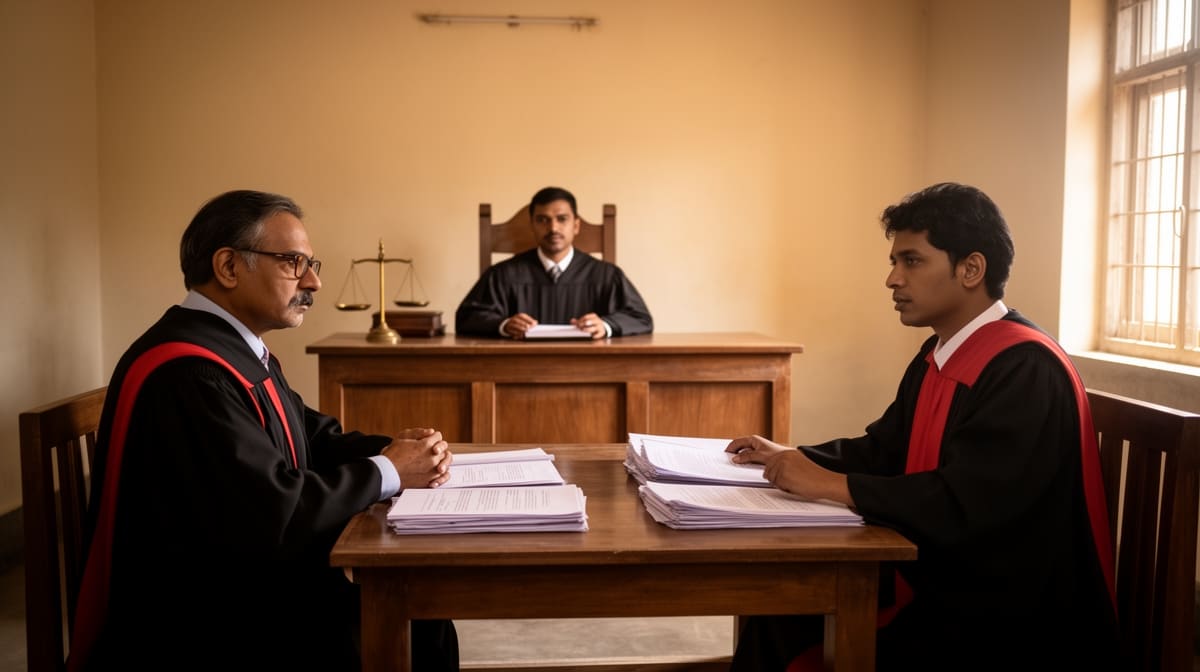
The Madhya Pradesh High Court has clarified that a wife’s decision to reside separately due to marital discord and pending criminal proceedings under Sections 498-A and 506-II IPC constitutes a valid ground for claiming maintenance under Section 125 CrPC. The Court set aside a Family Court order that dismissed maintenance on the sole ground of voluntary separation, emphasizing that such dismissal ignores the context of domestic conflict and procedural fairness.
Background & Facts
The Dispute
The petitioners, Smt. Jyoti Bramhe (wife) and her son, filed an application under Section 125 CrPC before the Family Court, Chhindwara, seeking maintenance from the respondent, Dinesh Bramhe (husband). The application was filed on 05.07.2012, while criminal proceedings under Sections 498-A and 506-II IPC were pending between the parties. The Family Court dismissed the application on 26.12.2014, holding that the wife was willingly residing separately and therefore not entitled to maintenance.
Key Facts
- The petitioners filed the maintenance application on 05.07.2012
- Criminal proceedings under Section 498-A IPC (cruelty) and Section 506-II IPC (criminal intimidation) were pending since at least 2011
- The wife alleged physical and mental harassment by the husband and his family
- The husband denied the allegations but did not dispute the pendency of criminal cases
- The Family Court did not examine evidence regarding the wife’s financial dependence, the husband’s income, or the son’s need for maintenance
- The wife had no independent source of income and was dependent on the husband for sustenance
Procedural History
- 2011: Criminal complaint filed under Sections 498-A and 506-II IPC
- 05.07.2012: Maintenance application filed under Section 125 CrPC
- 26.12.2014: Family Court dismissed the application on the ground that the wife was residing separately "willingly"
- 2015: Criminal Revision No. 638 of 2015 filed before the High Court of Madhya Pradesh, Jabalpur
- 07.04.2026: Hearing concluded before Justice Dwarka Dhish Bansal
Relief Sought
The petitioners sought: (1) setting aside the Family Court’s order dated 26.12.2014; (2) direction to the Family Court to decide the maintenance application afresh; (3) interim maintenance pending decision; and (4) maintenance for the son as a dependent child.
The Legal Issue
The central question was whether a wife’s residence separate from her husband, while criminal proceedings under Sections 498-A and 506-II IPC are pending, constitutes a valid ground to deny maintenance under Section 125 CrPC, or whether such separation must be evaluated in light of the circumstances leading to it.
Arguments Presented
For the Petitioner
Learned counsel for the petitioners argued that the Family Court erred in mechanically applying the doctrine of "voluntary separation" without examining the context. He relied on the pendency of serious criminal charges under Sections 498-A and 506-II IPC, which inherently indicate marital breakdown and threat to the wife’s safety. He cited Rajnesh v. Neha and Smt. Sunita v. Anil to argue that separation due to cruelty or intimidation cannot be treated as voluntary. He emphasized that Section 125 CrPC is a social welfare provision and must be interpreted liberally to protect vulnerable dependents.
For the Respondent
Learned counsel for the respondent supported the Family Court’s order, relying on Anil v. Smt. Sunita (2016), where this Court had held that a wife residing separately without cause cannot claim maintenance. He contended that the wife had not produced evidence of coercion or force compelling her to leave, and that mere pendency of criminal proceedings does not automatically justify separation.
The Court's Analysis
The Court observed that the Family Court’s reasoning was superficial and failed to engage with the factual matrix. The Court noted that the pendency of criminal proceedings under Sections 498-A and 506-II IPC is not a mere formality - it reflects a breakdown of marital trust and potential threat to the wife’s life and dignity. The Court held that such circumstances inherently negate the notion of "voluntary separation" under Section 125 CrPC.
"The mere fact that the wife is residing separately does not ipso facto disentitle her to maintenance, especially when the separation arises from allegations of cruelty and intimidation which are the subject of ongoing criminal proceedings."
The Court further noted that the Family Court completely ignored the maintenance claim of the son, who is a dependent child under Section 125 CrPC. The mechanical dismissal of the entire application without separate consideration of the son’s claim was held to be a violation of natural justice.
The Court emphasized that Section 125 CrPC is a remedial provision designed to prevent destitution. The burden on the husband to show that the wife is capable of maintaining herself is not discharged merely by alleging separation. The Court held that the Family Court must reassess the evidence - including income, living conditions, medical records, and the nature of the criminal allegations - before arriving at a conclusion.
The Verdict
The criminal revision was allowed in part. The High Court set aside the Family Court’s order dated 26.12.2014 and remitted the matter back to the Family Court for fresh adjudication. The Family Court is directed to decide the application under Section 125 CrPC afresh, taking into account all evidence on record, including the pendency of criminal proceedings under Sections 498-A and 506-II IPC, the financial status of the parties, and the maintenance needs of the son. The Family Court shall complete the proceedings within 12 weeks from the date of receipt of this order.
What This Means For Similar Cases
Separation Due to Cruelty Is Not Voluntary
- Practitioners must argue that any separation occurring during or after allegations of cruelty under Section 498-A IPC cannot be treated as "voluntary" for the purpose of denying maintenance
- Evidence of police complaints, medical reports, or witness statements supporting abuse must be foregrounded in Section 125 applications
- The burden shifts to the husband to prove that the wife left without cause, not to the wife to prove she was forced out
Children’s Maintenance Cannot Be Overlooked
- Applications under Section 125 CrPC must be examined separately for the wife and dependent children
- Courts cannot dismiss maintenance for children on the basis of the wife’s residence status
- Failure to consider the child’s claim constitutes a jurisdictional error and grounds for remand
Procedural Rigor Required in Family Courts
- Family Courts must conduct substantive hearings and not dispose of Section 125 applications on superficial grounds
- Mechanical dismissal without examining evidence violates the spirit of Section 125 CrPC and Article 21 of the Constitution
- Judges must record reasons for rejecting claims, especially where criminal proceedings are pending