The Allahabad High Court has reaffirmed that courts must refrain from quashing FIRs where a prima facie offence is disclosed, particularly when investigation is ongoing and evidence remains uncollected. The judgment underscores the limited scope of inherent powers under Section 482 CrPC and reinforces the principle that judicial interference in investigations is permissible only in the rarest of rare cases.
Background & Facts
The Dispute
The petitioner, Jai Prakash Tiwari, was appointed as an Assistant Teacher following verification of his educational documents. Subsequently, an FIR was registered against him alleging that he had forged his academic qualifications to secure the appointment. The State, upon inquiry with Gorakhpur University, discovered that the petitioner had never been enrolled as a student and that the degree submitted by him was fraudulent.
Key Facts
The petitioner was appointed as Assistant Teacher after submission of educational certificates
Gorakhpur University confirmed on investigation that the petitioner was never enrolled in the course for which the degree was claimed
The degree presented by the petitioner was found to be forged
The FIR was registered on the basis of this finding, alleging forgery and fraud under relevant provisions of the Indian Penal Code
No charge sheet has been filed as of the date of the judgment; investigation remains in progress
Procedural History
Date of appointment: Not specified in judgment, but occurred prior to FIR registration
Date of university verification: Not specified, but occurred prior to FIR
Date of FIR registration: Not specified, but filed before filing of writ petition
10.07.2026: Writ Petition No. 16231 of 2026 filed before the Allahabad High Court seeking quashing of the FIR
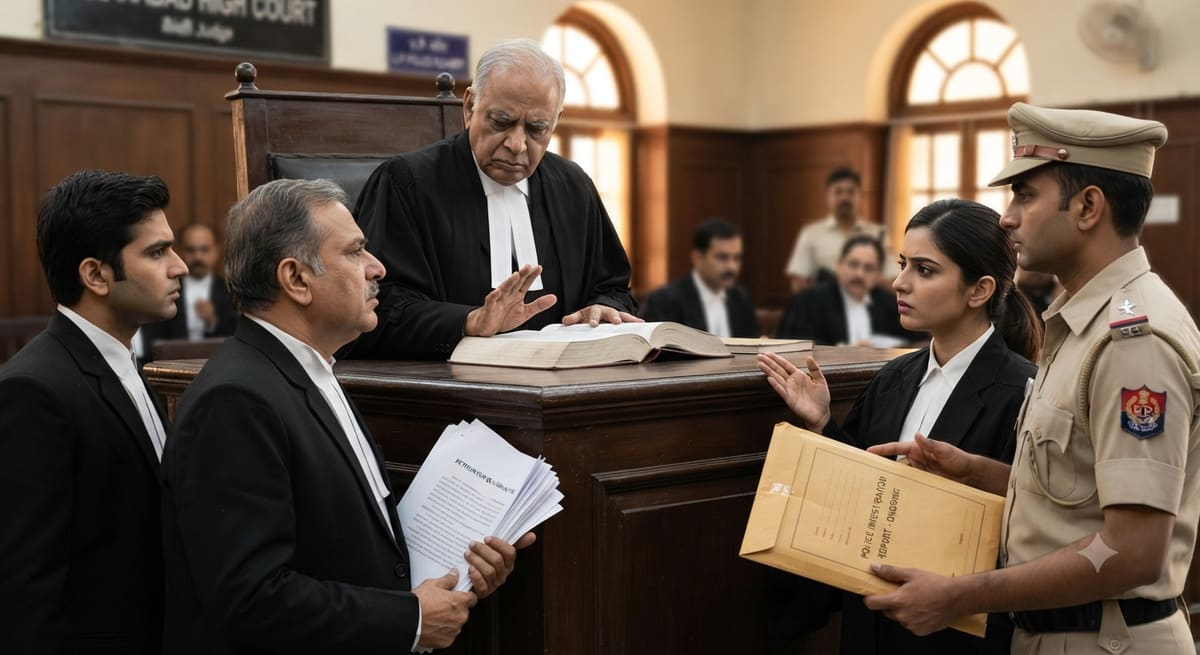
10.07.2026: Hearing conducted before Division Bench of Justices Ajay Bhanot and Divesh Chandra Samant
10.07.2026: Judgment delivered dismissing the writ petition
The Parties' Positions
For the Petitioner
The petitioner’s counsel, Shri Atul Kumar Giri, argued that the appointment was granted only after due verification of documents by the appointing authority. He contended that since the appointment process had already been completed and the petitioner had been serving for a period of time, the FIR was an abuse of process and should be quashed to prevent harassment.
For the Respondent
The Additional Government Advocate, Shri Ashish Kumar (Nagvanshi), submitted that the FIR disclosed a prima facie case of forgery and fraud. He emphasized that the university’s findings were conclusive and that the investigation was still in progress. He further argued that granting interim protection would obstruct the collection of evidence and compromise the integrity of the probe.
Relief Sought
The petitioner sought quashing of the FIR registered against him under Section 482 CrPC and Article 226 of the Constitution, arguing that no offence was made out and that the proceedings were maliciously initiated.
The Legal Issue
The central question was whether the High Court could quash an FIR under Section 482 CrPC or Article 226 of the Constitution where a prima facie case of forgery and fraud has been established during an ongoing investigation, and the accused has not yet applied for anticipatory bail.
Arguments Presented
For the Petitioner
The petitioner’s counsel relied on the principle that where the allegations, even if accepted at face value, do not constitute an offence, the court may exercise its inherent powers to quash the proceedings. He argued that since the appointment was granted after verification, the petitioner acted in good faith and the FIR was an afterthought designed to harass him. He contended that the matter was civil in nature and did not warrant criminal prosecution.
For the Respondent
The State countered that the forgery of educational documents to secure a public appointment constitutes a criminal offence under Sections 463, 464, 465, and 420 IPC. The A.G.A. emphasized that the university’s report was uncontroverted and established a clear case of fabrication. He cited State of Haryana v. Bhajan Lal and Neeharika Infrastructure Pvt. Ltd. v. State of Maharashtra to argue that courts must not interfere with investigations at the preliminary stage, especially when evidence is still being gathered and the accused has not sought anticipatory bail.
The Court's Analysis
The Division Bench undertook a detailed review of the Supreme Court’s jurisprudence on the exercise of inherent powers under Section 482 CrPC. It observed that the power to quash is extraordinary and must be exercised sparingly, as reiterated in Bhajan Lal. The Court noted that the seven categories enumerated in Bhajan Lal are illustrative and not exhaustive, but they collectively establish a high threshold for quashing.
"The power of quashing a criminal proceeding should be exercised very sparingly and with circumspection and that too in the rarest of rare cases; that the court will not be justified in embarking upon an enquiry as to the reliability or genuineness or otherwise of the allegations made in the FIR or the complaint."
The Court further relied on Neeharika Infrastructure, which held that interim orders staying investigation or granting protection from arrest during the pendency of a quashing petition must be avoided when the investigation is in progress and facts remain unclear. The Bench emphasized that the High Court is not a substitute for the investigative machinery and that the accused’s remedy lies in applying for anticipatory bail under Section 438 CrPC.
The Court found that the allegations in the FIR, if accepted at face value, clearly disclose a cognizable offence under the IPC. The forged degree, submitted to secure a public position, is not a mere civil dispute but a criminal act involving dishonest intent and deception. The fact that the appointment was granted after verification does not negate the criminality of the forgery itself.
The Court rejected the petitioner’s argument that the investigation was unnecessary or malicious, noting that the university’s findings were objective and unchallenged. It held that the State is entitled to complete its investigation, collect all evidence, and file a charge sheet before any judicial determination on the merits can be made.
The Verdict
The writ petition was dismissed. The High Court declined to quash the FIR and refused to grant any interim protection from arrest. The Court directed that the investigation shall proceed in accordance with law. The petitioner is at liberty to apply for anticipatory bail before the competent court under Section 438 CrPC.
What This Means For Similar Cases
Investigation Must Not Be Stalled by Quashing Petitions
Practitioners must advise clients to seek anticipatory bail under Section 438 CrPC rather than filing premature quashing petitions when investigation is ongoing
Courts will not entertain applications to halt investigations merely on the ground that the accused was appointed after verification
The burden shifts to the accused to demonstrate that the FIR is manifestly frivolous or mala fide, not merely that the facts are disputed
Prima Facie Forgery Triggers Criminal Proceeding
Submission of forged educational documents to secure government employment constitutes a clear case under Sections 463-465 and 420 IPC
Verification by the appointing authority does not immunize the accused from criminal liability if the documents were knowingly forged
The existence of a civil remedy (e.g., termination of service) does not bar criminal prosecution
Judicial Restraint in Interim Orders
High Courts must avoid granting "no arrest" or "no coercive steps" orders during investigation unless the case falls squarely within the Bhajan Lal exceptions
Interim protection should not be granted as a matter of routine, especially when the accused has not approached the court for anticipatory bail
The Neeharika principle now binds all High Courts to defer to the investigative process unless the FIR is legally unsustainable on its face