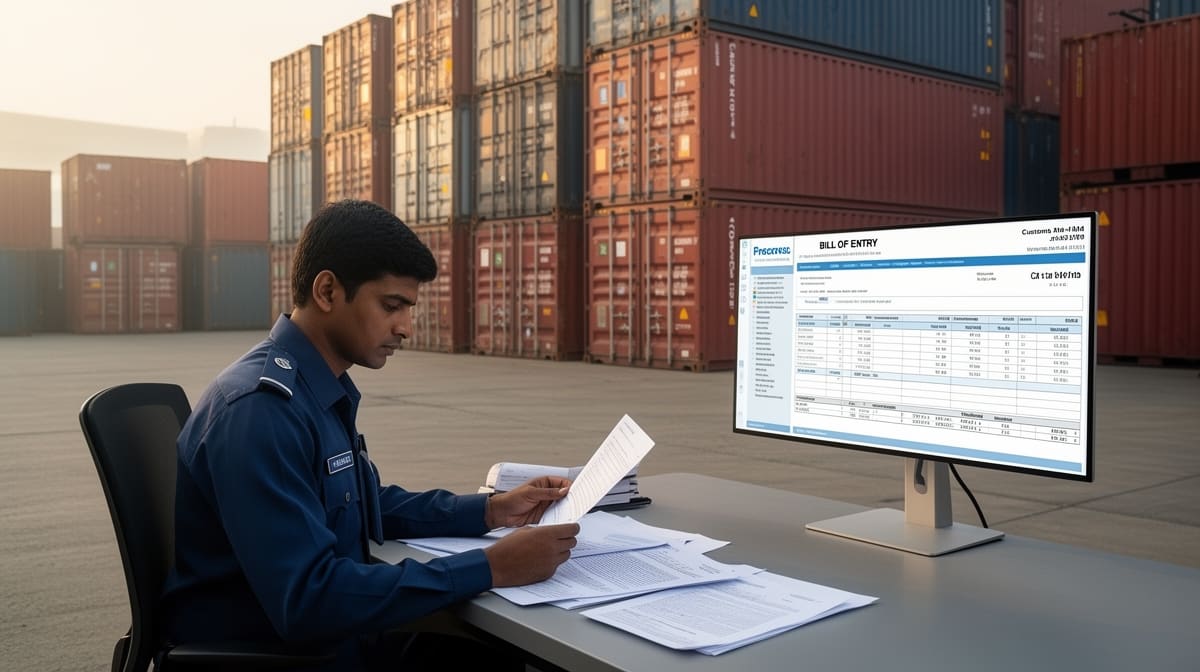
The Customs, Excise & Service Tax Appellate Tribunal, Kolkata Regional Bench, has clarified that late fees under Section 46 of the Customs Act, 1962, cannot be imposed mechanically when an importer files supplementary bills of entry to account for excess cargo discovered after clearance, provided there is no fault or mala fide on the importer’s part. This ruling reinforces the principle that statutory discretion to waive late fees must be exercised judiciously, not routinely.
Background & Facts
The Dispute
The appellant, M/s Agarwal Coal Corporation Pvt. Ltd., imported steam coal through Paradeep Port. After the original bills of entry were filed and goods cleared, a Draft Surveyor’s Report revealed excess quantities of coal remaining in the port area. The appellant sought to amend the Import General Manifest (IGM) and the original bills of entry to reflect the actual quantity, and offered to pay additional customs duty on the excess. The Proper Officer refused the amendment. Consequently, the appellant filed supplementary bills of entry to declare and pay duty on the excess coal.
Key Facts
- The original bills of entry were filed within the statutory time limit under Section 46(3) of the Customs Act, 1962
- Excess coal was identified post-clearance through Draft Surveyor’s Report
- Appellant requested amendment of IGM and original bills of entry on multiple occasions
- Proper Officer rejected amendment requests without assigning reasons
- Supplementary bills of entry were filed on the following dates:
- 03.10.2023 (for Bill of Entry No. 3674516)
- 04.10.2023 (for Bill of Entry No. 4047213)
- 08.11.2023 (for Bill of Entry No. 4116421)
- 25.01.2023 (for Bill of Entry No. 4342041 and 4342042)
- 27.09.2023 (for Bill of Entry No. 8034434)
- Late fees were automatically levied under Regulation 4(3) of the Bill of Entry (Electronic Integrated Declaration) Regulations, 2018, read with Section 46(3)
- Appellant paid the additional customs duty on the excess quantity as required
Procedural History
- 29.09.2023: Original bills of entry filed for steam coal consignments
- 03.10.2023 to 27.09.2023: Supplementary bills of entry filed for excess coal quantities
- 13.05.2024: Order-in-Appeal No. 14/CUS/CCP/2023 passed by Commissioner (Appeals), Bhubaneswar, upholding late fee imposition
- 13.05.2024: Order-in-Appeal No. 06-10/CUS/CCP/2024 passed by Commissioner (Appeals), Bhubaneswar, upholding late fee imposition in five other cases
- 29.05.2024: Order-in-Appeal No. 14/CUS/CCP/2023 issued for Appeal No. 76044/2024
- 06.06.2024: Notices of appeal filed before CESTAT Kolkata for six consolidated appeals
- 15.05.2026: Hearing held before CESTAT Kolkata
- 16.06.2026: Final Order pronounced
The Parties' Positions
For the Appellant
- Argued that the delay in filing supplementary bills of entry was not due to any fault, negligence, or mala fide on their part
- Emphasized that the excess cargo was discovered post-clearance and was part of the same consignment already declared
- Contended that the Proper Officer had a statutory duty under Section 46(3) to consider whether there was sufficient cause for delay
- Relied on Blueleaf Trading Company v. Commissioner of G.S.T. & C.Ex., Tiruchirapalli and the SOP dated 19.05.2023 issued by the Commissioner of Customs (Preventive), Bhubaneswar
- Asserted that the Revenue had previously accepted amendments in similar cases and collected duty without penalty
For the Respondent
- Maintained that supplementary bills of entry were filed beyond the statutory deadline
- Argued that the system automatically calculated late fees under Regulation 4(3)
- Did not dispute the bona fides of the appellant but contended that the law leaves no discretion to waive fees once the deadline is missed
- Relied on the mechanical application of the electronic system and the absence of a formal waiver application
Relief Sought
The appellant sought:
- Setting aside of late fees imposed under Regulation 4(3) of the Bill of Entry Regulations, 2018
- Waiver of late charges on all six supplementary bills of entry
- Consequential relief including refund of any paid late fees
The Legal Issue
The central question was whether Section 46(3) of the Customs Act, 1962, read with Regulation 4(3) of the Bill of Entry (Electronic Integrated Declaration) Regulations, 2018, mandates automatic imposition of late fees when supplementary bills of entry are filed after the statutory deadline, or whether the Proper Officer retains discretion to waive such fees where the delay arises from post-clearance discovery of excess cargo and there is no fault or mala fide on the part of the importer.
Arguments Presented
For the Appellant
The appellant relied on the proviso to Section 46(3), which permits waiver of late fees if the Proper Officer is satisfied that there was sufficient cause for delay. They cited Blueleaf Trading Company v. Commissioner of G.S.T. & C.Ex., Tiruchirapalli, where CESTAT Chennai held that late fees cannot be imposed mechanically when the delay stems from post-import developments beyond the importer’s control. The appellant also invoked the Standard Operating Procedure dated 19.05.2023, which directs officers not to impose penalties in a routine manner. They emphasized that the customs duty on the excess quantity was paid in full and that the Revenue had previously accepted similar amendments without penalty.
For the Respondent
The Respondent’s Authorized Representative argued that the filing of supplementary bills of entry after the statutory deadline triggered automatic liability under Regulation 4(3). They contended that the law does not permit retrospective amendment of bills of entry and that the system-generated late fee is non-negotiable unless a formal waiver application is made and approved. No specific statutory or judicial authority was cited to counter the appellant’s reliance on Blueleaf Trading Company or the SOP.
The Court's Analysis
The Tribunal examined the language of Section 46(3) and its second proviso, which states: "...the proper officer is satisfied that there was no sufficient cause for such delay, the importer shall pay such charges..." The Court emphasized that the statutory language is conditional: late fees are payable only if the Proper Officer is not satisfied that sufficient cause exists. The burden of non-satisfaction lies with the Revenue, not the importer.
"It is quite clear that the provisions of Section 46 ibid nowhere mandate charging of late fee for the delayed filing of Bill-of-Entry as fee is charged subject only to the 'non-satisfaction' of the proper officer and the Board's Instructions..."
The Tribunal noted that the appellant had filed original bills of entry within the stipulated time, and the excess cargo was discovered only after clearance through official survey. The appellant promptly sought amendment and offered to pay additional duty. There was no evidence of concealment, fraud, or intentional delay. The Revenue did not dispute the appellant’s bona fides.
The Court further relied on Circular No. 14/2017-Customs and the SOP dated 19.05.2023, which explicitly prohibit mechanical imposition of penalties. The Tribunal held that the Commissioner (Appeals) failed to apply their mind to the circumstances and treated the late fee as automatic, contrary to statutory intent.
The decision in Blueleaf Trading Company was found directly applicable: in both cases, the delay arose from post-import developments, the importer acted in good faith, and the Revenue collected the full duty. The Tribunal also referenced its own earlier decision in Kai International Pvt Ltd v. CC (Prev), Odisha, which set aside identical late fees on identical facts.
The Court concluded that the imposition of late fees in the absence of any fault or mala fide on the part of the importer, and where the duty on excess cargo was fully paid, was arbitrary and contrary to the spirit of Section 46(3).
The Verdict
The appellant succeeded. The Tribunal set aside the impugned orders dated 13.05.2024 and 29.05.2024 imposing late fees on all six supplementary bills of entry. The late fees levied under Regulation 4(3) of the Bill of Entry Regulations, 2018, are quashed in full. The appellant is entitled to a refund of any late fees already paid, to be processed within 45 days of the order. No costs were awarded.
What This Means For Similar Cases
Late Fees Are Not Automatic
- Practitioners must challenge automatic late fee assessments under Section 46(3) where delay arises from post-clearance discovery of excess cargo
- The burden shifts to the Revenue to prove lack of sufficient cause - mere passage of time is insufficient
- Electronic system-generated penalties cannot override statutory discretion under the proviso to Section 46(3)
Bona Fides Trump Procedural Non-Compliance
- Importers who act promptly upon discovering excess cargo and pay all due duties are protected under the law
- The Tribunal recognizes that customs operations involve logistical realities beyond the importer’s control
- Good faith conduct, including voluntary disclosure and payment of duty, must be rewarded, not penalized
SOPs and Circulars Are Binding on Officers
- Standard Operating Procedures issued by the Board or Commissionerates are not advisory but operational mandates
- Officers who ignore SOPs on penalty waiver risk having their orders set aside by appellate tribunals
- Practitioners should cite relevant SOPs and Circulars (e.g., Circular No. 14/2017) in appeals to reinforce arguments on discretion