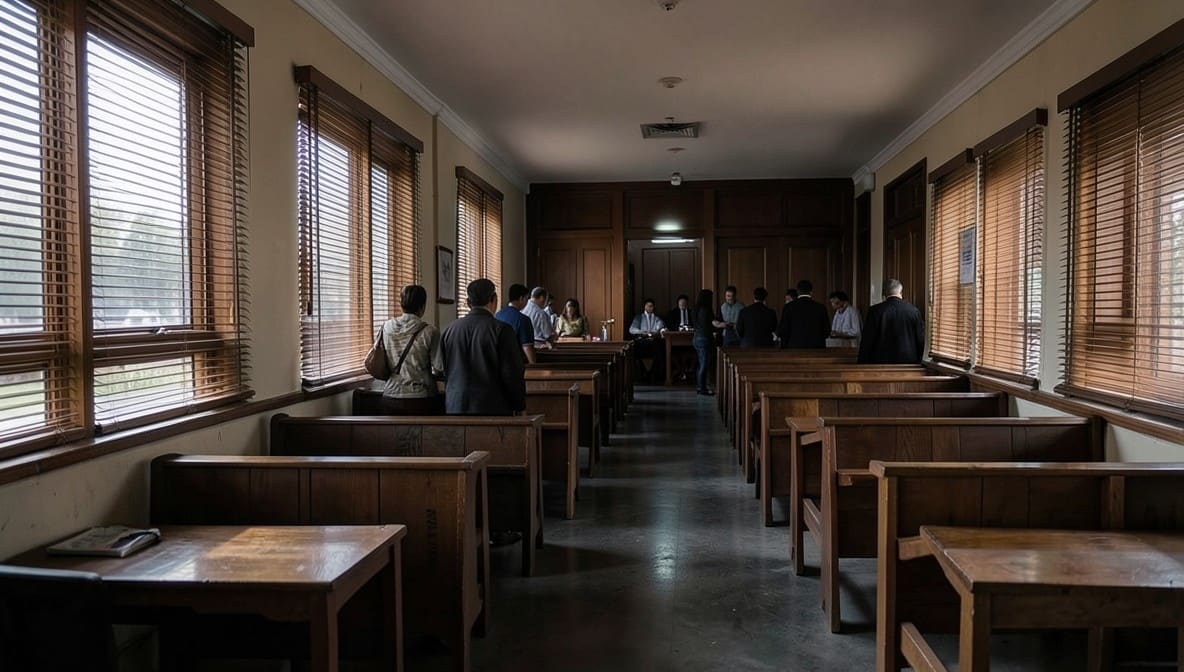
The Allahabad High Court has delivered a landmark directive curtailing the routine practice of remanding criminal revision matters to trial courts after already deciding the merits. This judgment establishes a critical doctrinal boundary: once a revisional court applies its judicial mind and records findings on the substantive issues, it must conclude the matter rather than perpetuate litigation through mechanical remands. The ruling reinforces the principle that revisional jurisdiction is supervisory, not appellate, and demands finality where the record permits.
Background & Facts
The Dispute
The dispute centers on a property conflict between Kundan Singh (petitioner) and Dhruv Singh (respondent) over a marriage hall named Kundan Vatika in Mathura. Kundan Singh, the owner, constructed the facility on his land and permitted Dhruv Singh, a security guard, to occupy one room. Dhruv Singh later claimed ownership of the entire property, asserting he had purchased it from Kundan Singh. The electricity and water connections remain in Kundan Singh’s name. The conflict escalated into a potential breach of peace, prompting Kundan Singh to file a complaint under Section 145 Cr.P.C. before the City Magistrate, Mathura.
Key Facts
- The disputed property includes rooms, a hall, and a field owned by Kundan Singh
- Dhruv Singh began residing in one room as a security guard
- Dhruv Singh filed a civil suit (Civil Suit No. 874 of 2019) seeking declaration of ownership and possession
- On 25.09.2023, the Civil Judge (Junior Division), Mathura, directed both parties to maintain status quo
- The City Magistrate, on 15.07.2021, received a police report confirming mutual claims and risk of violence
- On 10.08.2021, the City Magistrate ordered attachment of the property and its custody with a neutral person to prevent unrest
- Dhruv Singh filed a recall application on 30.09.2021, which was dismissed on 26.12.2024 after the Magistrate considered the pending civil suit and status quo order
- On 07.01.2025, Dhruv Singh filed Criminal Revision No. 32 of 2025 before the Additional Sessions Judge, Mathura, invoking Section 5 of the Limitation Act, 1963
- On 09.09.2025, the Revisional Court allowed the limitation application, set aside the Magistrate’s orders, and remanded the matter for fresh consideration
Procedural History
- 15.07.2021: Police report submitted to City Magistrate confirming risk of breach of peace
- 10.08.2021: City Magistrate orders attachment and neutral custody of property
- 30.09.2021: Respondent files application for recall of 10.08.2021 order
- 23.11.2024: Fresh police report submitted, referencing pending civil suit and status quo order
- 26.12.2024: City Magistrate dismisses recall application
- 07.01.2025: Criminal Revision No. 32 of 2025 filed before Additional Sessions Judge
- 09.09.2025: Revisional Court allows limitation application, sets aside Magistrate’s orders, and remands for fresh decision
- 29.05.2026: Allahabad High Court hears connected petitions and delivers judgment
The Parties' Positions
For the Petitioner (Kundan Singh)
- Argued that the City Magistrate acted lawfully under Section 145 Cr.P.C. to preserve peace amid conflicting claims
- Emphasized that the civil suit was pending and had not determined ownership
- Contended that the revisional court’s remand was unnecessary after it had already concluded the Magistrate’s order was legally flawed
For the Respondent (Dhruv Singh)
- Argued that the Magistrate had no jurisdiction to decide ownership rights, which were exclusively within the civil court’s domain
- Relied on precedents such as Vinay Tyagi v. Irshad Ali and Amit Kapur v. Ramesh Chander to support the view that criminal proceedings under Section 145 Cr.P.C. cannot determine title
- Sought remand to allow the Magistrate to reconsider in light of the civil court’s status quo order
Relief Sought
The petitioner sought quashing of the revisional order dated 09.09.2025 and restoration of the City Magistrate’s orders dated 10.08.2021 and 26.12.2024. The High Court, in its broader consideration, was also asked to lay down binding guidelines to prevent routine remands in similar cases.
The Legal Issue
The central question was whether a Revisional Court, after examining the merits of a dispute under Section 145 Cr.P.C., recording findings on ownership and jurisdictional competence, and setting aside the subordinate court’s order, is legally justified in remanding the matter for fresh adjudication without compelling necessity.
Arguments Presented
For the Petitioner
The petitioner’s counsel, supported by the Amicus Curiae, argued that the Revisional Court had already determined that the Magistrate’s order was legally sound and that the civil suit’s pendency did not bar interim protective measures under Section 145 Cr.P.C. They cited Suvej Singh v. Ram Naresh & Ors. and M.C. Mehta v. Union of India to emphasize judicial economy and the duty to avoid multiplicity of proceedings. They contended that the Revisional Court’s findings on the merits rendered remand redundant and contrary to the supervisory nature of revisional jurisdiction.
For the Respondent
The State, through the Additional Government Advocate, did not contest the legal principle but defended the remand as a procedural safeguard. They argued that since the civil court had directed status quo, the Magistrate should reconsider the attachment order in light of that development. However, they offered no precedent supporting routine remands after merits were decided.
The Court's Analysis
The High Court undertook a comprehensive review of the nature and scope of revisional jurisdiction under Section 438 BNSS, 2023 (corresponding to Section 397 Cr.P.C.) and Section 442 BNSS, 2023 (corresponding to Section 401 Cr.P.C.). It emphasized that revisional jurisdiction is not an appellate forum but a supervisory mechanism to correct jurisdictional errors, patent illegality, or gross miscarriage of justice.
"The power of remand must therefore be exercised sparingly and only in cases where the ends of justice genuinely require reconsideration of material issues that could not have been adequately addressed earlier."
The Court observed that the Revisional Court in the present case had already concluded that the Magistrate’s order was not erroneous, that the civil suit’s pendency did not invalidate the protective attachment, and that the Magistrate had acted within his powers. Yet, despite these findings, the Revisional Court remanded the matter for fresh consideration without assigning any legal or factual reason why it could not finally dispose of the matter.
The Court further noted that this was not an isolated incident but a systemic pattern across Uttar Pradesh, where revisional courts routinely set aside orders and remand them for fresh adjudication after having already expressed their views on the merits. This practice, the Court held, violates the doctrine of finality of litigation and creates a vicious cycle of litigation.
"Repeated remands merely burden the judicial system and yield no meaningful relief to litigants."
The Court distinguished between remand as an exception - where evidence is incomplete or procedural irregularity prevents final adjudication - and remand as a default, which it condemned as judicial abdication. It held that once a revisional court has applied its mind, heard the parties, and recorded findings, it is duty-bound to render a conclusive order unless exceptional circumstances exist.
The Court also referenced constitutional principles from M.C. Mehta v. Union of India and State of U.P. v. Sudhir Kumar Singh, underscoring that judicial efficiency and timely justice are fundamental to the rule of law.
The Verdict
The Allahabad High Court set aside the revisional order dated 09.09.2025 and restored the City Magistrate’s orders dated 10.08.2021 and 26.12.2024. In all ten connected matters, the revisional orders were quashed. The Court directed that no further remand shall be ordered in cases under Section 164 BNSS, 2023 or Section 175(3) BNSS, 2023 where the revisional court has already examined the merits. The State’s District Judges are directed to conduct mandatory training sessions, and the Judicial Training and Research Institute, Lucknow, must incorporate this principle into all judicial training programs.
What This Means For Similar Cases
Remand Is an Exception, Not the Rule
- Practitioners must now challenge any revisional order that remands a matter after merits have been decided, citing this judgment as binding precedent
- A revisional court’s failure to record reasons for remand renders the order liable to be set aside
- Applications under Section 5 of the Limitation Act cannot be used to justify remand where the substantive issue has been adjudicated
Judicial Economy Must Prevail
- Lawyers should move for final disposal in revision petitions once the court has expressed its view on the merits
- Courts must avoid directing fresh hearings unless the record is demonstrably inadequate or a procedural flaw prevents finality
- This judgment provides a strong basis to oppose repeated litigation cycles in property disputes under Section 145 Cr.P.C.
Clarification on Civil-Criminal Overlap
- The pendency of a civil suit does not automatically bar interim protective orders under Section 145 Cr.P.C.
- Criminal courts may act to preserve status quo pending civil adjudication, provided the action is limited to preventing breach of peace
- The civil court’s status quo order is a relevant factor but not a conclusive bar to criminal intervention