The Madhya Pradesh High Court has reaffirmed a foundational principle of criminal procedure: revisional jurisdiction cannot be invoked against interlocutory orders, even in cases involving serious allegations like cheque dishonour. This ruling clarifies the limits of appellate and revisional powers in pending criminal proceedings, offering critical guidance to practitioners navigating procedural hurdles in Section 138 NI Act cases.
Background & Facts
The Dispute
The dispute arose in the context of a criminal complaint filed under Section 138 of the Negotiable Instruments Act, 1881, by Abhishek Construction, proprietor Abhishek Shukla, against Punjab National Bank for dishonour of a cheque. The complaint was registered as SC-NIA No. 404/2019 before the Judicial Magistrate First Class, Betul.
Key Facts
- The complainant alleged that a cheque issued by the Bank was dishonoured due to insufficient funds
- During the pendency of the complaint case, the Bank filed an application under Section 91 of the Code of Criminal Procedure, 1973, seeking production of certain documents relevant to the transaction
- The documents sought included internal bank records, signature verification logs, and communication trails related to the cheque issuance
- The complainant opposed the application, arguing that the documents were irrelevant and sought to delay proceedings
- The Trial Court, by order dated 04.11.2025, allowed the Bank’s application under Section 91 CrPC and directed production of the documents
Procedural History
- 04.11.2025: Judicial Magistrate First Class, Betul, allowed the Bank’s application under Section 91 CrPC for production of documents
- 04.12.2025: Complainant filed Criminal Revision No. 49/2025 before the Additional Sessions Judge, Betul, challenging the Trial Court’s order
- 04.02.2026: Additional Sessions Judge allowed the revision, set aside the Trial Court’s order, and directed that the documents not be produced
- 20.03.2026: Notice to respondent was delivered via India Post
- 23.03.2026: Present petition filed under Section 528 of the Bharatiya Nagarik Suraksha Sanhita, 2023 (BNSS), before the High Court at Jabalpur
Relief Sought
The petitioner-Bank sought quashing of the order dated 04.02.2026 passed by the Additional Sessions Judge, restoration of the Trial Court’s order dated 04.11.2025, and a direction that the documents be produced as originally directed.
The Legal Issue
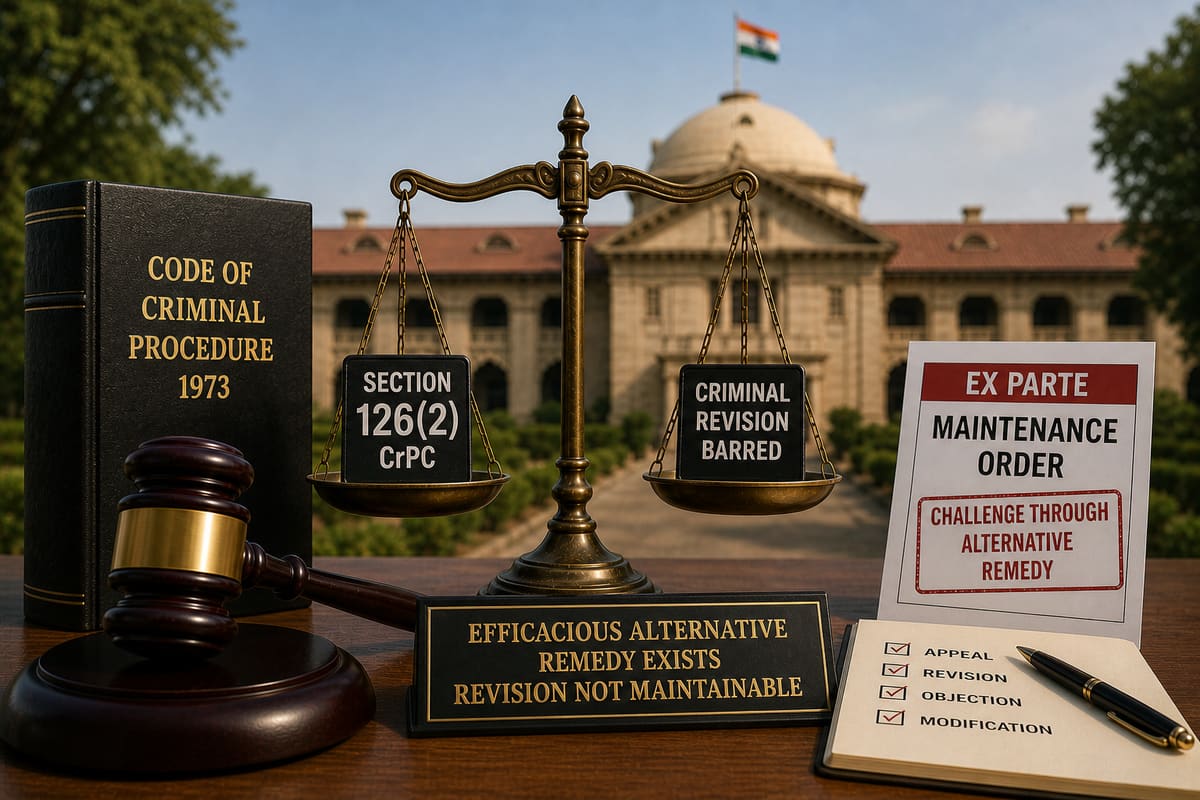
The central question was whether a revision petition under Section 397 CrPC is maintainable against an interlocutory order passed under Section 91 CrPC directing production of documents during the pendency of a criminal trial.
Arguments Presented
For the Petitioner
Learned counsel for the Bank argued that the order dated 04.11.2025 was purely interlocutory, as it did not finally determine any right or liability of the parties but merely facilitated evidence collection. Reliance was placed on Seturaman v. Rajamanickam, 2009 (65) ACC 607 (SC), which held that revision is barred against interlocutory orders under Section 397(2) CrPC. The counsel also cited the coordinate bench’s decision in Jabbar Khan v. Irshad Khan, decided on 23.06.2023, which followed the same principle.
For the Respondent
The respondent did not appear or file any written submissions. The Court proceeded on the basis of the record and the petitioner’s arguments.
The Court's Analysis
The Court examined the nature of the order passed under Section 91 CrPC. It observed that such an order is procedural, temporary, and does not conclude the rights of any party. It merely facilitates the production of documents that may assist in the trial’s progress. The Court emphasized that Section 397(2) CrPC explicitly bars revision against interlocutory orders, a bar that continues under Section 528 of BNSS, 2023.
"The Trial Court, in its common order, had clearly mentioned that the cheque was admittedly signed by the respondent/accused and the only defence that was raised, was that his signed cheques were lost and that the appellant/complainant had falsely used one such cheque. The Trial Court also recorded a finding that the documents were not necessary. This order did not, in any manner, decide anything finally. Therefore, both the orders, i.e., one on the application under Section 91 Cr.P.C. for production of documents and other on the application under Section 311 Cr.P.C. for recalling the witness, were the orders of interlocutory nature, in which case, under Section 397(2), revision was clearly not maintainable."
The Court held that the Sessions Judge erred in entertaining the revision petition, as the order under Section 91 CrPC was not a final order and did not cause irreparable prejudice. The revisional court’s interference was therefore a clear violation of the statutory bar under Section 397(2) CrPC, now carried forward under BNSS, 2023.
The Verdict
The petition was allowed. The order dated 04.02.2026 passed by the Additional Sessions Judge in CRR No. 49/2025 is set aside. The order dated 04.11.2025 of the Trial Court, directing production of documents under Section 91 CrPC, is restored. The respondent shall comply with the production order within 14 days from the date of this judgment. Certified copies shall be issued as per rules.
What This Means For Similar Cases
Interlocutory Orders Are Beyond Revisional Reach
- Practitioners must immediately challenge any revision petition filed against orders under Sections 91, 311, or 156(3) CrPC on grounds of non-maintainability
- Courts must reject such revisions at the threshold without entering into merits
- This applies equally under BNSS, 2023, which retains the prohibition under Section 528
Strategic Use of Section 91 CrPC in Cheque Dishonour Cases
- Banks and financial institutions can now confidently seek production of internal records without fear of revisional interference
- Defence counsel cannot use revision petitions to stall evidence collection in Section 138 cases
- The ruling reinforces that procedural fairness does not require final adjudication at the pre-trial stage
Procedural Discipline in Criminal Courts
- Trial courts must clearly record whether an order is interlocutory or final
- Revisional courts must conduct a preliminary inquiry into the nature of the order before entertaining petitions
- This judgment closes a common loophole used to delay trials under the guise of revisional jurisdiction