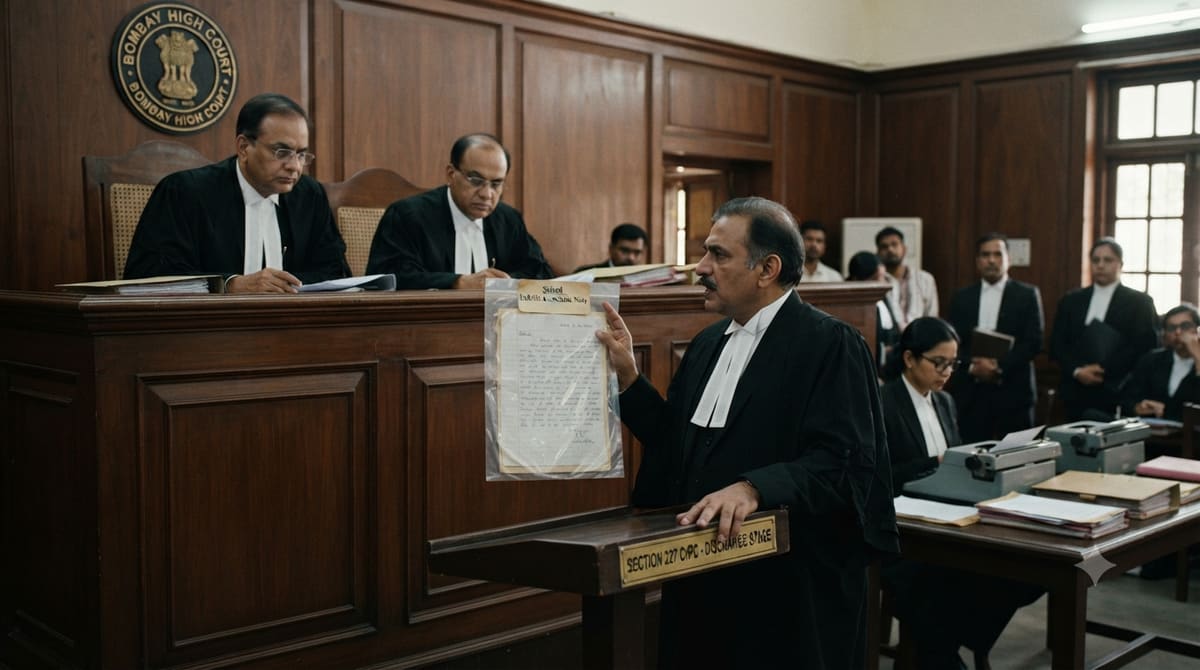
The Bombay High Court has set aside an appellate court order that refused to record evidence of a mentally ill accused under Section 391 of the Criminal Procedure Code. The Court held that the appellate forum must consider the evidence of a treating psychiatrist where the accused's mental illness is prima facie evident from the record.
Background & Facts
The Dispute
The petitioner, Irshadoor Hafizoor Rehman, was convicted in a criminal case and filed Criminal Appeal No. 757 of 2019 before the Additional Sessions Judge, Greater Mumbai. During the appeal, the petitioner sought to examine Dr. Machiswala, a psychiatrist who had treated him for mental illness, under Section 391 of the Criminal Procedure Code, 1973.
Key Facts
- The petitioner was treated by Dr. Machiswala for Bipolar Mood Disorder and Schizoaffective Features as recorded in the Investigating Officer's statement during cross-examination of PW-13 (Investigating Officer).
- The petitioner's statement under Section 313 CrPC did not mention his mental illness.
- The Additional Sessions Judge, by order dated 04.03.2023, rejected the application under Section 391 CrPC, observing that there was no suggestion of mental illness in the accused's statement.
- The petitioner challenged this order before the Bombay High Court via Writ Petition No. 862 of 2026.
Procedural History
- 04.03.2023: Additional Sessions Judge, Greater Mumbai, dismissed the application under Section 391 CrPC (Exhibit 4 in Criminal Appeal No. 757 of 2019).
- 06.03.2026: Learned Single Judge of the Bombay High Court issued notice and permitted adjournment before the appellate court.
- 21.07.2026: Present judgment delivered by the Division Bench.
Relief Sought
The petitioner sought quashing of the order dated 04.03.2023 and restoration of the application under Section 391 CrPC for fresh consideration.
The Legal Issue
The central question was whether the appellate court, while considering an application under Section 391 CrPC, could disregard evidence of the accused's mental illness recorded by the Investigating Officer and reflected in the cross-examination of the IO, merely because the accused did not mention it in his Section 313 CrPC statement.
Arguments Presented
For the Appellant/Petitioner
The petitioner's counsel argued that the appellate court erred in ignoring the Investigating Officer's statement, which clearly indicated that Dr. Machiswala had treated the accused for serious mental health conditions. The counsel contended that the appellate forum must consider such evidence where the accused's mental state is relevant to the appeal.
For the Respondent/State
The State, through the learned APP, did not file any substantive counter-affidavit or contest the factual assertion regarding the accused's mental illness. The State's presence was limited to procedural compliance.
The Court's Analysis
The Court examined the impugned order and noted that the Additional Sessions Judge had concluded that there was no suggestion of mental illness in the accused's statement under Section 313 CrPC. However, the Court observed that the Investigating Officer's cross-examination clearly recorded that Dr. Machiswala had treated the accused for Bipolar Mood Disorder and Schizoaffective Features.
The Court held that the appellate forum cannot ignore such material on record merely because the accused did not mention it in his Section 313 CrPC statement. The Court emphasized that the purpose of Section 391 CrPC is to enable the court to secure the attendance of witnesses whose evidence is necessary for the just decision of the case.
"Thus, the observations of the learned Appellate Court in the impugned order are contrary to the record."
The Court further clarified that all contentions of the parties remain open and that the application shall be reconsidered afresh by the Sessions Judge in accordance with law.
The Verdict
The writ petition was allowed. The Court quashed and set aside the order dated 04.03.2023 passed by the Additional Sessions Judge, Greater Mumbai. The application under Section 391 CrPC (Exhibit 4 in Criminal Appeal No. 757 of 2019) was restored to the file of the learned Sessions Judge for fresh consideration and disposal in accordance with law. All contentions of the parties were expressly kept open.
What This Means For Similar Cases
Mental Health Evidence Cannot Be Ignored
- Courts must consider all relevant evidence on record, including medical records and witness statements, even if not explicitly mentioned in the accused's Section 313 CrPC statement.
- The appellate forum cannot disregard prima facie evidence of mental illness solely because the accused did not raise it during examination.
Section 391 CrPC Is Not Merely Procedural
- The provision empowers courts to secure evidence necessary for a just decision.
- Appellate courts must apply their mind to such applications and not reject them on flimsy grounds.
Preserve All Contentions
- Courts must ensure that all legal contentions remain open during reconsideration to prevent prejudice to either party.
Role of Investigating Officer's Evidence
- The IO's cross-examination can form a crucial part of the record and must be considered where relevant to the accused's mental state or other defenses.