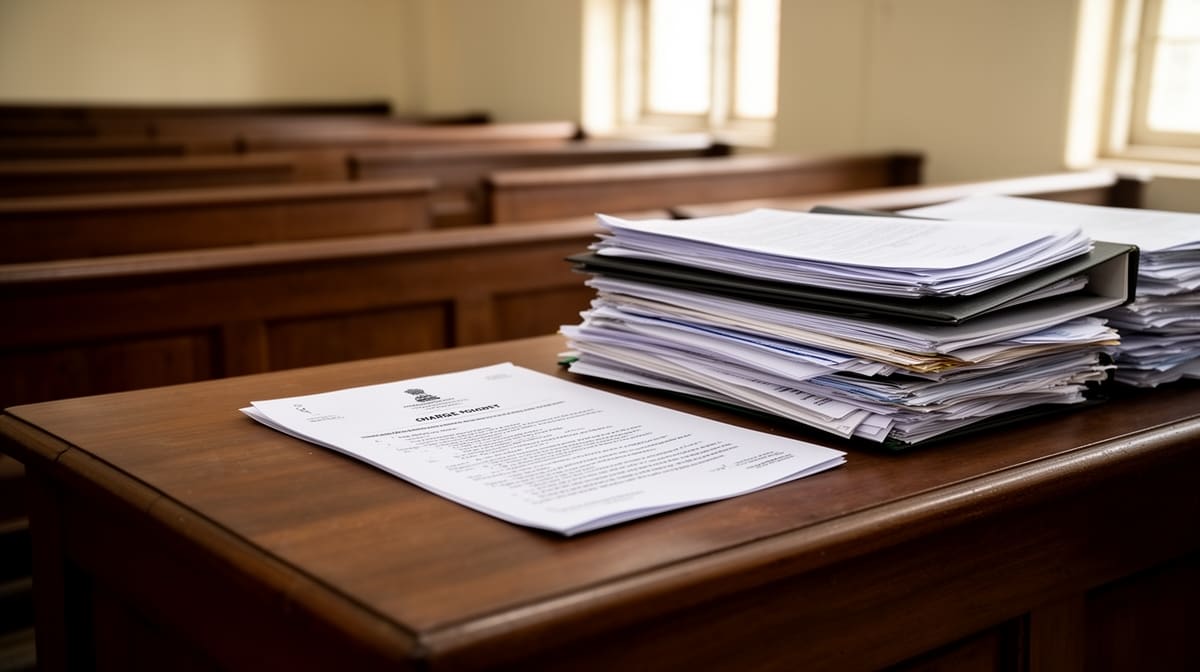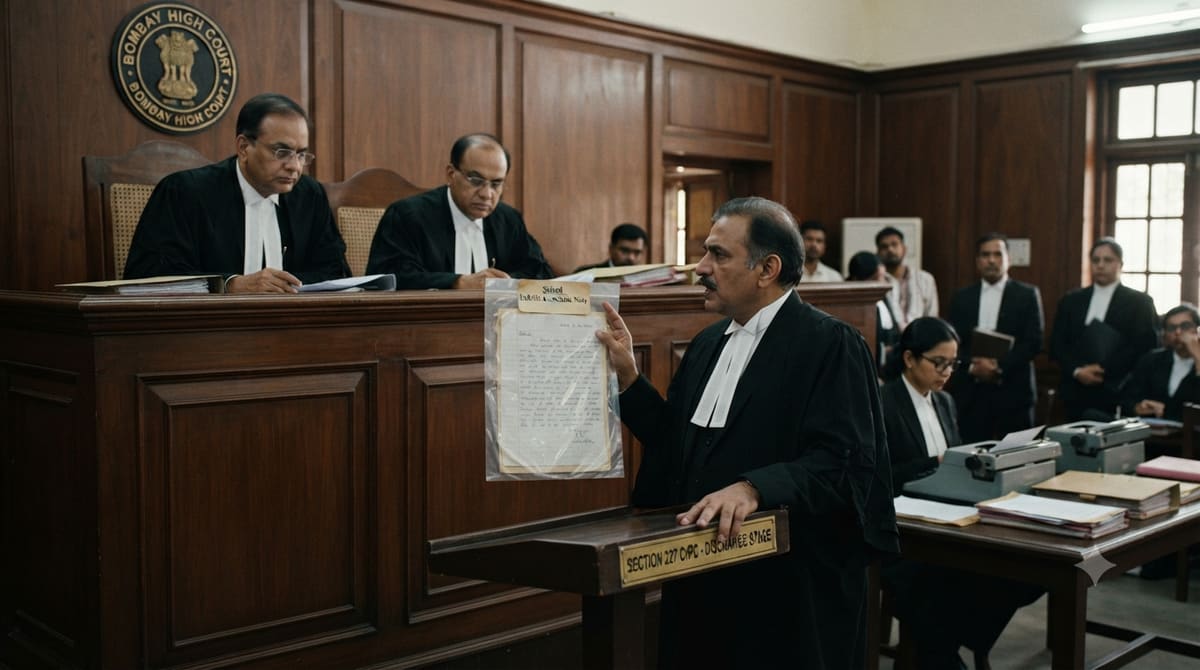
The Bombay High Court has clarified that a suicide note seized at the crime scene and documented in the spot panchnama constitutes material evidence that must be produced at the discharge stage under Section 227 of the Code of Criminal Procedure. This ruling reinforces the principle that procedural fairness demands access to all seized evidence, even if not formally included in the charge sheet, when it bears directly on the accused’s potential innocence.
Background & Facts
The Dispute
The petitioner, Rakhi Makhanlal Patra @ Rakhi Rakesh Belel, is accused in Sessions Case No. 387 of 2018 arising from the death of a person on 22nd May 2017. The prosecution alleges culpable homicide not amounting to murder. The petitioner filed an application under Section 227 CrPC seeking discharge, arguing that the evidence against her is insufficient. A critical piece of evidence referenced in the investigation but not included in the charge sheet is a suicide note allegedly found at the scene.
Key Facts
The deceased was found dead on 22nd May 2017 at a residence in Kalyan, Thane
The spot panchnama dated 22nd May 2017 (pages 54 - 57) records the recovery of a handwritten note at the scene, explicitly stating: "A suicide note was found near the body and seized"
The suicide note was not annexed to the charge sheet filed on 15th October 2017
The petitioner’s counsel requested production of the note on 10th June 2026, arguing it could establish the deceased’s intent and negate mens rea
The Trial Court rejected the request on 29th June 2026, holding that at discharge stage, the court need only examine whether a prima facie case exists
Procedural History
22.05.2017: Incident occurred; spot panchnama prepared; suicide note seized
15.10.2017: Charge sheet filed under Sections 304A and 498A IPC; suicide note not included
10.06.2026: Petitioner filed Application under Section 227 CrPC seeking production of suicide note
29.06.2026: Sessions Court, Kalyan, rejected application; impugned order dated 29.06.2026 (Exhibit-16)
15.07.2026: Writ Petition No. 3464 of 2026 filed before Bombay High Court
Relief Sought
The petitioner sought quashing of the order dated 29.06.2026 and a direction to the Investigating Officer to produce the suicide note seized on 22.05.2017 before the Trial Court for consideration at the discharge stage.
The Legal Issue
The central question was whether, at the stage of discharge under Section 227 of the Code of Criminal Procedure, the Trial Court is obligated to permit production of a document seized during investigation and referenced in the spot panchnama, even if not included in the charge sheet, when it is material to the accused’s defence.
Arguments Presented
For the Petitioner
Learned counsel argued that the suicide note, being seized and recorded in the spot panchnama, forms part of the investigation record under Section 173 CrPC. Its exclusion from the charge sheet does not negate its evidentiary value. Reliance was placed on State of Haryana v. Bhagwan Das and Rajesh Kumar v. State of Haryana, which hold that the court must consider all material available to the prosecution at discharge stage. The note could indicate the deceased’s state of mind and potentially rebut the prosecution’s case of intentional harm.
For the Respondent/State
The Additional Public Prosecutor contended that the Trial Court correctly applied the law, as Section 227 CrPC only requires a prima facie assessment based on the charge sheet and accompanying documents. The note, not being part of the charge sheet, was not required to be produced. The court’s role at discharge is not to conduct a mini-trial, and allowing production of unfiled documents would blur procedural boundaries.
The Court's Analysis
The Court rejected the State’s narrow interpretation of Section 227 CrPC. It emphasized that the provision does not restrict the court to documents formally annexed to the charge sheet, but rather to the entire record of the case compiled under Section 173 CrPC. The Court noted that the spot panchnama is a statutory document under Section 164 CrPC, and its mention of the suicide note renders the document part of the investigation record.
"The fact that the suicide note was seized and recorded in the spot panchnama makes it an integral part of the investigation record. To deny its production at the discharge stage, when it directly relates to the accused’s potential innocence, would be a denial of natural justice."
The Court further held that the Trial Court’s refusal to permit production of the note amounted to a failure to consider all relevant material, which is contrary to the spirit of fair trial enshrined in Article 21 of the Constitution. The Court distinguished State of Maharashtra v. Suresh (2019), which dealt with irrelevant documents, noting that here the note was directly connected to the cause of death and the accused’s state of mind.
The Verdict
The writ petition was allowed. The order dated 29th June 2026 of the Sessions Court, Kalyan, was quashed and set aside. The Investigating Officer is directed to produce the suicide note seized during the spot panchnama dated 22nd May 2017 before the Trial Court within 14 days. The Trial Court shall consider the note in the discharge proceedings under Section 227 CrPC. No order as to costs.
What This Means For Similar Cases
Evidence Seized But Not Annexed Must Be Considered
Practitioners must now routinely request production of all seized items referenced in panchnamas, even if absent from the charge sheet
Failure to produce such material at discharge stage may be challenged via writ petition
The burden shifts to the prosecution to justify non-production of seized evidence with clear, documented reasons
Discharge Stage Is Not a Procedural Black Box
Courts must examine the full investigation record, including panchnamas, seizure memos, and recovery reports
The phrase "record of the case" under Section 227 CrPC includes all documents collected during investigation, not merely those formally filed
Defence counsel should file applications under Section 227 CrPC specifically listing seized items referenced in panchnamas and demand their production
Natural Justice Trumps Technical Omissions
The exclusion of a material document from the charge sheet does not extinguish its evidentiary value
Courts must act as guardians of fair procedure, not procedural formalists
This judgment reinforces that the right to a fair trial under Article 21 overrides rigid adherence to procedural technicalities