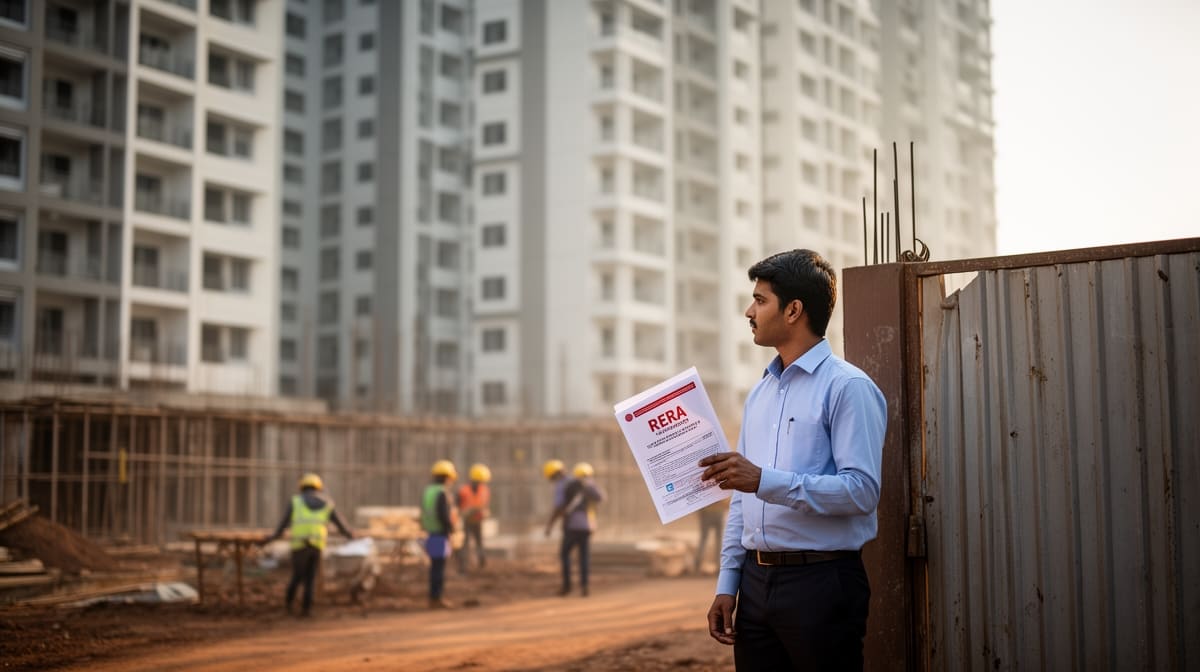
The Delhi High Court dismissed two appeals by Omaxe Ltd., affirming arbitral awards that held the builder liable for delayed possession and ordered compensation, thereby delineating the narrow scope of judicial interference under Section 37(1)(c) of the Arbitration and Conciliation Act, 1996.
Background & Facts
The Dispute
The appellant, Omaxe Ltd., entered into separate Builder-Buyer Agreements (BBAs) with the respondent, Asha Saini, for two flats in the Omaxe North Avenue project, Bahadurgarh, Haryana. The core contention was the delay in handing over possession of the flats and the consequent entitlement to compensation.
Key Facts
- 21.03.2006: Booking Application Form filed for Flat No. 706, Petronas Tower.
- 23.03.2006: Booking Application Form filed for Flat No. 602, Empire Tower.
- September 2008: Draft BBAs forwarded to the respondent.
- 09.02.2012: BBA executed for Flat No. 706.
- 02.02.2012: BBA executed for Flat No. 602.
- March 2006 - January 2009: Respondent paid the entire base price under the Construction Linked Plan.
- October 2012: Legal notices issued by respondent alleging delay.
- January 2014: Offer of possession made by appellant.
- 08.01.2014: Sale deeds executed; respondent took possession.
- 26.12.2018: Sole Arbitrator awarded damages, interest, refund of over-charged interest and costs.
- 11.02.2019: Arbitrator modified award, enhancing damages.
- 25.01.2017: Additional District Judge ordered reference to arbitration under Section 8 of the Act.
- 12.12.2017: Delhi International Arbitration Centre appointed Sole Arbitrator.
- 22.08.2017: Respondent invoked arbitration clause.
- 11.01.2022: District Judge dismissed Section 34 petitions and upheld arbitral awards.
- 14.08.2026: Delhi High Court delivered judgment dismissing appeals.
Procedural History
- OMP (Comm.) No. 53/2019: Section 34 petition filed by appellant for Flat No. 706.
- OMP (Comm.) No. 50/2019: Section 34 petition filed by appellant for Flat No. 602.
- 11.01.2022: District Judge (Commercial Court, South-East District, Saket) dismissed both petitions and affirmed awards.
- FAO (COMM) 53/2022: Appeal filed by appellant, treated as lead appeal.
- FAO (COMM) 91/2022: Parallel appeal filed by appellant.
- 14.08.2026: High Court delivered judgment dismissing both appeals.
Relief Sought
The appellant sought setting aside of the arbitral awards on grounds of contractual interpretation, excess of jurisdiction, and violation of public policy, invoking Sections 34 and 37 of the Arbitration Act.
The Legal Issue
What is the proper scope of judicial interference under Section 37(1)(c) of the Arbitration and Conciliation Act, 1996 when an arbitral award determines the commencement of contractual obligations and awards compensation for delayed possession in a builder-buyer dispute?
Arguments Presented
For the Appellant
- Contended that the arbitral tribunal wrongly treated the BBAs as a continuation of the 2006 booking applications, thereby mis-calculating the contractual period for possession.
- Asserted that the award of damages at 15 % per annum exceeded the contractual rate of Rs 5 per sq ft stipulated in Clause 21 of the BBAs.
- Invoked Sections 7, 10, 55, 62, 73 and 74 of the Indian Contract Act, 1872 and Sections 91, 92 and 115 of the Indian Evidence Act, 1872, claiming the award contravened statutory provisions and public policy.
- Alleged that the respondent’s delay in executing the BBAs pre-empted any liability for the period between March 2006 and February 2012.
For the Respondent
- Maintained that the contractual relationship arose on the date of the booking application (23 March 2006) and that the BBAs could not alter the agreed 30-month possession period.
- Supported the arbitral finding that the respondent suffered loss due to the appellant’s unjustified delay, invoking Section 55 of the Indian Contract Act, 1872, Section 18 of RERA 2016, and Section 21 of the Consumer Protection Act, 2019.
- Relied on precedents such as Kailash Nath Associates v. DDA and Arifur Rahman Khan v. DLF Southern Homes to justify compensation at a rate higher than the contractual stipulation.
- Argued that the scope of interference under Section 37 is extremely limited and that the award was a lawful exercise of the arbitrator’s jurisdiction.
The Court's Analysis
The Court first examined whether the arbitral tribunal had exceeded its jurisdiction under Section 28 of the Act. It observed that the arbitrator’s determination that the contract commenced on 23 March 2006 was grounded in the booking application, acceptance of the booking amount of Rs 4,53,750, and subsequent payments under the Construction Linked Plan. The Court held that this factual finding was a finding of fact grounded in evidence and therefore not amenable to interference.
"The award of compensation, therefore, does not suffer from any patent illegality warranting interference by this Court."
The Court reiterated that Section 37(1)(c) permits interference only on limited grounds such as violation of public policy or excess of jurisdiction. It found no breach of public policy; the award of 15 % interest was consistent with Supreme Court and National Consumer Forum precedents, notably Pioneer Urban Land & Infrastructure Ltd. v. Govindan Raghavan and Arifur Rahman Khan v. DLF Southern Homes.
Regarding limitation, the Court accepted the arbitrator’s view that the cause of action crystallised on actual possession (08 January 2014) and that the period spent by the respondent in a civil suit was excluded from limitation computation. This approach was deemed plausible and within the arbitrator’s discretion.
The Court also addressed the appellant’s claim that the BBAs could not extend the possession period. It held that the BBAs were merely a continuation of the earlier contract and could not unilaterally alter the agreed 30-month timeline. Consequently, the appellant was liable for delay from 23 March 2006 to 08 January 2014.
Finally, the Court noted that the District Judge’s concurrence with the arbitrator’s findings required no independent reasoning, as the law does not obligate a single-judge to provide fresh reasons when upholding an award.
The Verdict
Both appeals are dismissed. The High Court upholds the arbitral awards, confirming damages of Rs 14,99,000 for the period 23 September 2009 to 08 January 2014, pendente-lite interest of Rs 7,19,000 at 12 % per annum, and post-award interest at 12 % per annum on the total award. Costs of Rs 1,00,000 each are awarded to the respondent, payable within two weeks of the judgment.
What This Means For Similar Cases
Scope of Section 37 Interference Is Narrow
- Courts will not re-appreciate the factual matrix of an arbitral award; interference is limited to jurisdictional defects or violation of public policy.
- Practitioners should focus arguments on statutory grounds rather than mere disagreement with the award’s reasoning.
Contractual Commencement Determined by Booking Application
- In builder-buyer transactions, the date of acceptance of the booking amount can constitute the contract’s inception, superseding later BBAs.
- Parties should ensure that BBAs expressly state any intended alteration of the commencement date to avoid unintended contractual obligations.
Compensation for Delay Not Capped by Contractual Rate
-
Even where a BBA stipulates a nominal compensation rate, courts may award higher interest if the delay is unjustified, relying on Section 55 of the Indian Contract Act, RERA, and Consumer Protection statutes.
-
Counsel should gather evidence of the builder’s conduct (e.g., coercion, withholding possession) to justify higher compensation.
-
Actionable Takeaways:
- Draft BBAs with clear, unambiguous commencement clauses.
- Preserve all booking application records as they may define the contract’s start.
- When challenging an award, target jurisdictional errors, not merely the quantum of relief.