The Bombay High Court has set aside a conviction under Sections 353, 504, and 506 r/w Section 34 of the Indian Penal Code, holding that the prosecution failed to establish beyond reasonable doubt that the accused was involved in any act threatening a public servant while discharging official duties. The judgment underscores the necessity of specific, corroborated evidence in cases involving allegations of obstruction of public officials.
Background & Facts
The Dispute
The appellant, Saleem Patel s/o Daulat Patel Borgaonkar, a social worker, was charged alongside another individual, Maqsood Ansari, for allegedly assaulting and threatening a public servant, PW-2, who was officiating as Sub Divisional Officer and Deputy Collector (Election) at the Collector’s Office, Aurangabad, on 03.01.2014. The prosecution alleged that the appellant and seven to eight associates entered the complainant’s chamber to protest the inclusion of bogus voters in the Biajipura electoral list and, upon being told the matter fell under the Tahsil office’s jurisdiction, resorted to abuse, physical scuffle, and destruction of files. The appellant was specifically accused of threatening to immolate himself.
Key Facts
- The incident occurred on 03.01.2014 at approximately 4.00 p.m. in the office of PW-2, the complainant
- PW-2 was officiating as Deputy Collector (Election) but was not formally assigned election duties on that day
- The complainant lodged an FIR on 04.01.2014 at City Chowk Police Station, Aurangabad (Exh.15)
- The charge sheet was filed in Sessions Case No. 533/2019
- The prosecution relied on five witnesses: PW-1 (panch), PW-2 (complainant), PW-3 (stenographer), PW-4 (clerk), and PW-5 (Investigating Officer)
- The stenographer (PW-3) and clerk (PW-4) retracted their initial statements during cross-examination
- CCTV footage was reportedly available at the office but was not produced despite demand
- The appellant was not named in the initial complaint as the primary aggressor; the abusive language and physical acts were attributed to Maqsood Ansari
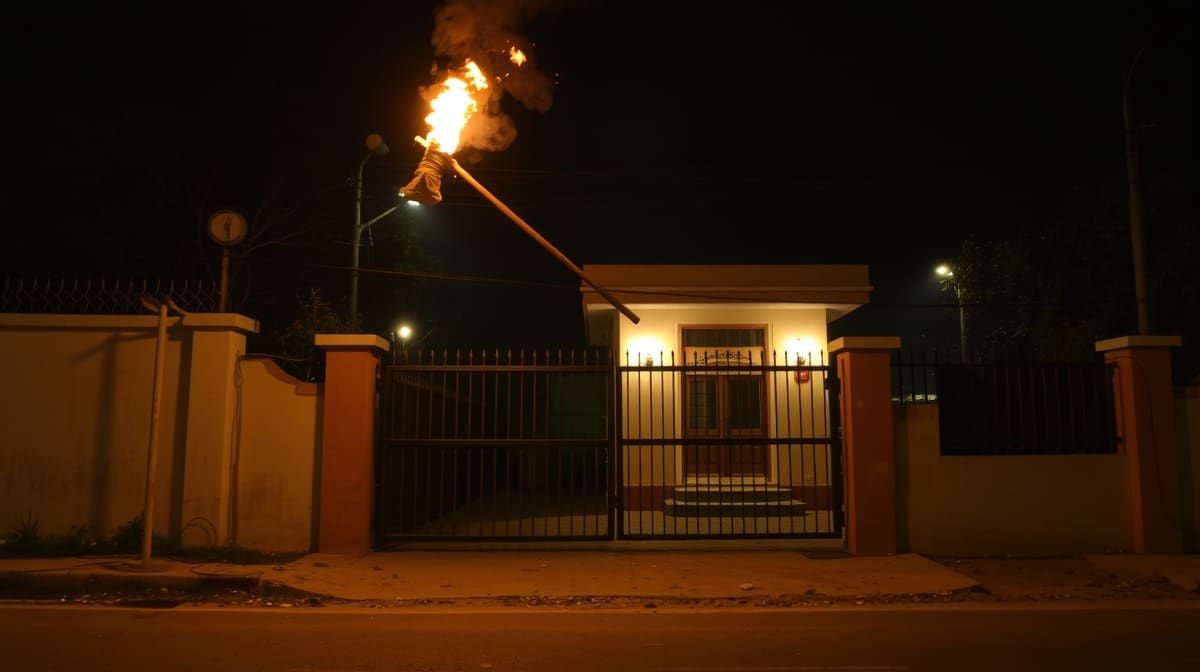
- The only specific allegation against the appellant was that he threatened to set himself on fire
Procedural History
- 03.01.2014: Incident occurred at Collector’s Office, Aurangabad
- 04.01.2014: FIR registered at City Chowk Police Station
- 27.09.2021: Trial Court (Extra Joint District Judge, Aurangabad) convicted appellant under Sections 353, 504, 506 r/w Section 34 IPC and sentenced him to simple imprisonment till rising of the court and fine
- 08.06.2026: Appeal heard and reserved by the Bombay High Court, Aurangabad Bench
- 09.06.2026: Judgment pronounced
The Parties' Positions
For the Appellant
The appellant’s counsel argued that:
- The complainant was not engaged in official duties under Section 353 IPC on the date of the incident
- The allegations against the appellant were vague, general, and lacked specificity
- The only direct accusation was the threat to immolate himself, which does not constitute assault or intentional insult under Sections 504 or 506
- No corroborative evidence supported the complainant’s version
- The stenographer and clerk, who were present, did not support the prosecution
- CCTV footage, if available, was not produced, raising suspicion about the prosecution’s case
For the Respondent/State
The Additional Public Prosecutor contended that:
- The complainant was acting in an official capacity as Deputy Collector (Election)
- The conduct of the appellant and his associates amounted to obstruction of a public servant
- The threat to immolate oneself was an intimidation tactic intended to coerce official action
- The trial court had correctly appreciated the evidence
Relief Sought
The appellant sought quashing of the conviction and sentence, and full acquittal on all charges under Sections 353, 504, and 506 r/w Section 34 IPC.
The Legal Issue
The central question was whether the prosecution established beyond reasonable doubt that the appellant committed an offence under Section 353 IPC by assaulting or using criminal force against a public servant while discharging official duty, and whether the threats and conduct attributed to him satisfied the ingredients of Sections 504 and 506 IPC.
Arguments Presented
For the Appellant
The appellant’s counsel emphasized that Section 353 IPC requires proof that the accused assaulted or used criminal force against a public servant who was actually discharging official duty. The complainant’s role on 03.01.2014 was merely officiating, not formally assigned election duties. The prosecution failed to produce any document or order confirming his official assignment on that day. The only specific act attributed to the appellant was a threat to immolate himself, which, while alarming, does not constitute criminal force, assault, or intentional insult under the relevant provisions. The absence of corroboration from the stenographer and clerk, coupled with the non-production of CCTV footage, rendered the prosecution’s case inherently unreliable. The counsel relied on State of Maharashtra v. Suresh and Rajendra Singh v. State of Maharashtra to argue that vague, uncorroborated testimony cannot sustain a conviction.
For the Respondent/State
The Additional Public Prosecutor argued that the complainant’s position as Deputy Collector (Election) inherently constituted official duty, regardless of formal assignment on that day. The entry of a large group into the office, coupled with threats and abuse, was inherently disruptive to official functions. The threat to immolate oneself was presented as a coercive tactic to influence official action, thereby falling within the ambit of Section 506 IPC. The prosecution contended that the trial court’s appreciation of evidence was reasonable and that the retraction of witness statements did not invalidate the core testimony of the complainant.
The Court's Analysis
The Court undertook a meticulous review of the evidence and found the prosecution’s case fundamentally deficient. The complainant’s testimony was the sole source of allegations against the appellant, and even that was non-specific. The Court noted that while the complainant alleged abuse and scuffling, he could not identify who uttered the abusive language or who physically assaulted him. The only act directly attributed to the appellant was the threat to immolate himself. The Court held that such a threat, without any accompanying act of criminal force or assault, does not satisfy the requirements of Section 353 IPC, which demands actual use of criminal force or assault against a public servant in the discharge of duty.
"Only allegation against appellant seems to be that he threatened to immolate himself."
The Court further observed that Section 504 IPC requires intentional insult with intent to provoke breach of peace, and Section 506 IPC requires threat of injury to person, property, or reputation. The threat to self-immolation, while serious, was not directed at the complainant as a threat of injury to him or his property. It was a form of protest, not a criminal threat under the IPC.
The Court emphasized that the stenographer and clerk, who were present, had retracted their statements and contradicted the complainant. The non-production of CCTV footage, despite its availability and demand, raised a serious adverse inference under Section 114, Evidence Act. The Court concluded that the prosecution had not discharged its burden of proving guilt beyond reasonable doubt.
The Verdict
The appeal is allowed. The conviction of the appellant, Saleem Patel s/o Daulat Patel Borgaonkar, under Sections 353, 504, and 506 r/w Section 34 of the Indian Penal Code in Sessions Case No. 533/2019 is quashed and set aside. The appellant is acquitted of all charges. Any fine amount deposited by the appellant shall be refunded after the statutory period. The order regarding disposal of muddemal remains unchanged.
What This Means For Similar Cases
Official Duty Must Be Proven, Not Assumed
- Practitioners must establish that the public servant was actively discharging official duties at the time of the incident, not merely holding a title
- Mere officiating status without formal assignment or documented duty on the day of incident is insufficient to invoke Section 353 IPC
- Documentary proof of duty assignment should be sought and produced in all such cases
Vague Threats Do Not Satisfy IPC Sections 504 or 506
- Threats of self-harm or self-immolation, without direct targeting of the victim, do not constitute intentional insult or criminal intimidation under Sections 504 or 506 IPC
- Prosecutions must clearly link the threat to the victim’s person, property, or reputation
- Courts will not infer criminal intent from ambiguous or generalized conduct
Non-Production of Available Evidence Raises Adverse Inference
- Where CCTV or other objective evidence is available and not produced despite demand, courts may draw adverse inference under Section 114 of the Evidence Act
- Defence counsel should formally demand such evidence at trial and record objections to its non-production
- Prosecution’s failure to produce such evidence may be fatal to the case, even if witness testimony appears consistent