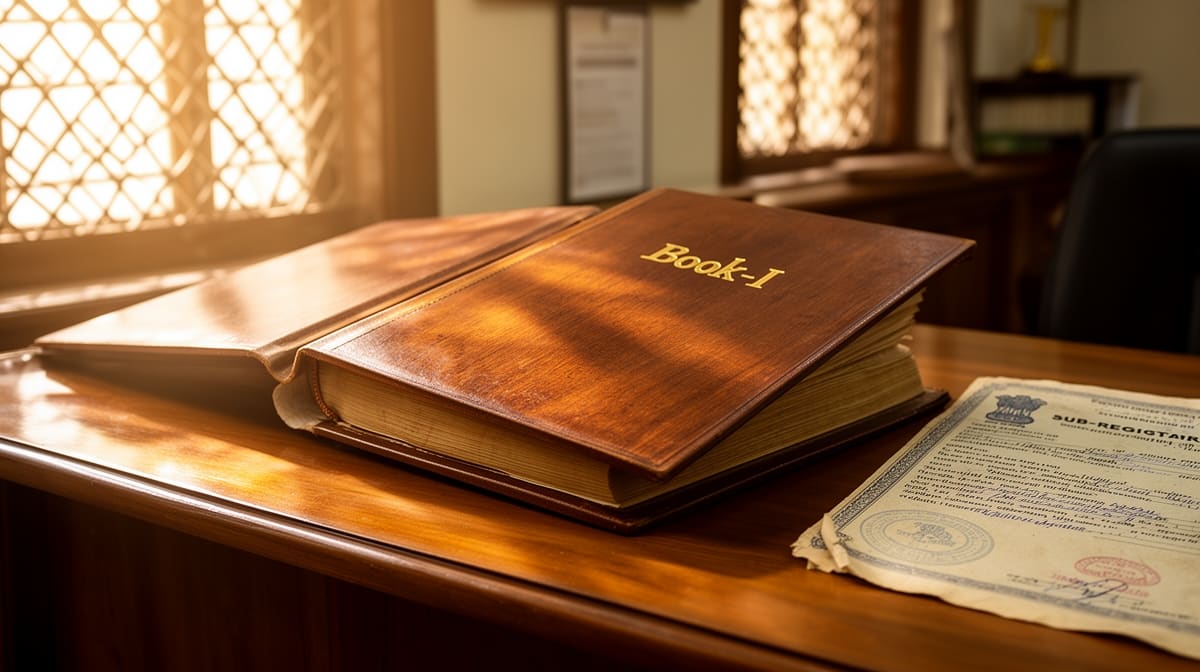
The Telangana High Court has affirmed a critical statutory obligation under the Registration Act, 1908: Sub-Registrars must record sale certificates issued by Debt Recovery Tribunals in Book-I, ensuring legal recognition of auction purchasers’ titles. This interim order resolves a systemic failure that left rightful owners in legal limbo despite valid court-ordered sales.
Background & Facts
The Dispute
The petitioner, Gudala Arun Kumar, became the successful auction purchaser of a property through a sale certificate issued by the Debt Recovery Tribunal-2, Hyderabad. Despite possessing a legally valid sale certificate, the Sub-Registrar, Malkajgiri, refused to make Book-I entries in his name, thereby denying him formal registration of title and exposing him to third-party claims and encumbrances.
Procedural History
- The petitioner filed Writ Petition No. 6298 of 2026 under Article 226 of the Constitution seeking a writ of mandamus.
- Simultaneously, he filed IA No. 1 of 2026 under Section 151 CPC seeking interim relief to direct the Sub-Registrar to record the sale certificate pending final disposal.
- The matter was listed for admission, with the State of Telangana and the Sub-Registrar appearing through the Government Pleader.
- The petitioner relied on a prior interim order dated 08.09.2025 in W.P. No. 26653 of 2025, where the same court had directed similar relief.
The Parties' Positions
- Petitioner: Argued that refusal to record the sale certificate violates Section 53 of the Registration Act, 1908, which mandates entry of all instruments affecting immovable property in Book-I. He further contended that the inaction violates Articles 14, 21, and 300A of the Constitution.
- Respondents 1 to 3: Did not dispute the petitioner’s submissions. The Government Pleader conceded the legal position and did not oppose the interim relief.
- Respondent No. 4 (Recovery Officer): Was directed to show cause but did not oppose the interim direction.
Relief Sought
The petitioner sought an interim order directing the Sub-Registrar to enter the sale certificate in Book-I, thereby establishing his claim in the encumbrance records and preventing further prejudice.
The Legal Issue
The central question was whether a Sub-Registrar is statutorily bound under Section 53 of the Registration Act, 1908 to record a sale certificate issued by a Debt Recovery Tribunal in Book-I, even if the underlying transaction is not a conventional sale deed.
Arguments Presented
For the Petitioner
The petitioner relied on Section 53 of the Registration Act, 1908, which requires every Sub-Registrar to maintain Book-I for recording instruments affecting immovable property. He argued that a sale certificate issued under the SARFAESI Act qualifies as an instrument of transfer under Section 2(14) of the Registration Act. He cited State of Maharashtra v. M/s. M. R. D. Enterprises to establish that court-ordered sales are equivalent to registered conveyances for title purposes. He further invoked Article 300A to assert the constitutional right to property.
For the Respondent
The State did not contest the petitioner’s legal position. The Government Pleader acknowledged that the Sub-Registrar’s inaction was inconsistent with statutory duty and judicial precedent. No counter-legal argument was advanced.
The Court's Analysis
The Court examined the nature of a sale certificate issued by a Debt Recovery Tribunal under the SARFAESI Act, 2002, and its relationship with the Registration Act, 1908. It held that while the sale certificate itself is not a ‘document’ requiring compulsory registration under Section 17, it is an instrument that conclusively transfers title and must be recorded in Book-I under Section 53 to ensure public notice and legal certainty.
"The purpose of Book-I is not merely administrative but foundational to the public record of title. To deny entry to a court-ordered sale certificate is to render the auction process meaningless."
The Court emphasized that Section 53 imposes a mandatory duty on Sub-Registrars to record any instrument affecting immovable property, including those issued by statutory tribunals. It distinguished Rajesh Kumar v. Sub-Registrar (2019), which dealt with private sale deeds, by noting that court-ordered sales carry greater legal authority and are binding on all parties. The Court also noted that its prior order in W.P. No. 26653 of 2025 had already settled this principle, and consistency demanded identical relief.
The Court further held that the failure to record such entries violates natural justice by depriving the purchaser of the ability to defend his title against third-party claims, thereby infringing Article 21.
The Verdict
The petitioner succeeded. The Court directed the Sub-Registrar to record the sale certificate issued by the Debt Recovery Tribunal in Book-I maintained in his office. The interim order was granted on the basis of statutory duty and precedent, pending final disposal of the writ petition.
What This Means For Similar Cases
Book-I Entries Are Mandatory for Court-Sales
- Practitioners must now insist on Book-I entries for all auction purchasers under SARFAESI, DRT, or other court-ordered sales.
- Failure to record constitutes a breach of Section 53 of the Registration Act, 1908, actionable via writ petition.
- Sub-Registrars cannot refuse entry on grounds of ‘non-registration’ - the certificate itself is the operative instrument.
Title Clarity Requires Proactive Recording
- Auction purchasers must file IA under Section 151 CPC immediately after obtaining the sale certificate to secure interim relief.
- Delay in seeking Book-I entry may be construed as acquiescence, weakening future claims.
- Encumbrance certificates will no longer reflect the true ownership status unless Book-I is updated.
Judicial Consistency as a Tool for Enforcement
- The Court’s reliance on its own prior order in W.P. No. 26653 of 2025 establishes that consistent interim relief is enforceable across similar petitions.
- Practitioners should cite identical interim orders as binding precedent in analogous cases.
- This creates a replicable model for securing title rights across Telangana and other jurisdictions with similar statutory frameworks.