The Bombay High Court has delivered a nuanced judgment under Section 34 of the Arbitration and Conciliation Act, 1996, addressing the enforceability of a 1% damages cap in an Engineering Procurement Construction (EPC) contract where the Public Works Department (PWD) failed to provide 90% of the Right of Way (ROW) within the stipulated 15-day period. While upholding the arbitral tribunal’s refusal to apply the cap, the Court modified the 18% compounded interest rate awarded, holding it contrary to the contract’s calibrated bargain. The judgment underscores the business efficacy test in contractual interpretation and the limited scope of judicial interference under Section 34.
Background & Facts
The Dispute
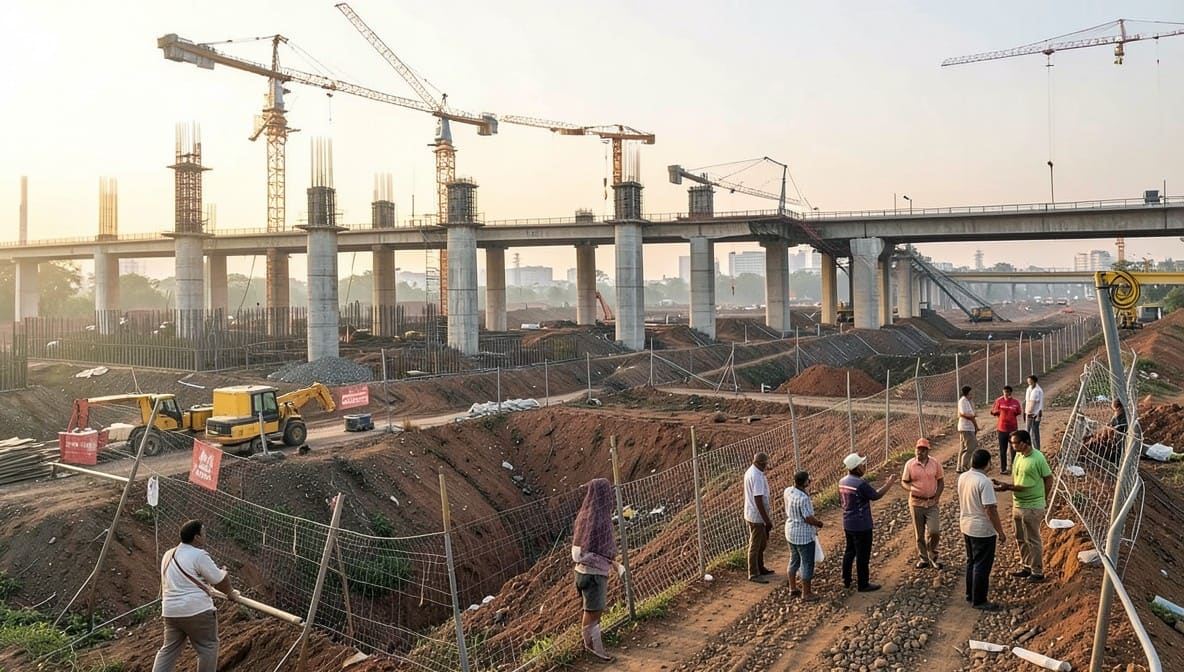
The dispute arises from three EPC contracts (aggregating Rs. 148.51 crores) awarded by the Public Works Department (PWD), Government of Maharashtra, to Khare And Tarkunde Infrastructure Pvt. Ltd. (KTIPL) for the construction of road infrastructure, including bridges and overbridges. The contracts, executed in December 2014, stipulated completion within 18 months of the Appointed Date (January 27, 2015), with 90% of the ROW to be handed over within 15 days of receiving performance security. However, PWD failed to provide the ROW, leading to cascading delays and eventual termination of the contracts on October 25, 2018 - nearly 45 months after the Appointed Date.
Key Facts
- Contract Value: Three packages aggregating Rs. 148.51 crores (Rs. 53.24 crores, Rs. 48.80 crores, and Rs. 46.46 crores).
- ROW Obligation: PWD was to provide 90% of the ROW within 15 days of receiving performance security (Clause 4.1.3(a)), and the remaining 10% within 150 days (Clause 8.2).
- Scheduled Completion: July 26, 2016 (18 months from the Appointed Date).
- Actual Termination: October 25, 2018, after 45 months of mobilization.
- Damages Cap: Clause 4.1.5 limited aggregate damages to 1% of the contract price.
- Interest Clauses:
- Clause 19.9.2: PWD to pay base rate + 2% (quarterly rests) for delayed payments.
- Clause 19.2.7: KTIPL to pay 18% per annum for delayed repayment of advance.
- Arbitral Award: Dated April 14, 2023, awarded damages without applying the 1% cap and granted 18% compounded interest for pre-arbitration, pendente lite, and post-arbitration periods.
Procedural History
- December 17 & 24, 2014: Contracts executed.
- January 27, 2015: Appointed Date declared by PWD (despite 90% ROW not being handed over).
- February 21, 2015: KTIPL raises issue of non-provision of ROW.
- June 21, 2015: First milestone reached.
- January 24, 2017: Second milestone reached (delayed by 12 months).
- October 1, 2018: KTIPL invokes arbitration.
- October 25, 2018: PWD terminates contracts.
- April 14, 2023: Arbitral Tribunal awards damages without applying the 1% cap and grants 18% compounded interest.
- 2024: PWD files Arbitration Petitions No. 262, 263, and 264 of 2024 under Section 34 challenging the award.
- March 30, 2026: Final hearing before the Bombay High Court.
- June 12, 2026: Judgment pronounced.
The Parties' Positions
For the Petitioner (PWD)
- Damages Cap: Clause 4.1.5 is a non-obstante provision capping damages at 1% of the contract price, irrespective of the breach’s nature or extent.
- Interest Rate: The 18% compounded interest awarded is contrary to Clause 19.9.2 (base rate + 2%) and Section 31(7) of the Act.
- Precedents Cited: Reliance on judgments like Bright Power Projects, Vilayati Ram, and Ssangyong to argue that arbitral tribunals cannot rewrite contracts.
For the Respondent (KTIPL)
- Damages Cap: Clause 4.1.5 is unconscionable and arbitrary if applied without regard to PWD’s fundamental breach (non-provision of ROW).
- Business Efficacy: The cap must be read harmoniously with other contractual obligations (Clause 4.1.3(a)).
- Precedents Cited: Reliance on Simplex Concrete, G. Ramachandra Reddy, and K.N. Sathyapalan to argue that reasonable damages cannot be restricted by contractual clauses.
- Interest Rate: The 18% rate aligns with Clause 19.2.7 (KTIPL’s obligation for delayed repayments) and reflects the actual interest burden borne by KTIPL (13.8% compounded monthly, escalating to 18.8%).
Relief Sought
- PWD: Quashing of the arbitral award’s refusal to apply the 1% damages cap and the 18% compounded interest rate.
- KTIPL: Upholding of the award, including damages for 45 months of mobilization and interest reflecting the actual financial burden.
The Legal Issue
The central questions were:
- Whether Clause 4.1.5 (capping damages at 1% of the contract price) could be disregarded when PWD fundamentally breached its obligation to provide 90% of the ROW within 15 days.
- Whether the 18% compounded interest rate awarded was contrary to the contract and Section 31(7) of the Act.
Arguments Presented
For the Petitioner (PWD)
- Damages Cap: Clause 4.1.5 is clear and unambiguous, and the arbitral tribunal rewrote the contract by refusing to apply it.
- Interest Rate: The 18% rate is contrary to Clause 19.9.2 (base rate + 2%) and Section 31(7), which binds the tribunal to the parties’ agreement on interest.
- Precedents: Cited Bright Power Projects, Vilayati Ram, and Ssangyong to argue that arbitral tribunals cannot ignore contractual terms.
For the Respondent (KTIPL)
- Damages Cap: Clause 4.1.5 is unconscionable if applied without regard to PWD’s breach. The tribunal applied the business efficacy test to reconcile the cap with Clause 4.1.3(a).
- Interest Rate: The 18% rate aligns with Clause 19.2.7 (KTIPL’s obligation) and reflects the actual interest burden (18.8% compounded monthly).
- Precedents: Cited Simplex Concrete, G. Ramachandra Reddy, and Kailash Nath to argue that reasonable damages cannot be restricted by arbitrary contractual limits.
The Court's Analysis
Damages Cap: Clause 4.1.5
The Court examined the interplay between Clause 4.1.5 (damages cap) and Clause 4.1.3(a) (ROW obligation) through the lens of Section 28(3) of the Act, which mandates that arbitral tribunals “take into account the terms of the contract” while adjudicating disputes. The Court distinguished the pre-2015 position (where tribunals were bound to decide “in accordance with” the contract) from the post-2015 amendment, which grants tribunals greater leeway to interpret contracts in light of peculiar facts.
"The term ‘in accordance with’ entails a mandatory stipulation, while the term ‘take into account’ would entail factoring in the terms of the contract. Therefore, if the contract in question contains a provision of limiting damages, needless to say, it cannot be wished away or ignored. However, when the statutory stipulation is to ‘take into account’ such provision of the contract, as a conscious departure from the phrase ‘in accordance with’, the legislature in its wisdom has specifically held that the arbitral tribunal must have regard to the contract. Yet, in a peculiar situation such as this, where the ROW has simply not been provided for an inordinately long period of time... the empowerment of the Arbitral Tribunal to decide the validity of the limit in the contract introduced by Section 28(3) cannot be ignored."
The Court upheld the tribunal’s application of the business efficacy test, citing Nabha Power and The Moorcock, to reconcile Clause 4.1.5 with the foundational obligation under Clause 4.1.3(a). The tribunal’s finding - that applying the 1% cap in the face of PWD’s abject default would place a premium on non-compliance - was held to be reasonable and plausible.
"The Learned Arbitral Tribunal found that the work site involving approaches to the bridge could indeed be considered to be reasonably problematic since there could be ownership of private lands in the process. However, the handing over of the site was so inordinately delayed that the work envisaged to be done in 18 months was prolonged by an additional 27 months and then only upon arbitration being invoked, was the termination notice issued. The Learned Arbitral Tribunal could not be blind to the fact that KTIPL was at the site for 45 months prior to the termination and therefore could not be held to be limited in its claim for damages to 1% of the contract value as envisaged in Clause 4.1.5."
The Court rejected PWD’s reliance on precedents like Bright Power Projects and Vilayati Ram, distinguishing them on the grounds that the tribunal in this case did not ignore Clause 4.1.5 but interpreted it harmoniously with the rest of the contract.
Interest Rate: 18% Compounded Quarterly
The Court held that the 18% compounded interest rate awarded by the tribunal was contrary to the contract and Section 31(7) of the Act, which binds tribunals to the parties’ agreement on interest unless otherwise agreed.
"From a plain reading of the foregoing, it would be seen that where the award is for payment of a sum of money and the parties have an agreement on payment of interest on such amount, then the Arbitral Tribunal would be bound by the agreement already made between the parties. This is why the phrase ‘unless otherwise agreed by the parties’ is used in this provision to fetter the Tribunal’s power to assess interest and award the same ‘at such rate as it deems reasonable’."
The Court noted that Clause 19.9.2 provided for base rate + 2% (quarterly rests), while Clause 19.2.7 imposed 18% per annum for KTIPL’s delayed repayments. The tribunal’s reliance on Clause 19.2.7 to justify the 18% rate was held to be perverse, as it turned the contractual bargain on its head by extrapolating from KTIPL’s obligation to PWD’s liability.
The Court cited Gayatri Balasamy to hold that while post-award interest could be modified under Section 34, pendente lite interest could not. However, since the 18% rate applied to both pre-arbitration and pendente lite periods, the Court set aside the entire interest component of the award, leaving it open for the parties to refer the issue back to arbitration.
The Verdict
The Court partly allowed the petitions under Section 34, upholding the arbitral award in all respects except the award of interest. The key holdings are:
- Damages Cap: The 1% cap under Clause 4.1.5 was rightly disregarded by the tribunal in light of PWD’s fundamental breach (non-provision of ROW). The award of damages without applying the cap was upheld.
- Interest Rate: The 18% compounded interest rate was set aside as contrary to the contract and Section 31(7) of the Act. The parties were left at liberty to refer the interest issue back to arbitration.
- No Costs: In the peculiar circumstances, no order as to costs was passed.
What This Means For Similar Cases
Business Efficacy Test Trumps Rigid Contractual Limits
- Foundational Breaches: Where a party fundamentally breaches a foundational obligation (e.g., non-provision of ROW), damages caps or exclusionary clauses may be disregarded if their application would lead to absurd outcomes or place a premium on non-compliance.
- Multi-Clause Contracts: Tribunals and courts must reconcile interconnected clauses rather than applying one provision in isolation. The business efficacy test (Nabha Power, The Moorcock) may be invoked to give commercial sense to the contract.
- Section 28(3) of the Act: The post-2015 amendment empowers arbitral tribunals to interpret contracts in light of peculiar facts, rather than being bound strictly by contractual terms.
Interest Rates Must Align With Contractual Bargain
- Section 31(7) of the Act: Arbitral tribunals cannot award interest rates that deviate from the parties’ agreement unless the contract itself is silent or ambiguous.
- Precedential Clarity: Courts will modify post-award interest under Section 34 but cannot interfere with pendente lite interest unless it is patently illegal (Gayatri Balasamy).
- Practical Takeaway: Parties should clearly stipulate interest rates for all scenarios (pre-arbitration, pendente lite, post-award) to avoid judicial modification.
Limited Scope of Judicial Interference Under Section 34
- Reasonable Interpretation: Courts will not interfere with an arbitral award merely because they disagree with the tribunal’s interpretation, unless it is manifestly arbitrary or contrary to law.
- Partial Setting Aside: Courts may sever and set aside only the illegal portion of an award (e.g., interest) while upholding the rest (Gayatri Balasamy).
- Arbitrability of Remaining Disputes: If a facet of the award (e.g., interest) is set aside, the underlying dispute remains arbitrable, and parties may refer it back to arbitration.