The Karnataka High Court has set aside convictions under Sections 307, 326, and 324 IPC, holding that unexplained delay in lodging the FIR, coupled with prior family enmity and absence of independent corroboration, creates reasonable doubt fatal to the prosecution case. The judgment reinforces the principle that in criminal trials, especially where family ties and delayed reporting are involved, the burden of proving guilt beyond reasonable doubt cannot be met through interested testimony alone.
Background & Facts
The Dispute
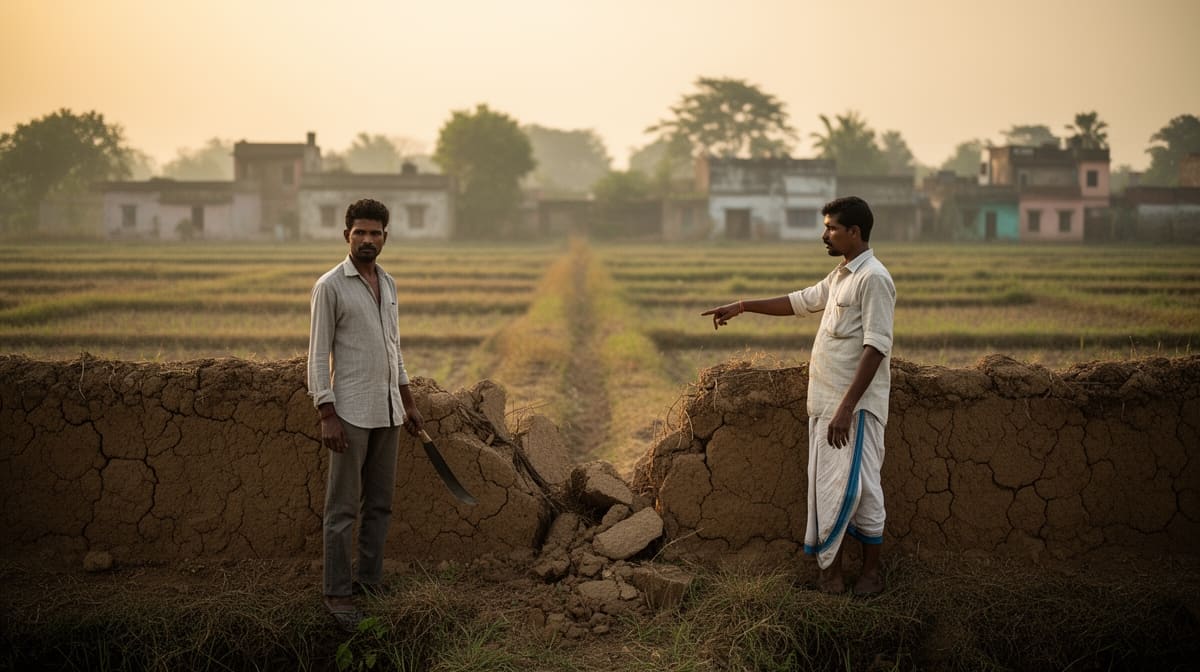
The dispute arose from a long-standing boundary conflict between two branches of the same family over agricultural land in Kempisiddanahundi Village, Nanjangud Taluk, Mysuru District. The appellants, K.J. Umesha and K.J. Nagesha, and the complainants, P.W.1 (K.K. Nagaraj) and P.W.2 (K.K. Shivanandu), are cousins. Their residential houses and fields are adjacent, separated by a ridge locally known as "Badu". The prosecution alleged that for two years prior to the incident, the appellants had encroached upon the complainants’ land by breaking the ridge, leading to repeated quarrels.
Key Facts
- The alleged incident occurred on 03.01.2014 at approximately 5:30 p.m. near the appellants’ house.
- P.W.2 confronted the appellants over the ridge-breaking incident earlier that day, leading to verbal abuse by Accused No.1.
- Accused No.1 allegedly returned with a machete (M.O.1) and assaulted P.W.2 on the head.
- Accused No.2 allegedly assaulted P.W.1 with another machete (M.O.2), causing injury to the right side of his neck.
- P.W.3 (nephew of P.W.2) and P.W.4 (Rachiah) intervened and seized the weapons.
- The injured were taken to Nanjangud Government Hospital at approximately 6:00 p.m. on 03.01.2014 and later referred to K.R. Hospital.
- A complaint was recorded by P.W.8, a Police Constable, at K.R. Hospital on 04.01.2014 at 5:00 p.m. (Ex.P1).
- FIR (Ex.P18) was registered at 6:15 p.m. on 04.01.2014.
- Accused No.1 was arrested on 05.01.2014.
- Spot mahazar was conducted on 07.01.2014, after initial failure due to lack of eyewitnesses.
- M.O.1 (machete), M.O.2 (machete), M.O.3 (blood-stained shirt), and M.O.4 (blood-stained dhoti) were seized during the mahazar.
- RFSL report confirmed human blood of ‘O’ group on all material objects.
- Medical opinion confirmed injuries could have been caused by the seized weapons.
- P.W.2 was examined at NIMHANS on 07.01.2014 by Dr. Sampath (P.W.14), who found his condition stable, with only a mild head injury, and treated him as an outpatient.
- P.W.2 later underwent treatment at Apollo BGS Hospital, Mysuru, which the defense alleged was fabricated to inflate injury severity.
- P.W.4, the witness who identified the spot for mahazar, turned hostile during trial.
- P.W.3, the only other eyewitness, is the maternal nephew of P.W.2.
- No independent eyewitnesses were examined by the prosecution.
- The Investigating Officer was not examined by the prosecution.
- The appellants and complainants are sons of brothers (C. Javari Gowda and Kade Gowda) and resided under the same roof with temporary partitions.
- Accused No.1 was 23 years old and Accused No.2 was 26 years old at the time of incident; both unmarried.
- No prior criminal history or separate incidents were reported between the parties in the two years preceding the incident.
Procedural History
- 03.01.2014: Alleged incident occurred at 5:30 p.m.
- 03.01.2014, 6:00 p.m.: Injured admitted to Nanjangud Government Hospital.
- 04.01.2014, 5:00 p.m.: Complaint recorded by Police Constable at K.R. Hospital (Ex.P1).
- 04.01.2014, 6:15 p.m.: FIR registered as Crime No.09/2014 (Ex.P18).
- 04.01.2014, 9:30 p.m.: Judicial Magistrate received FIR (delay unexplained).
- 05.01.2014: Accused No.1 arrested by P.W.10.
- 06.01.2014: Attempted spot mahazar failed due to absence of eyewitnesses.
- 07.01.2014, 10:00 a.m.: Spot mahazar conducted by P.W.11 with P.W.4 as witness.
- 13.02.2015: Charges framed under Sections 307, 326, 324, 504 r/w 34 IPC.
- 25.05.2018: Trial Court convicted Accused No.1 under Sections 307 and 326 IPC; Accused No.2 under Section 324 IPC.
- 17.03.2026: Karnataka High Court delivered judgment allowing appeal.
The Parties' Positions
For the Appellants
- The delay of over 28 hours in lodging the FIR was unexplained and fatal to the prosecution case.
- The Investigating Officer was not examined, depriving the defense of a critical opportunity to challenge investigation procedures.
- The sole eyewitnesses (P.W.1, P.W.2, P.W.3) were closely related to the complainants.
- P.W.4, who identified the spot, turned hostile.
- No independent witnesses were examined despite the incident occurring in an open area.
- Medical evidence from NIMHANS showed only a mild head injury, contradicting the claim of grievous hurt or attempt to murder.
- The private hospital treatment at Apollo was fabricated to claim compensation under the Yashswini scheme.
- P.W.2 had pre-existing epilepsy, which was suppressed.
- The parties lived under the same roof; motive for attempted murder was implausible.
- The ridge-breaking incident on the morning of 03.01.2014 was not independently verified.
For the Respondent-State
- The trial court correctly appreciated the evidence.
- The delay in FIR was not material as the injured were undergoing treatment.
- The medical evidence, including RFSL report and doctor’s opinion, supported the prosecution.
- The family relationship did not negate the possibility of violence.
- The conviction was based on consistent testimony of injured witnesses.
Relief Sought
The appellants sought acquittal of all charges, cancellation of bail bonds, refund of any deposited fine, and return of trial court records with a copy of the judgment.
The Legal Issue
The central question was whether unexplained delay in lodging the FIR, coupled with prior family enmity, reliance on interested witnesses, hostility of a material eyewitness, lack of independent corroboration, and doubtful medical evidence, collectively create a reasonable doubt sufficient to warrant acquittal under Section 101 of the Indian Evidence Act and the principle of benefit of doubt in criminal jurisprudence.
Arguments Presented
For the Appellant
The appellants contended that the prosecution failed to establish a prima facie case. The 28-hour delay in filing the FIR was not explained despite the injured being admitted to a hospital within hours. The Investigating Officer was not examined, violating the principle laid down in Binod Murmu v. State of Jharkhand. The only eyewitnesses were close relatives of the complainants, and the sole other witness, P.W.4, turned hostile. The medical evidence from NIMHANS, given by a neurosurgeon, conclusively showed only a mild head injury, contradicting the claim of grievous hurt under Section 326 IPC or attempt to murder under Section 307 IPC. The subsequent treatment at Apollo Hospital was alleged to be fabricated for financial gain under the Yashswini scheme. The suppression of P.W.2’s pre-existing epilepsy further undermined credibility. The family relationship and cohabitation negated any motive for violent assault. The trial court failed to apply the test of reasonable doubt as mandated in State of U.P. v. Krishna and State of Maharashtra v. Damu.
For the Respondent
The State argued that the trial court had correctly weighed the evidence and that the delay in FIR was due to the injured being shifted between hospitals. The medical evidence, including RFSL reports and the doctor’s opinion, was sufficient to establish the nature of injuries. The family relationship did not preclude violence, and the testimony of injured witnesses was reliable. The prosecution was not obligated to examine the Investigating Officer if the evidence was otherwise consistent. The conviction was sustainable under the law.
The Court's Analysis
The Court undertook a meticulous review of the entire evidentiary record and found multiple infirmities that collectively eroded the prosecution’s case beyond reasonable doubt. The Court emphasized that in cases involving prior enmity, the burden on the prosecution to explain delay is heightened. The Court relied on Rema Raghavan v. State of Kerala and Achhar Singh v. State of Punjab to hold that unexplained delay, especially when coupled with family animosity, raises a serious suspicion of fabrication.
"The non-examination of the Investigating Officer causes serious prejudice to the accused, particularly in a case where delay in registration of the FIR is a significant factor requiring clarification."
The Court noted that P.W.3, the only other eyewitness besides the injured, was the maternal nephew of P.W.2, making him an interested witness whose testimony required independent corroboration. The hostility of P.W.4, who had identified the spot for the mahazar, further weakened the prosecution’s narrative. The Court observed that no independent witness was examined despite the incident occurring in a public area near the house.
Regarding medical evidence, the Court gave decisive weight to the testimony of Dr. Sampath (P.W.14), Professor of Neurosurgery at NIMHANS, who stated that P.W.2’s condition was stable, he had sustained only a mild head injury, and hospitalization was unnecessary. The Court held that the subsequent treatment at Apollo Hospital, including alleged surgery, was inconsistent with this expert opinion and appeared designed to inflate injury severity. The suppression of P.W.2’s pre-existing epilepsy was deemed a material omission affecting credibility.
The Court also highlighted the familial relationship between the parties: both accused and complainants were sons of brothers and resided under the same roof with temporary partitions. In such circumstances, the prosecution’s assertion of a motive for attempted murder was implausible. The Court concluded:
"The evidence relied upon by the prosecution suffers from multiple infirmities, including reliance on interested witnesses, hostility of a material eyewitness, lack of independent corroboration, delay in lodging the FIR, delay in conducting the spot mahazar, and doubtful medical evidence..."
The Court reiterated that in criminal law, when reasonable doubt arises from any quarter, the benefit must go to the accused. The trial court’s failure to appreciate these cumulative infirmities rendered the conviction unsustainable.
The Verdict
The appeal was allowed. The judgment of conviction and sentence dated 25.05.2018 passed by the I Additional Sessions Judge, Mysuru, was set aside. Accused No.1, K.J. Umesha, was acquitted of the offences under Sections 307 and 326 IPC. Accused No.2, K.J. Nagesha, was acquitted of the offence under Section 324 IPC. Any bail bonds and sureties were cancelled. Any fine deposited by the accused was ordered to be refunded after the appeal period expired. The trial court records were directed to be returned with a copy of this judgment.
What This Means For Similar Cases
Delay in FIR Is Fatal Without Explanation
- Practitioners must now treat any unexplained delay exceeding 24 hours in FIR registration as a critical defect, especially in cases involving family disputes.
- Prosecution must proactively explain delays through witness testimony or documentary evidence; silence invites acquittal.
- Relying on "injured being treated" as justification is insufficient unless corroborated by hospital records and timelines.
Independent Corroboration Is Non-Negotiable
- In cases where prosecution relies on injured or closely related witnesses, independent corroboration is mandatory.
- Hostility of even one material witness, especially one who identified the scene, can collapse the entire case.
- Courts will not accept testimony from relatives as sufficient proof without external validation.
Medical Evidence Must Be Consistent and Transparent
- Expert medical opinions from government hospitals (e.g., NIMHANS) carry greater weight than private hospital records.
- Discrepancies between initial medical reports and later private treatments must be explained; unexplained deviations invite suspicion of fabrication.
- Suppression of pre-existing medical conditions affecting injury severity is a material irregularity that can vitiate conviction.
Family Relationship Negates Motive in Violent Crimes
- When accused and complainant are blood relatives and co-residents, the prosecution must establish a compelling motive beyond mere quarrel.
- Courts will not presume intent to murder or cause grievous hurt from ordinary family disputes without concrete evidence.
- The presumption of innocence is strengthened where familial ties make violent acts improbable.