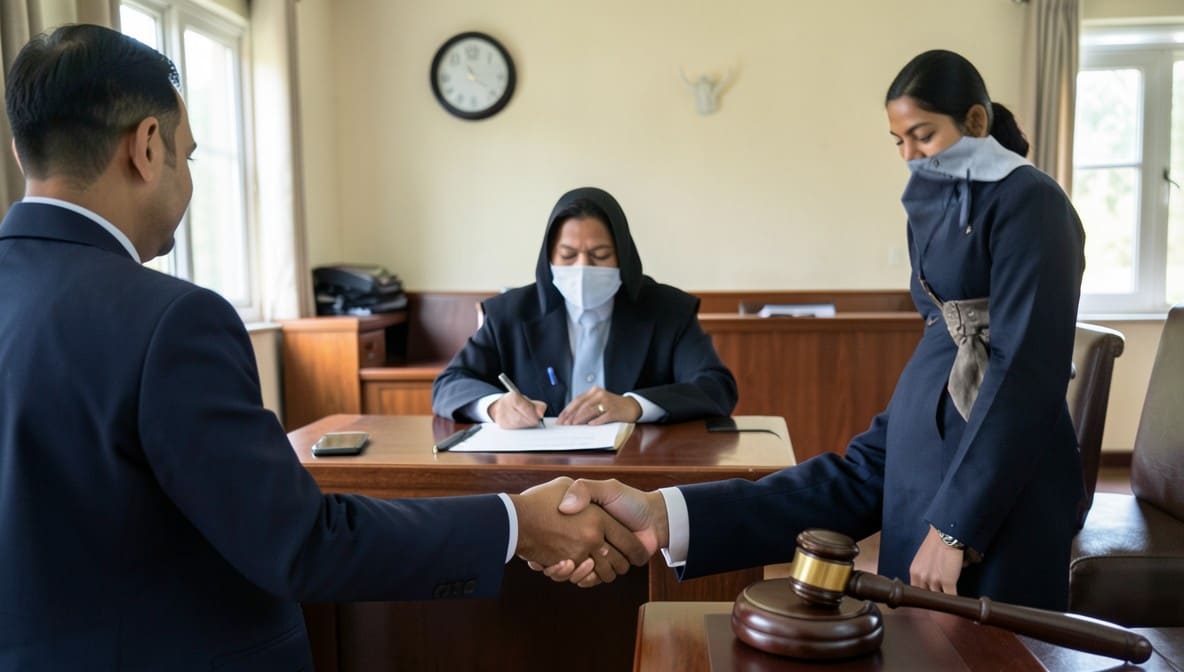
The Himachal Pradesh High Court has reaffirmed that an FIR registered under Section 307 IPC for attempt to murder cannot be quashed merely because the parties have settled their dispute. The judgment underscores that such offences are not private wrongs but crimes against society, and judicial discretion under Section 482 CrPC must yield to the public interest in prosecuting serious violent crimes.
Background & Facts
The Dispute
The petitioners - Rajinder Singh and others - sought quashing of FIR No. 16 of 2022, registered at Police Station Nurpur, District Kangra, Himachal Pradesh, for offences under Sections 341, 323, 504, 506, 147, 148, 149, 325 and 307 of the Indian Penal Code. The alleged incident occurred on 13.01.2022 at Dehri College ground, where the petitioners, along with others, assaulted the complainants, Ayush and Shivank, using an iron grip and a darati (a pointed agricultural tool). The complainants sustained injuries to the head and hand. The petitioners claim that a compromise has been reached with the complainants (Respondents No. 2 to 4), who no longer wish to pursue the case and seek to maintain cordial relations.
Key Facts
- The incident occurred on 13.01.2022 at approximately 5:30 PM at Dehri College ground, Kangra
- The complainants, Ayush and Shivank, were attacked by the petitioners and others
- Ayush was struck on the head with an iron grip, described as a pointed weapon capable of causing puncture wounds
- Shivank was attacked with a darati; he blocked the blow with his hand, resulting in injury
- The FIR was registered on 13.01.2022
- The petitioners filed the present petition on 20.12.2025 seeking quashing of the FIR
- The compromise was allegedly reached after the FIR was registered and during the investigation phase
- No medical report or post-mortem was referenced in the petition or judgment
- The petitioners did not dispute the factual allegations in the FIR
Procedural History
- 13.01.2022: FIR No. 16 of 2022 registered at Police Station Nurpur, District Kangra
- 20.12.2025: Petition under Section 482 CrPC filed before the High Court of Himachal Pradesh seeking quashing of the FIR
- 05.03.2026: Petition reserved for judgment
- 30.03.2026: Judgment delivered dismissing the petition
Relief Sought
The petitioners sought quashing of FIR No. 16 of 2022 and all consequential proceedings on the ground of compromise between the parties. No monetary relief or restitution was claimed.
The Legal Issue
Can an FIR registered under Section 307 IPC be quashed under Section 482 CrPC on the ground of compromise between the accused and the victim, even if the offence is non-compoundable and prima facie involves an attack on a vital part of the body with a dangerous weapon?
Arguments Presented
For the Petitioner
Mr. Goldy Kumar, Advocate for the petitioners, submitted that the parties had mutually settled the dispute and no animosity remained. He argued that the allegations, even if true, did not establish the necessary mens rea for Section 307 IPC, as the injuries were not life-threatening. He relied on Sahil @ Chhotu v. State of HP, Chetan & ors. v. State of HP, and Naushey Ali & ors. v. State of U.P. to contend that courts have quashed FIRs in cases of compromise, even involving serious offences, where the likelihood of conviction is remote.
For the Respondent/State
Mr. Prashant Sen, Deputy Advocate General, opposed the petition, arguing that Section 307 IPC is a heinous offence against society, not merely a private dispute. He emphasized that the use of an iron grip on the head and a darati constitutes a clear attempt to cause death, and that compromise cannot override the public interest in prosecuting such crimes. He cited Gian Singh v. State of Punjab, Narender Singh v. State of Punjab, and State of M.P. v. Laxmi Narayan to assert that Section 307 IPC offences are categorically excluded from quashing on compromise.
The Court's Analysis
The Court undertook a comprehensive review of the Supreme Court’s jurisprudence on the exercise of inherent powers under Section 482 CrPC to quash criminal proceedings based on compromise. It distinguished between compounding under Section 320 CrPC and quashing under Section 482, noting that while the former is statutory and limited, the latter is inherent and discretionary but not unfettered.
The Court emphasized that the nature and gravity of the offence must be the primary consideration. It held that Section 307 IPC offences are not private wrongs but crimes against society, as they threaten public order and safety. The Court observed:
"The injury was inflicted on the informant’s head by means of a grip, a pointed weapon, which could have caused a puncture wound. Shivank was attacked with a darati, and he avoided the blow by means of his hands. Therefore, prima facie, the ingredients of the commission of an offence punishable under Section 307 of the IPC are made out."
The Court rejected the petitioners’ reliance on Chetan and Naushey Ali, distinguishing those cases as involving civil disputes or lesser injuries, not attacks on vital organs with dangerous weapons. It reaffirmed the principles laid down in Narender Singh v. State of Punjab and State of M.P. v. Laxmi Narayan, which categorically exclude Section 307 IPC from the ambit of quashing on compromise.
The Court further clarified that even if the compromise is genuine and the parties are willing to reconcile, the High Court cannot ignore the societal impact of the crime. It noted that the timing of the compromise - after FIR registration but before charge sheet filing - does not alter the nature of the offence. The Court held that the mere existence of a compromise cannot override the prima facie evidence of an attempt to cause death.
The Verdict
The petition was dismissed. The High Court held that the FIR under Section 307 IPC cannot be quashed on the ground of compromise between the parties. The Court directed that the investigation and subsequent proceedings shall continue as per law. No stay or interim relief was granted, and the parties were directed to abide by the judicial process.
What This Means For Similar Cases
Attempt to Murder Is Non-Negotiable
- Practitioners must advise clients that compromise in Section 307 IPC cases will not lead to quashing, regardless of reconciliation or payment of compensation
- Applications under Section 482 CrPC seeking quashing on compromise grounds in such cases are likely to be dismissed at the threshold
- Defence counsel should focus on challenging the sufficiency of evidence for Section 307, not on the existence of compromise
Prima Facie Assessment Must Be Rigorous
- Courts will examine the nature of the weapon, location of injury, and medical evidence (if available) to determine if Section 307 is prima facie applicable
- A mere allegation of Section 307 in the FIR without supporting facts may be challenged, but the burden lies on the accused to show absence of intent or injury
- In cases where the injury is to non-vital areas and the weapon is blunt, courts may consider quashing - but not where a pointed or lethal instrument is used on the head or torso
Settlement Timing Is Irrelevant for Heinous Offences
- Compromise reached during investigation or before charge sheet filing does not trigger leniency for offences like Section 307 IPC
- Even if the victim withdraws complaint, the State retains the right to prosecute
- Legal practitioners must advise clients early that settlement is not a legal defence to Section 307 IPC charges