The Allahabad High Court has reaffirmed that a conviction under Section 302 IPC can be sustained solely on the testimony of a single reliable eyewitness, even in the absence of immediate motive or recovery of the murder weapon. This judgment clarifies the legal threshold for relying on direct ocular evidence in homicide cases where procedural lapses and familial relationships do not automatically invalidate testimony.
Background & Facts
The Dispute
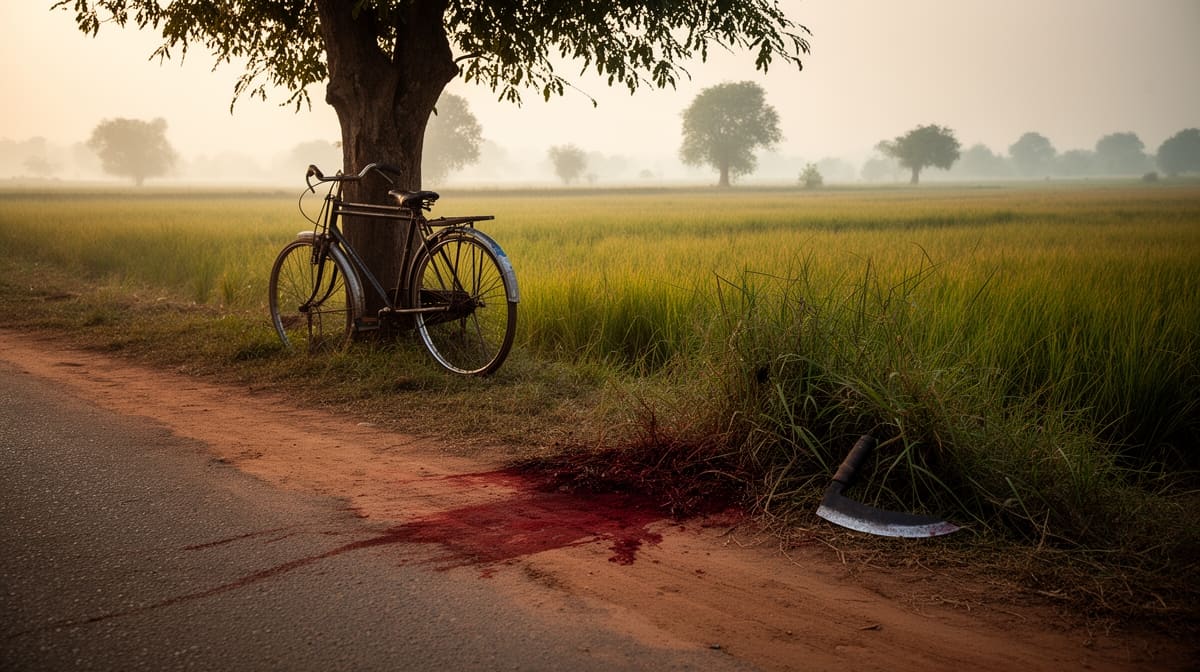
The case arose from the brutal murder of Suraj Deen, a 62-year-old farmer, on 15.07.1984 in his agricultural field near village Kanjora, District Unnao. The prosecution alleged that four cousins - Suresh, Awadhesh, Rakesh, and Santosh - attacked and beheaded Suraj Deen with a gandasa (axe-like weapon), while one of them held a country-made pistol. The motive was traced to a 24 - 25-year-old enmity stemming from the 1959 - 60 murder of Santosh’s father, Rajjan Tiwari, in which Suraj Deen had been named as an accused but acquitted.
Key Facts
- The incident occurred on 15.07.1984 at approximately 11:30 A.M. in a field half a mile south of the village.
- The deceased, Suraj Deen, was engaged in agricultural work, mending the boundary ridge of his field with a shovel (fawda).
- The complainant, PW-1 Brij Kishore, was Suraj Deen’s son and was ploughing the adjacent field at the time of the incident.
- Two other witnesses, PW-3 Amar Singh and PW-4 Ram Kumar alias Kallu, were present in nearby fields.
- The deceased had been involved in multiple prior disputes, including criminal cases under Sections 323, 326, 363, and 376 IPC, some filed by Brij Kishore himself.
- The weapon used (gandasa) was not recovered. The shovel (fawda) found at the scene was handed over to the complainant without a recovery memo.
- No bloodstains were found on the shovel or the deceased’s clothing.
- The severed head of the deceased was wrapped in polythene (momiya paper) and carried away by the accused.
- Brij Kishore filed a written complaint (Ext. Ka-1) at Ganga Ghat Police Station at 1:30 P.M. on the same day.
- The deceased’s body was taken for post-mortem on 16.07.1984.
- The post-mortem report (Ext. Ka-14) recorded four incised wounds, including a deep neck cut severing the larynx and upper oesophagus, consistent with a sharp weapon like an axe.
- The time of death was estimated to be around 11:00 - 11:30 A.M. on 15.07.1984.
- Brij Kishore was employed at the Kanpur Ordinance Factory and resided in Kanpur, but had returned to the village for agricultural work prior to the incident.
- Ram Kumar alias Kallu, the deceased’s nephew, was declared hostile during trial and denied witnessing the incident.
- Amar Singh, a witness with a prior conviction under Section 376 IPC, testified against the accused.
- The accused persons are all cousins and reside adjacent to the deceased’s house.
Procedural History
- 15.07.1984: Incident occurred at approximately 11:30 A.M. FIR (Ext. Ka-3) registered at Ganga Ghat Police Station at 1:30 P.M.
- 15.07.1984: Investigation commenced by Sub-Inspector Hari Shankar Singh.
- 15.07.1984: Inquest report (Ext. Ka-6) prepared; site plan (Ext. Ka-11) drawn; blood-stained and plain earth samples collected (Ext. Ka-5).
- 16.07.1984: Post-mortem conducted by Dr. O.P. Gupta; body sent for burial.
- 17.07.1984: Statement of Head Moharir recorded.
- 19.07.1984: Accused Santosh and Rakesh appeared before court.
- 20.07.1984: Accused Awadhesh and Suresh appeared before court.
- 23.07.1984: Statements of all accused recorded under Section 161 CrPC.
- 11.08.1984: Charge-sheet (Ext. Ka-12) submitted under Sections 302/34 and 201/34 IPC.
- 08.10.1986: IIIrd Additional Sessions Judge, Unnao, convicted all four accused and sentenced them to life imprisonment under Section 302/34 IPC and five years under Section 201/34 IPC, with sentences to run concurrently.
- 1986: Criminal Appeal No. 737 of 1986 filed before the Allahabad High Court.
- 07.01.2026: Appeal abated as appellants Suresh and Awadhesh died during pendency.
- 18.03.2026: Judgment delivered by the Division Bench of the Allahabad High Court.
The Parties' Positions
Appellants (Rakesh and Santosh): Argued that conviction was based solely on the testimony of PW-1 Brij Kishore, who was the deceased’s son and allegedly residing permanently in Kanpur. Contended that motive was remote (25-year-old enmity), no weapon was recovered, and two eyewitnesses (PW-3 and PW-4) were disbelieved. Asserted that investigative lapses - including non-recovery of weapon, absence of bloodstains, and defective inquest - rendered the prosecution case unreliable.
Respondent (State): Maintained that PW-1’s testimony was consistent, natural, and corroborated by medical evidence. Argued that motive, though ancient, was credible and supported by the familial enmity context. Emphasized that non-recovery of weapon and minor procedural lapses are not fatal where ocular testimony is reliable. Cited Supreme Court precedents affirming conviction on single eyewitness testimony.
Relief Sought
The surviving appellants, Rakesh and Santosh, sought quashing of the conviction and sentence under Sections 302/34 and 201/34 IPC, arguing that the trial court erred in relying on the testimony of a related and allegedly unreliable eyewitness, and that the prosecution failed to prove its case beyond reasonable doubt.
The Legal Issue
Can a conviction under Section 302 IPC be sustained solely on the testimony of a single eyewitness, even when the motive is remote, the weapon is not recovered, and the witness is the victim’s son?
Arguments Presented
For the Appellant
Counsel for Rakesh and Santosh contended that the conviction was unsustainable because it rested entirely on the testimony of PW-1 Brij Kishore, who was the deceased’s son and thus an interested witness. They argued that his presence at the scene was improbable given his employment in Kanpur, and that his conduct during and after the incident was unnatural. They highlighted the absence of recovery of the gandasa, lack of bloodstains on the shovel, and inconsistencies in witness statements - particularly the hostile testimony of PW-4 Ram Kumar and the discredited testimony of PW-3 Amar Singh, who had a prior conviction under Section 376 IPC. They relied on Mohd. Rojali Ali v. State of Assam to argue that the testimony of a related witness must be treated with extreme caution and cannot be the sole basis for conviction without corroboration. They further contended that the 25-year-old motive was too remote to establish intent and that defective investigation vitiated the entire prosecution case.
For the Respondent
The Government Advocate and counsel for the complainant argued that PW-1’s testimony was consistent, detailed, and remained unshaken during cross-examination. They emphasized that the Supreme Court in Anil Phukan v. State of Assam and Chandan v. State (NCT of Delhi) has held that conviction can be based on a single eyewitness if the testimony is reliable and inspires confidence. They submitted that motive is not a sine qua non in cases with direct ocular evidence, and that the ancient enmity was corroborated by the familial context and the nature of the attack. They cited Om Pal v. State of Uttar Pradesh to argue that non-recovery of the weapon is not fatal, and Brahm Swaroop v. State of U.P. to contend that minor investigative lapses do not invalidate a case supported by credible evidence. They maintained that the trial court’s appreciation of evidence was correct and that the High Court should not interfere unless there was a manifest error.
The Court's Analysis
The Court undertook a meticulous review of the evidence, beginning with the foundational principle under Section 134 of the Indian Evidence Act, which states that no particular number of witnesses is required to prove any fact. The Court emphasized that the law prioritizes quality over quantity of evidence.
"Indeed, conviction can be based on the testimony of a single eyewitness and there is no rule of law or evidence which says to the contrary provided the sole witness passes the test of reliability."
The Court cited Anil Phukan v. State of Assam to clarify that a single eyewitness’s testimony is sufficient for conviction if it is wholly reliable. Only when the witness is found to be wholly unreliable is corroboration required - and even then, it cannot cure a fundamentally unreliable account.
The Court found that PW-1 Brij Kishore’s testimony was clear, consistent, and detailed. He described the sequence of events with specificity: the arrival of the accused, the manner in which each participated, the use of the gandasa, the wrapping of the head in polythene, and the threats issued to witnesses. His presence in the village on the day of the incident was corroborated by his own deposition that he had returned from Kanpur for agricultural work, and his father’s routine of working in the field in the morning.
The Court rejected the argument that his employment in Kanpur rendered his presence improbable. It noted that no material evidence disproved his claim of being in the village, and his cross-examination did not expose any fabrication.
Regarding motive, the Court held that while motive is relevant in circumstantial cases, it loses significance where direct, credible eyewitness testimony exists. The Court relied on Chandan v. State (NCT of Delhi) and Shivaji Genu Mohite v. State of Maharashtra to affirm that absence of immediate provocation does not undermine a prosecution case grounded in ocular evidence.
"Motive assumes greater importance in cases based entirely on circumstantial evidence; it is not of decisive consequence where there is credible direct evidence."
The Court dismissed the argument that the 25-year-old enmity was too remote. It held that the longstanding familial hostility, coupled with the targeted nature of the attack (beheading), provided a plausible and sufficient motive.
On the issue of non-recovery of the weapon, the Court cited Om Pal v. State of Uttar Pradesh, holding that recovery is corroborative, not essential. The absence of bloodstains on the shovel was explained as potentially due to cleaning, time lapse, or limitations of forensic examination - none of which invalidated the ocular account.
The Court also addressed the argument that PW-1 was an interested witness. It distinguished between a "related" witness and an "interested" one, citing Mohd. Rojali Ali v. State of Assam and Dalip Singh v. State of Punjab. It held that mere familial relationship does not render testimony suspect. The Court found no evidence that PW-1 stood to gain from the conviction or harbored malice against the accused.
The Court further rejected claims of defective investigation. It relied on Brahm Swaroop v. State of U.P. and Dhanaj Singh v. State of Punjab, holding that procedural lapses - such as omission of weapon details in the inquest report or failure to prepare a recovery memo - do not vitiate the case if the substantive evidence is credible.
Finally, the Court rejected the notion that PW-1’s conduct was unnatural. It cited Marwadi Kishor Parmanand v. State of Gujarat, noting that human reactions to trauma vary, and no rigid standard can be applied.
The Verdict
The appeal was dismissed. The conviction of appellant no. 3 Rakesh and appellant no. 4 Santosh under Section 302 read with Section 34 IPC for life imprisonment, and under Section 201 read with Section 34 IPC for five years of rigorous imprisonment, was affirmed. The sentences were to run concurrently. The appellants, who were on bail, were directed to surrender within 15 days to serve their sentences. Their bail bonds were cancelled and sureties discharged. The trial court record was to be transmitted for compliance.
What This Means For Similar Cases
Conviction on Single Eyewitness Is Legally Valid
- Practitioners must argue that Section 134 of the Indian Evidence Act permits conviction on a single eyewitness if the testimony is credible, consistent, and inspires confidence.
- Do not automatically challenge convictions based on one witness - focus instead on testing reliability, not quantity.
- Cite Anil Phukan v. State of Assam and Chandan v. State (NCT of Delhi) to support the proposition that direct ocular testimony can sustain conviction even without corroboration.
Motive Is Not a Requirement in Direct Evidence Cases
- In murder trials with eyewitnesses, argue that motive is secondary. The absence of immediate provocation or a long-standing grudge does not create reasonable doubt.
- Use Shivaji Genu Mohite to counter defense arguments that delay in motive invalidates the prosecution.
- Emphasize that motive is a corroborative factor, not a foundational one, when direct evidence exists.
Related Witnesses Are Not Inherently Unreliable
- Do not concede that a victim’s son or close relative is automatically an "interested" witness.
- Distinguish between "related" (family tie) and "interested" (personal gain or malice) under Mohd. Rojali Ali and Dalip Singh.
- Argue that the Court’s duty is to assess consistency and intrinsic credibility - not to discard testimony based on relationship alone.
Non-Recovery and Investigative Lapses Are Not Fatal
- When the weapon is not recovered, cite Om Pal v. State of Uttar Pradesh to argue that it is not a sine qua non.
- For procedural lapses (e.g., incomplete inquest, missing recovery memo), rely on Brahm Swaroop v. State of U.P. and Dhanaj Singh v. State of Punjab to show that defects do not override credible substantive evidence.
- Stress that the burden is on the defense to prove that the lapses created reasonable doubt - not merely to point them out.
Human Conduct Cannot Be Judged by Hypothetical Norms
- When the defense attacks a witness’s behavior as "unnatural," cite Marwadi Kishor Parmanand to argue that trauma responses are individual and subjective.
- Avoid applying rigid expectations of how a witness "should" react - focus instead on the coherence of the testimony.