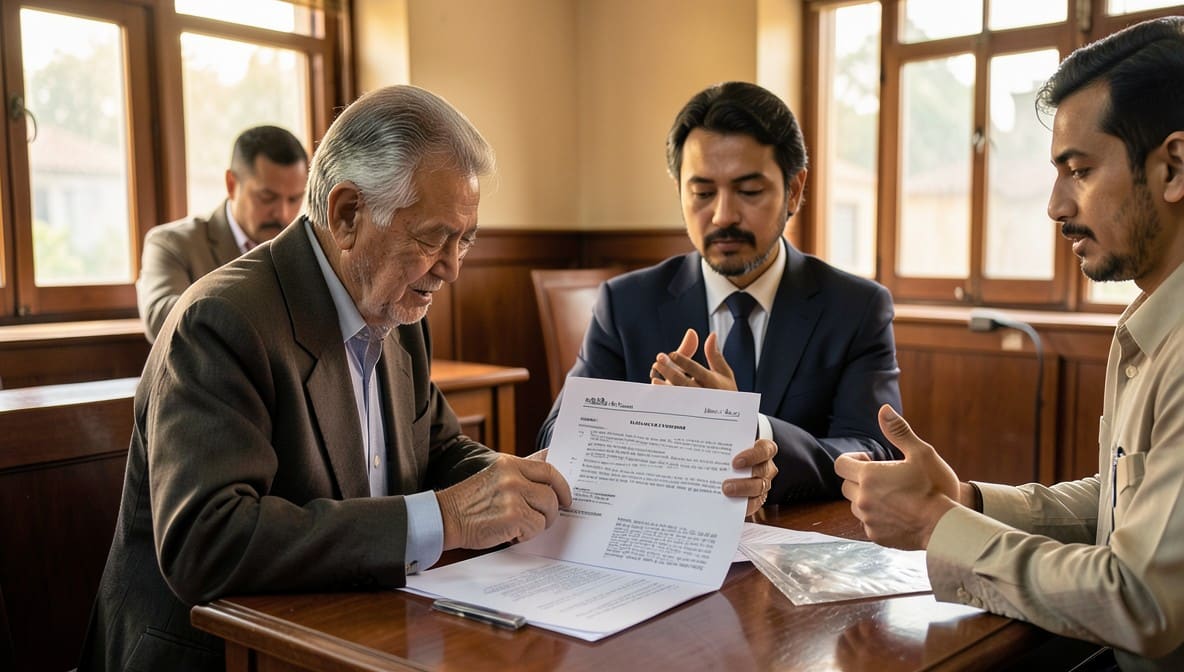
The Rajasthan High Court recently allowed a suspension of sentence application for two convicts serving life imprisonment under Section 302 of the Indian Penal Code (IPC). The Court observed that while the deceased died of asphyxia due to smothering, the injuries on the body were simple, and eyewitnesses did not allege smothering by the accused. Given the lack of misuse of bail during trial and the expected delay in appeal disposal, the Court suspended the sentence, imposing strict conditions for bail compliance.
Background & Facts
The Dispute
The applicants, Sayarmal (aged 72) and Deshraj (aged 23), residents of Sundarpura, Kotputli district, were convicted by the Additional & District Sessions Judge No. 1, Kotputli, in Sessions Case No. 14/2016 for offences under Sections 302, 120B, 365, 323, 342, and 143 IPC. The deceased, Bhojraj, allegedly died due to asphyxia caused by smothering after being beaten on suspicion of stealing a buffalo. The applicants were on bail during the trial but were sentenced to life imprisonment on 09.04.2026.
Key Facts
- 09.04.2026: Conviction and sentencing by the trial court under multiple IPC sections, including Section 302 (murder) and Section 120B (criminal conspiracy).
- Post-mortem report (Ex.P-21): Found injuries on the deceased to be simple; cause of death was asphyxia due to smothering.
- Medical board testimony: Dr. Ashvini Goyal (PW-10), Dr. Vishambhar Gupta (PW-11), and Dr. Prem Chand (PW-19) confirmed simple injuries and smothering as the cause of death.
- Eyewitness accounts: Sheeshram (PW-1) and Roshan (PW-6) alleged beating but did not attribute smothering to the applicants.
- Hospitalization: When the deceased’s condition deteriorated, the applicants, along with co-accused and family members, took him to the hospital.
- Bail during trial: The applicants were on bail with no allegations of misuse.
Procedural History
- Sessions Case No. 14/2016: Trial conducted before the Additional & District Sessions Judge No. 1, Kotputli.
- 09.04.2026: Conviction and sentencing under Sections 302, 120B, 365, 323, 342, and 143 IPC.
- Section 302 IPC: Life imprisonment and fine of Rs. 30,000; default: six months’ additional imprisonment.
- Section 120B IPC: Life imprisonment and fine of Rs. 30,000; default: six months’ additional imprisonment.
- Section 365 IPC: Five years’ rigorous imprisonment and fine of Rs. 5,000; default: two months’ additional imprisonment.
- Section 323 IPC: Six months’ rigorous imprisonment and fine of Rs. 500; default: one month’s additional imprisonment.
- Section 342 IPC: Six months’ rigorous imprisonment and fine of Rs. 500; default: fifteen days’ additional imprisonment.
- Section 143 IPC: Three months’ rigorous imprisonment and fine of Rs. 200; default: fifteen days’ additional imprisonment.
- Sentences: Ordered to run concurrently.
- 27.05.2026: Suspension of sentence application filed under Section 430 of the Bharatiya Nagarik Suraksha Sanhita, 2023 along with D.B. Criminal Appeal No. 180/2026.
Relief Sought
The applicants sought suspension of their substantive sentences during the pendency of their appeal, arguing that:
- The injuries on the deceased were simple, and the cause of death (smothering) was not directly attributed to them by eyewitnesses.
- They had cooperated during the trial and taken the deceased to the hospital when his condition worsened.
- They were on bail during the trial without any misuse.
- The appeal was likely to take time for disposal.
The Legal Issue
The central question before the Court was whether suspension of sentence under Section 430 of the Bharatiya Nagarik Suraksha Sanhita, 2023 could be granted to convicts serving life imprisonment for Section 302 IPC, where:
- The post-mortem report indicated simple injuries.
- Eyewitnesses did not allege smothering by the accused.
- The accused had cooperated during the trial and taken the deceased to the hospital.
Arguments Presented
For the Applicants
- Simple injuries: The post-mortem report and medical board testimony established that the injuries on the deceased were simple, and the cause of death was asphyxia due to smothering, which was not directly attributed to the applicants.
- Eyewitness accounts: The prosecution’s eyewitnesses (Sheeshram and Roshan) alleged only beating, not smothering, by the applicants.
- Cooperation: The applicants, along with co-accused and family members, took the deceased to the hospital when his condition deteriorated.
- Bail history: The applicants were on bail during the trial with no allegations of misuse.
- Delay in appeal: The hearing of the appeal was likely to take time, warranting suspension of sentence.
For the Respondent
- Gravity of offence: The State opposed the suspension, emphasizing the conviction under Section 302 IPC and the seriousness of the offence.
- Prosecution evidence: Relied on the post-mortem report and eyewitness accounts to argue that the applicants were involved in the deceased’s death.
The Court's Analysis
The Court examined the post-mortem report (Ex.P-21) and the testimony of the medical board, which confirmed that the injuries on the deceased were simple and the cause of death was asphyxia due to smothering. However, the Court noted that the prosecution’s eyewitnesses (Sheeshram and Roshan) did not allege that the applicants caused the deceased’s death by smothering; their testimony was limited to allegations of beating.
The Court also observed that when the deceased’s condition deteriorated, the applicants, along with co-accused and family members, took him to the hospital for treatment. Additionally, the applicants were on bail during the trial without any allegations of misuse.
"From the post-mortem report of the body of the deceased and the testimony of the members of medical board, it is reflected that injuries on the body of the deceased were found to be simple in nature and cause of death was opined to be asphyxia due to smothering. However, two eye witnesses relied upon by the prosecution namely Sheeshram (PW-1) and Roshan (PW-6) have not stated that the applicants caused death of deceased Bhojraj by strangulation rather, their only allegation is of beating the deceased."
Given these circumstances, the Court held that the applicants were entitled to suspension of sentence during the pendency of their appeal, as the appeal was likely to take time for disposal.
The Verdict
The Court allowed the suspension of sentence application. The substantive sentences awarded to the applicants by the trial court on 09.04.2026 were suspended during the pendency of the appeal. The applicants, Sayarmal and Deshraj, were directed to be released on bail, subject to the following conditions:
- Annual appearance: They must appear before the trial court in January of every year until the appeal is decided.
- Change of address: If the applicants or their sureties change their place of residence, they must inform the trial court and their High Court counsel in writing.
- Record maintenance: The trial court must maintain a separate file for the applicants’ attendance, registered as a Criminal Misc. Case relating to the original case.
The trial court was further directed to report to the High Court for cancellation of bail if the applicants failed to comply with these conditions.
What This Means For Similar Cases
Suspension of Sentence Not Automatic Even for Section 302 IPC
- Courts may grant suspension of sentence under Section 430 of the Bharatiya Nagarik Suraksha Sanhita, 2023 even for convictions under Section 302 IPC, if the evidence does not conclusively establish the accused’s direct involvement in the cause of death.
- The nature of injuries (simple vs. grievous) and the specificity of eyewitness accounts play a crucial role in determining whether suspension of sentence is warranted.
Cooperation and Bail History Matter
- The applicants’ cooperation in taking the deceased to the hospital and their clean bail record during the trial weighed in their favor.
- Practitioners should emphasize such factors in suspension applications to strengthen their case.
Strict Compliance Conditions for Bail
- Courts may impose stringent conditions for suspension of sentence, such as annual appearances and mandatory reporting of address changes.
- Non-compliance with these conditions can lead to cancellation of bail, as explicitly stated in this judgment.