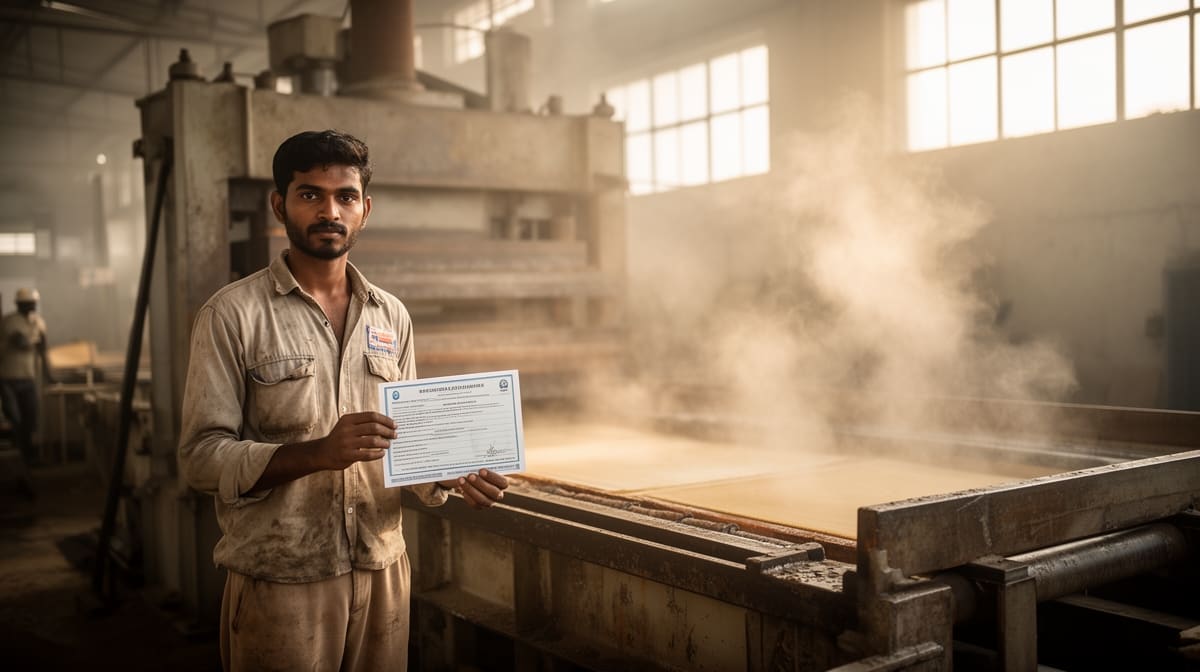
The Bombay High Court has clarified that termination of service due to persistent medical incapacity, even when linked to workplace conditions, does not constitute retrenchment under the Industrial Disputes Act, 1947. This ruling reinforces the statutory exclusion in Section 2(oo)(c) and sets a critical precedent for employers and employees navigating health-related separations.
Background & Facts
The Dispute
The petitioner, Suresh Vishram Sawant, was a permanent employee of Ceat Limited since 1972, working as a Curing Operator in the BOM Section. He alleged that prolonged exposure to heat, steam, and chemical fumes in the department led to the development of asthma and bronchitis from 1996 - 97 onward. Despite submitting medical certificates for absences, he was issued multiple show cause notices for excessive leave between 2000 and 2002. On 23 July 2002, he was terminated with immediate effect citing "continued ill health," without a domestic inquiry.
Procedural History
- 2002: Termination issued on grounds of medical incapacity; no disciplinary inquiry conducted
- 2002: Petitioner filed Complaint (ULP) No. 289 of 2002 before Labour Court, Thane under MRTU and PULP Act, 1971
- 2009: Labour Court held termination constituted unfair labour practice under Schedule IV, Items 1(a), (b), (d), (f), (g)
- 2012: Industrial Court allowed respondent’s revision, set aside Labour Court’s order, holding termination was not retrenchment
- 2012: Writ petition filed before Bombay High Court challenging Industrial Court’s order
Relief Sought
The petitioner sought reinstatement with back wages, arguing that termination without a domestic inquiry violated principles of natural justice and amounted to unfair labour practice under the MRTU and PULP Act.
The Legal Issue
The central question was whether termination of service on the ground of continued ill health, even if the illness arose from workplace conditions, constitutes retrenchment under Section 2(oo) of the Industrial Disputes Act, 1947, and whether a domestic inquiry is mandatory in such cases.
Arguments Presented
For the Petitioner
Counsel argued that termination without a domestic inquiry violated principles of natural justice. It was contended that the illness was work-related due to exposure to hazardous conditions and lack of protective gear, making the termination punitive in effect. The petitioner’s application under the Voluntary Retirement Scheme (VRS), submitted before the deadline, was claimed to have altered the nature of separation. Reliance was placed on Labour Court’s finding that absence was medically justified and thus could not be treated as misconduct.
For the Respondent
Counsel relied on Ceat Limited v. S.D. Sawant and Others to assert that termination for prolonged medical incapacity is legally permissible. It was emphasized that the employer had issued repeated warnings, accepted medical certificates, and never treated the absences as misconduct. The VRS application remained unaccepted and could not override the termination order. The Industrial Court correctly applied Section 2(oo)(c), which excludes such terminations from the definition of retrenchment.
The Court's Analysis
The Court examined the nature of the termination by scrutinizing the employer’s correspondence, the termination letter, and the statutory framework under the Industrial Disputes Act, 1947. It found that the employer consistently treated the matter as one of medical incapacity, not misconduct. No charge of unauthorized absence or indiscipline was framed. The Court emphasized that Section 2(oo)(c) explicitly excludes termination due to "continued ill health" from the definition of retrenchment.
"Clause (c) of Section 2(oo) specifically recognizes that where a workman is unable to continue in service due to persistent medical incapacity, the employer may terminate the employment on that ground."
The Court held that the absence of a domestic inquiry is not fatal because such terminations are not punitive. The requirement of natural justice applies only when stigma or punishment is involved. The Court further clarified that even if the illness originated from workplace conditions, the statutory exclusion remains unaffected unless the employer fabricated the ground to circumvent retrenchment procedures - a claim unsupported by evidence.
Regarding the VRS application, the Court noted that mere submission does not create a right to retirement; acceptance by the employer is mandatory. Subsequent communications to provident fund authorities referring to "resignation" or "voluntary retirement" were held to be administrative post-termination correspondence, incapable of altering the legal character of the termination.
The Industrial Court’s interpretation of Section 2(oo) was upheld as consistent with legislative intent. Courts cannot impose additional procedural requirements not mandated by statute.
The Verdict
The petitioner’s writ petition was dismissed. The Court held that termination on the ground of continued ill health, even if work-related, falls squarely within the statutory exception under Section 2(oo)(c) of the Industrial Disputes Act, 1947, and does not constitute retrenchment. No domestic inquiry was required, and the Industrial Court’s order was legally sound.
What This Means For Similar Cases
Termination for Ill Health Is Not Retrenchment
- Practitioners must distinguish between termination for incapacity and termination for misconduct
- Employers need not conduct domestic inquiries when terminating on medical grounds, provided the basis is genuine and documented
- Labour Courts cannot reclassify such terminations as unfair labour practices merely due to absence of inquiry
Workplace Causation Does Not Override Statutory Exclusion
- Even if an employee’s illness is proven to stem from hazardous working conditions, Section 2(oo)(c) remains applicable
- Claims for compensation or safety violations must be pursued separately under occupational safety laws, not through unfair labour practice petitions
- This judgment prevents misuse of MRTU and PULP Act to circumvent the clear statutory carve-out
VRS Applications Do Not Automatically Confer Rights
- Submission of a VRS application before deadline does not bind the employer to accept it
- Termination remains valid unless the VRS is formally approved
- Post-termination administrative letters referencing "voluntary retirement" cannot retrospectively alter the legal nature of the separation