The Calcutta High Court has clarified that statutory tenancy under Section 2(g) of the West Bengal Premises Tenancy Act, 1997 terminates five years after the death of the original tenant, rendering continued possession by the heir unlawful. This judgment reinforces the principle that admissions in pleadings, when clear and unequivocal, permit summary judgment without a full trial.
Background & Facts
The Dispute
The petitioner, Tapan Mitra, filed a title suit for eviction and mesne profits against the respondent, Tushar Chawla, concerning a residential flat at 7 Clarke Street, Kolkata-700026. The suit is grounded in the expiration of statutory tenancy under Section 2(g) of the West Bengal Premises Tenancy Act, 1997, following the death of the original tenant, Suresh Chawla, in 2004.
Key Facts
- The original landlord, Subarna Mitra (petitioner’s mother), inducted M/s. Kapoor and Chawla as tenants on 21.11.1970 for the entire second floor of the premises.
- The partnership firm dissolved in 1999, after which Pradip Kapoor and Suresh Chawla became independent tenants of the northern and southern portions respectively.
- Pradip Kapoor surrendered his tenancy in favour of the petitioner in June 2024.
- Suresh Chawla, the original tenant of the northern portion, died intestate on 29.11.2004.
- His wife, Karishma Chawla, inherited the tenancy and continued possession until her death on an unspecified date in 2021.
- The respondent, Tushar Chawla, is the sole son of Suresh Chawla and Karishma Chawla.
- No fresh tenancy agreement was ever executed between the petitioner and the respondent.
- Rent payments ceased from January 2010.
- The respondent has occupied the premises without payment since 2010.
- The respondent admitted in a prior suit affidavit that upon his father’s death, he and his mother jointly inherited the tenancy.
Procedural History
- 29.11.2004: Death of original tenant, Suresh Chawla.
- 21.11.2009: Five-year statutory tenancy period under Section 2(g) expired.
- 2021: Death of Karishma Chawla, widow of original tenant.
- 2023: Petitioner filed Title Suit No. 1676 of 2023 for eviction and mesne profits.
- 2025: Respondent filed written statement and counterclaim alleging adverse possession.
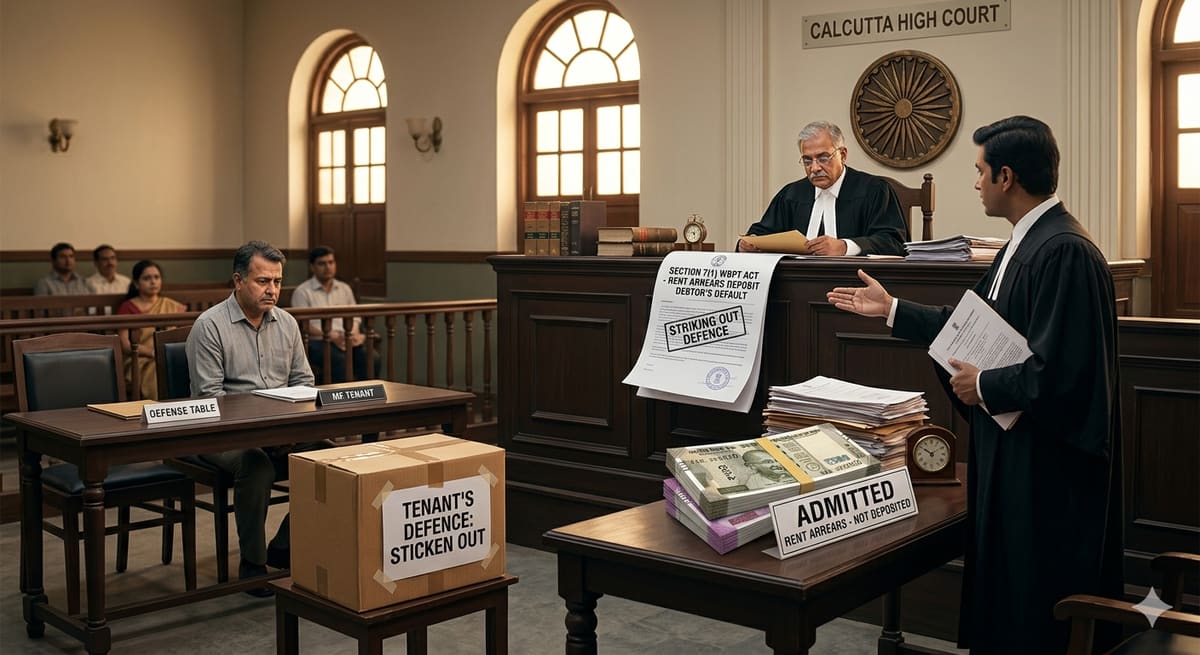
- 23.04.2025: Trial Court dismissed petitioner’s application under Order 12 Rule 6 CPC for summary judgment.
- 20.03.2026: Calcutta High Court heard the revisional application.
The Parties' Positions
For the Petitioner
The petitioner contended that the statutory tenancy under Section 2(g) expired in November 2009, five years after Suresh Chawla’s death. The widow’s protection ended with her death in 2021, leaving the respondent with no legal right to possession. The petitioner relied on the respondent’s own admission in a prior suit that he inherited tenancy upon his father’s death, thereby triggering Section 2(g). The petitioner argued that this admission was sufficient for summary judgment under Order 12 Rule 6 CPC.
For the Respondent
The respondent claimed continued tenancy rights, asserting adverse possession and challenging the petitioner’s title. He relied on a prior suit where he was held to be a tenant, arguing that this conferred permanent protection. He denied the applicability of Section 2(g) and contended that the petitioner had not established a clear right to possession.
Relief Sought
The petitioner sought a decree for khas and peaceful possession of the suit premises, along with mesne profits, costs, and interest. The application under Order 12 Rule 6 CPC was filed to obtain immediate possession based on the respondent’s admissions.
The Legal Issue
The central question was whether the respondent’s admission in prior proceedings that he inherited tenancy upon his father’s death, combined with the undisputed facts of the statutory five-year limit under Section 2(g) of the West Bengal Premises Tenancy Act, 1997, permitted the court to grant summary judgment under Order 12 Rule 6 CPC without a full trial.
Arguments Presented
For the Appellant/Petitioner
The petitioner relied on Rajiv Ghosh v. Satya Naryan Jaiswal (2025 SCC OnLine SC 751) to establish that Section 2(g) grants statutory tenancy only for five years after the original tenant’s death, excluding the son unless he qualifies under the proviso. The petitioner emphasized that the respondent’s own affidavit in the prior suit admitted inheritance of tenancy, which triggered the five-year clock. The petitioner further cited E.D. Enterprises Pvt. Ltd. v. Kaiser Begum (2022 SCC OnLine Cal 4428) and Uttam Singh v. United Bank of India (2000) to argue that clear admissions permit summary judgment under Order 12 Rule 6 CPC. The petitioner contended that the respondent’s claim of adverse possession was contradictory to his admission of tenancy and thus meritless.
For the Respondent/State
The respondent argued that the prior suit’s finding that he was a tenant conferred permanent rights and that the petitioner had not established clear title. He contended that the absence of a formal tenancy agreement and the passage of time rendered the statutory period inapplicable. He further claimed that the petitioner’s delay in filing the suit amounted to laches and that a full trial was necessary to determine possession.
The Court's Analysis
The Court examined the statutory framework under Section 2(g) of the West Bengal Premises Tenancy Act, 1997, and the procedural mechanism under Order 12 Rule 6 CPC. It held that the definition of "tenant" under Section 2(g) explicitly limits succession rights to five years after the death of the original tenant, with the sole exception of the spouse, who enjoys lifetime protection.
"Thus, the plain reading of Section 2(g) referred to above would indicate that the dependent heir of the original tenant unless she is the widow of the original tenant would be entitled to carry on as a tenant [...] for a period of 5 years from the demise of the original tenant."
The Court noted that the respondent’s own admission in the prior suit - that he inherited tenancy upon his father’s death - was not merely a denial but a positive assertion of legal status under the Act. This admission, coupled with the undisputed timeline (death in 2004, widow’s death in 2021, rent non-payment since 2010), rendered the respondent’s continued possession unlawful after November 2009.
The Court further held that the prior litigation, which concerned a license dispute during the lifetime of the original landlord, was irrelevant to the current claim based on statutory tenancy under Section 2(g). The Court emphasized that the respondent’s plea of adverse possession was irreconcilable with his admission of tenancy, citing Brij Narayan Shukla v. Sudesh Kumar and Nand Ram v. Jagdish Prasad.
Regarding Order 12 Rule 6 CPC, the Court reiterated that the provision is discretionary and permissive, designed to avoid unnecessary trials when facts are admitted. The Court observed:
"The purpose of this Rule is for either party to get rid of so much of the rival claims about which there is no controversy."
The Court concluded that the facts were undisputed and the legal consequences clear. The respondent’s possession was unauthorized after the statutory period expired, and the petitioner was entitled to immediate possession.
The Verdict
The Calcutta High Court allowed the revision and set aside the Trial Court’s order dated 23.04.2025. The Court directed the Trial Court to draw a decree for khas and peaceful possession of the suit premises in favour of the petitioner. The remaining claims for mesne profits, costs, and interest are to be adjudicated by the Trial Court in accordance with law. The respondent’s possession is deemed unlawful as of 29.11.2009, five years after the death of the original tenant.
What This Means For Similar Cases
Statutory Tenancy Has a Fixed Expiry
- Practitioners must calculate the five-year window under Section 2(g) from the date of the original tenant’s death, not from the death of the widow.
- Tenants who are sons, daughters, or parents lose statutory protection after five years, regardless of whether the widow survives longer.
- Claims of adverse possession are invalid if the occupant admits to being a statutory tenant under the Act.
Admissions Under Order 12 Rule 6 CPC Are Binding
- Clear admissions in pleadings or affidavits, even if made in prior proceedings, can trigger summary judgment.
- Courts are empowered to grant possession without trial when the legal consequence of an admission is unambiguous.
- Delay in filing eviction suits does not cure unlawful possession if the statutory tenancy has expired.
Litigation Strategy Shift
- Landlords should identify and document admissions made by tenants in prior litigation.
- Applications under Order 12 Rule 6 CPC should be filed promptly upon establishing clear admissions and statutory expiry.
- Defences based on prior tenancy findings are ineffective if the cause of action in the current suit is distinct and grounded in statutory termination.