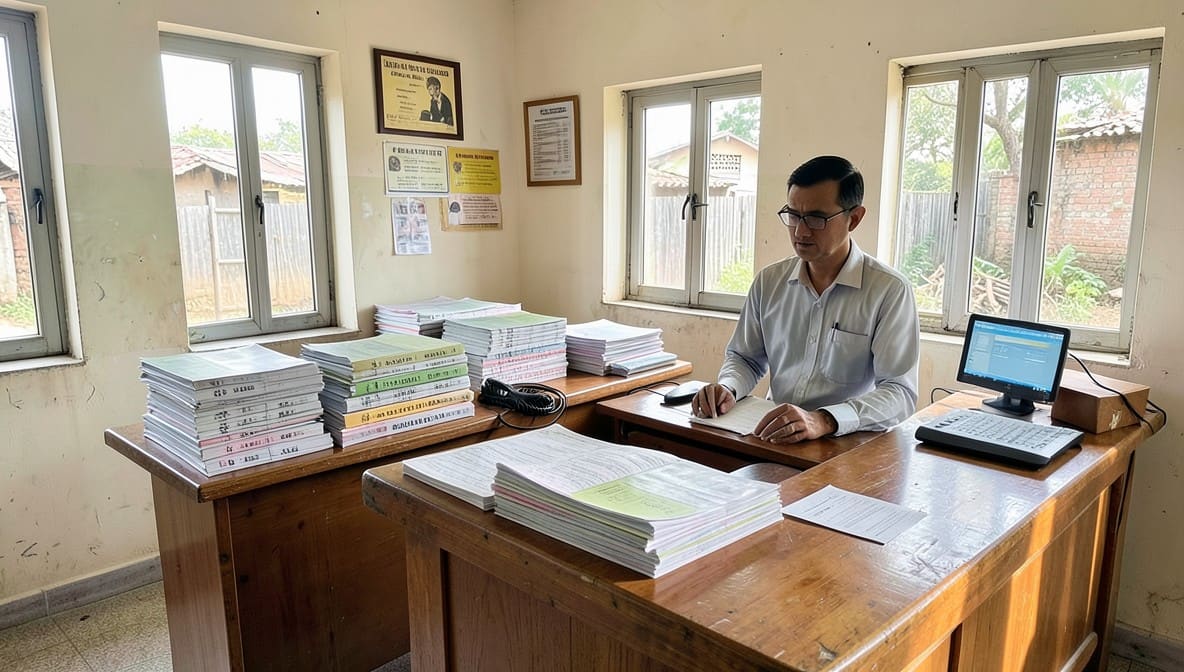
The Madhya Pradesh High Court has clarified that successive applications under Section 29 of the Madhya Pradesh Land Revenue Code, 1959 are not barred by law, overturning a lower revenue authority’s dismissal on procedural grounds. This ruling reinforces the principle that statutory provisions must be interpreted according to their plain text and purpose, not by implied restrictions.
Background & Facts
The Dispute
The petitioner, Karamat S/o Ameer Patel, filed an application under Section 29 of the Madhya Pradesh Land Revenue Code, 1959 seeking transfer of Revenue Case No. 0011/A-70/2024-25 from the Tehsildar to another Revenue Officer. The application was dismissed by the Additional Commissioner, Indore Division, on 12.02.2026 on the ground that a prior application under the same provision had already been granted, rendering the second application non-maintainable.
Key Facts
- Revenue Case No. 0011/A-70/2024-25 pertains to a land revenue dispute involving title, possession, and assessment.
- The petitioner filed his first application under Section 29 on an earlier date, which was accepted and resulted in the transfer of the case to the Tehsildar for hearing.
- On 24.12.2025, the petitioner filed a second application under Section 29, alleging apprehension of bias and procedural irregularity in the ongoing proceedings before the Tehsildar.
- The second application was supported by a detailed affidavit from the petitioner, outlining specific grounds for transfer, including delay, lack of impartiality, and risk of prejudice.
- The Additional Commissioner dismissed the second application on 12.02.2026, stating it was not maintainable because a prior application had been allowed, and that no cogent reasons were assigned.
- No substantive consideration was given to the averments in the affidavit or the factual basis for the second application.
Procedural History
- 24.12.2025: Petitioner files second application under Section 29 of the MP Land Revenue Code, supported by affidavit (Annexure P/5).
- 12.02.2026: Additional Commissioner, Indore Division, dismisses the application, holding successive applications under Section 29 are not maintainable.
- 17.03.2026: Petitioner files MISC. PETITION NO. 1533 OF 2026 under Article 227 of the Constitution before the Madhya Pradesh High Court, Indore Bench.
- 17.03.2026: Hearing conducted on admission and IA No. 2161 of 2026 for stay.
The Parties' Positions
Petitioner (Original Plaintiff): Argued that Section 29 contains no express or implied bar on successive applications. Emphasized that each application must be judged on its own merits, particularly when new facts or apprehensions arise. Cited the detailed affidavit and factual basis as sufficient grounds for reconsideration.
Respondent (Additional Commissioner): Contended that since a prior application under Section 29 had been granted, a second application is inherently non-maintainable. Asserted that the petitioner failed to assign new or cogent reasons, and that the dismissal was procedural and not substantive.
Relief Sought
The petitioner sought: (1) setting aside of the impugned order dated 12.02.2026; (2) direction to the Additional Commissioner to reconsider the Section 29 application on its merits; and (3) interim stay on the Tehsildar from passing any final order in Revenue Case No. 0011/A-70/2024-25 until reconsideration is complete.
The Legal Issue
The central question was whether Section 29 of the Madhya Pradesh Land Revenue Code, 1959 permits successive applications for transfer of a revenue case, or whether a prior successful application bars a subsequent one.
Arguments Presented
For the Petitioner
The petitioner’s counsel argued that Section 29 is a remedial provision designed to ensure justice, and its language is permissive, not restrictive. No clause prohibits multiple applications, and the provision empowers the Commissioner to act whenever transfer is expedient for the ends of justice. The affidavit attached to the second application contained specific, non-frivolous grounds warranting reconsideration. Reliance was placed on the principle that statutory powers must be interpreted liberally when intended to secure justice.
For the Respondent
The Additional Commissioner’s position, as presented in the impugned order, was that since the first application had already resulted in transfer, a second application under the same provision is redundant and not maintainable. The respondent argued that the petitioner had not demonstrated any new or material change in circumstances to justify a second application, and that allowing successive applications would lead to abuse of process.
The Court's Analysis
The Court undertook a textual analysis of Section 29, which states: "Whenever it appears that an order is expedient for the ends of justice, the Board may direct that any particular case be transferred..." and "The Commissioner may, if he is of the opinion that it is expedient for the ends of justice, order that any particular case be transferred..."
The Court observed that the provision contains no limitation on the number of applications that may be filed. It does not require that the transfer be granted only once, nor does it condition subsequent applications on the failure of the first. The phrase "whenever it appears" is inherently temporal and situational, implying that circumstances may change, and new grounds may emerge.
"Application dated 24.12.2025 under Section 29 of the Code... by which the sequence of events and apprehension have been mentioned vividly and the same was also supported by affidavit of petitioner... these averments... have not been considered in right perspective."
The Court held that the Additional Commissioner erred in dismissing the application on the sole ground of prior maintainability, without examining the substance of the new averments. The existence of an affidavit detailing apprehensions of bias and procedural irregularity rendered the dismissal arbitrary and contrary to the spirit of the provision. The Court emphasized that administrative tribunals must engage with factual submissions, not dispose of matters on formalistic grounds.
The Court further noted that the power under Section 29 is not a one-time remedy but a continuing authority vested in the Commissioner to ensure fair adjudication. Denying a second application without substantive review violates the principle of natural justice and the statutory mandate to act for the ends of justice.
The Verdict
The petition was allowed. The impugned order dated 12.02.2026 was set aside. The Additional Commissioner, Indore Division, was directed to reconsider the petitioner’s Section 29 application dated 24.12.2025 in light of the facts and affidavit submitted. In the interim, the Tehsildar was restrained from passing any final order in Revenue Case No. 0011/A-70/2024-25 until reconsideration is complete.
What This Means For Similar Cases
Successive Applications Are Not Per Se Invalid
- Practitioners may file multiple applications under Section 29 if new factual grounds arise, even after a prior transfer.
- Each application must be evaluated on its own merits, not dismissed on the basis of prior filing alone.
- Affidavits detailing apprehensions of bias, delay, or procedural irregularity constitute sufficient grounds for reconsideration.
Substantive Review Is Mandatory
- Revenue authorities cannot dismiss applications with boilerplate reasoning such as "not maintainable" or "no cogent reasons" without engaging with the substance.
- The burden is on the authority to record reasons for rejection, not on the applicant to prove the futility of a prior application.
- Failure to consider sworn affidavits renders orders liable to be set aside under Article 227.
Procedural Fairness Trumps Formalism
- The ends of justice under Section 29 override procedural technicalities.
- Courts will intervene where administrative bodies treat remedial provisions as one-time mechanisms.
- This judgment reinforces that statutory powers intended to secure justice must be interpreted expansively, not restrictively.