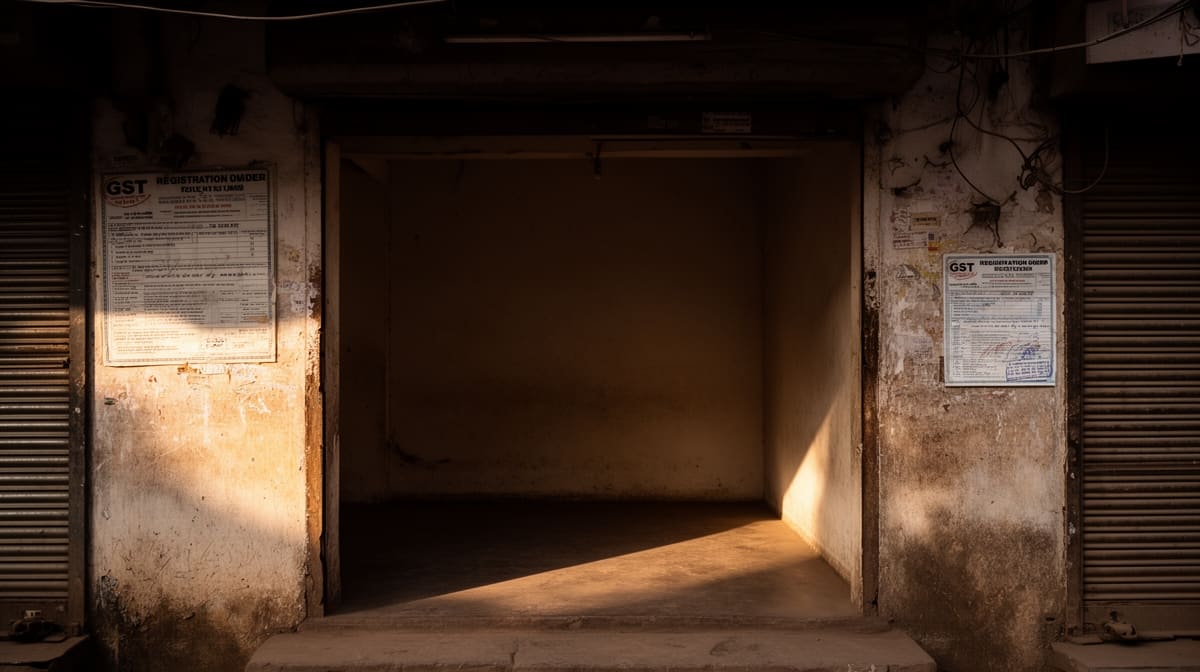
The Punjab and Haryana High Court has reaffirmed that retrospective cancellation of GST registration without explicit notice of such intent violates the fundamental principles of natural justice. This judgment clarifies that even where statutory power exists for retrospective action, procedural fairness demands clear communication of the proposed consequence to the affected taxpayer.
Background & Facts
The Dispute
The petitioner, Shri Ram and Sons, was issued a show cause notice dated 19.05.2023 proposing cancellation of its GST registration on the ground that "PV conducted on 19.05.2023 but at declared PPoB other firm was functioning." No written response was filed by the petitioner. Subsequently, on 23.06.2023, the GST authorities cancelled the petitioner’s registration with retrospective effect w.e.f. 20.05.2019. The petitioner challenged this cancellation through multiple statutory remedies, all of which were rejected.
Key Facts
- The petitioner’s GST registration was originally granted under valid circumstances.
- The show cause notice dated 19.05.2023 cited only one ground: presence of another firm at the declared place of business.
- The notice did not mention, suggest, or imply that cancellation would be retrospective.
- No supporting documents or evidence were attached to the notice.
- The retrospective effect (w.e.f. 20.05.2019) was introduced for the first time in the cancellation order dated 23.06.2023.
- The petitioner filed an application under Section 30 of the CGST Act, 2017 for revocation of cancellation on 24.06.2023.
- The revocation application was rejected on 27.07.2023.
- The petitioner filed a statutory appeal against the cancellation order, which was dismissed by the Appellate Authority on 07.02.2024.
Procedural History
- 19.05.2023: Show cause notice issued proposing cancellation of GST registration.
- 23.06.2023: GST registration cancelled retrospectively w.e.f. 20.05.2019.
- 27.07.2023: Revocation application under Section 30 CGST Act rejected.
- 07.02.2024: Statutory appeal dismissed by Appellate Authority.
- 29.04.2026: Writ petition filed before the Punjab and Haryana High Court.
The Parties' Positions
The petitioner contended that the retrospective cancellation was procedurally flawed and violative of natural justice. The respondents did not dispute the absence of notice regarding retrospective effect but argued that the underlying facts justified cancellation.
Relief Sought
The petitioner sought quashing of the show cause notice dated 19.05.2023, the cancellation order dated 23.06.2023, the revocation rejection dated 27.07.2023, and the appellate order dated 07.02.2024. The petitioner also sought restoration of its GST registration.
The Legal Issue
The central question was whether Section 29(2) of the CGST Act, 2017 permits retrospective cancellation of GST registration without the taxpayer being given prior notice of such intent, and whether such omission violates the principles of natural justice.
Arguments Presented
For the Petitioner
The petitioner relied on the principle that a show cause notice must clearly state the nature and consequences of the proposed action, including any retrospective effect. It cited ORYX Fisheries Pvt. Ltd. v. Union of India to establish that quasi-judicial authorities must act fairly and provide a reasonable opportunity of being heard. It argued that the absence of any mention of retrospective cancellation in the notice rendered the entire proceeding void ab initio. The petitioner further relied on the recent Division Bench judgment in M/s Bansal Casting v. Union of India, which directly addressed identical facts and held that retrospective cancellation without notice is impermissible.
For the Respondent
The respondents did not contest the absence of notice regarding retrospective effect. Their counsel conceded that the show cause notice did not mention the proposed retrospective effect but argued that the underlying facts (presence of another firm at the registered place of business) justified cancellation. They contended that the statutory power under Section 29(2) was sufficient to justify the action, irrespective of procedural lapses.
The Court's Analysis
The Court examined the statutory framework under Section 29 of the CGST Act, 2017, which permits cancellation of registration, including retrospectively, but only upon compliance with procedural safeguards. The Court emphasized that while the power to cancel retrospectively exists, its exercise is not unfettered. The Court held that the right to be heard is not a mere formality but a substantive guarantee under Article 14 and Article 21 of the Constitution.
"It is well settled that a quasi-judicial authority, while acting in exercise of its statutory power must act fairly and must act with an open mind while initiating a show cause proceeding. A show cause proceeding is meant to give the person proceeded against a reasonable opportunity of making his objection against the proposed charges indicated in the notice."
The Court noted that the show cause notice failed to indicate that cancellation would be retrospective, thereby depriving the petitioner of the opportunity to present relevant facts, documents, or arguments regarding the period 20.05.2019 to 18.05.2023. The Court further held that the absence of attached documents or materials, as referenced in the notice, compounded the procedural defect.
The Court found the petitioner’s case indistinguishable from M/s Bansal Casting v. Union of India, where the same Division Bench had held that retrospective cancellation without notice is legally unsustainable. The Court rejected the respondents’ attempt to distinguish the precedent, noting that the legal principle applied universally to all taxpayers.
The Court concluded that the show cause notice, cancellation order, revocation rejection, and appellate order were all vitiated by the failure to provide fair notice. The Court emphasized that the power to cancel retrospectively cannot be exercised in a manner that circumvents the basic requirements of natural justice.
The Verdict
The petition was allowed. The Court set aside the show cause notice dated 19.05.2023, the cancellation order dated 23.06.2023, the revocation rejection dated 27.07.2023, and the appellate order dated 07.02.2024. The respondents are granted liberty to initiate fresh proceedings for retrospective cancellation of the petitioner’s GST registration, provided they issue a new show cause notice clearly indicating the intent to cancel with retrospective effect and afford the petitioner a full opportunity to respond.
What This Means For Similar Cases
Notice Must Explicitly Mention Retrospective Effect
- Practitioners must now argue that any show cause notice proposing retrospective cancellation under Section 29 CGST Act must explicitly state the proposed retrospective date.
- Failure to do so renders the entire proceeding void, regardless of the merits of the underlying allegation.
Procedural Defects Cannot Be Curried by Subsequent Orders
- Even if the facts justify cancellation, a procedural flaw in the notice cannot be cured by the final order or appellate decision.
- Taxpayers can challenge cancellation orders at any stage on the ground of non-compliance with natural justice.
Documentation and Evidence Must Be Disclosed
- If a show cause notice refers to attached documents, those documents must be physically or electronically provided to the taxpayer.
- Non-disclosure of material relied upon invalidates the proceeding, as held in ORYX Fisheries and reaffirmed here.
Precedent Binding Across Jurisdictions
- The Bansal Casting precedent is binding on all GST authorities within the jurisdiction of the Punjab and Haryana High Court.
- Similar writ petitions in other states may cite this judgment to challenge retrospective cancellations lacking notice.
Burden of Proof Shifts to the Authority
- The onus now lies on the tax authority to prove that the notice clearly communicated the possibility of retrospective cancellation.
- Taxpayers need not prove prejudice; the mere absence of notice is sufficient to invalidate the order.
No Automatic Validity for Retrospective Orders
- Authorities cannot assume that retrospective effect is implied or understood.
- Every retrospective action must be expressly justified and notified.
Legal Principle Applied
- Natural Justice requires that no one shall be condemned unheard (audi alteram partem).
- Procedural Fairness is non-negotiable even under statutory powers.
- Statutory Power ≠ Unfettered Discretion.
Practical Takeaway
- Tax practitioners must scrutinize show cause notices for any omission of retrospective effect.
- If absent, file a writ petition immediately - the defect is fatal and cannot be waived.
- Do not rely on subsequent hearings or appeals to cure defective notices.
Key Statutory Provision
- Section 29(2) of the CGST Act, 2017 permits cancellation with retrospective effect, but only if the procedure under Section 29(1) is followed - including issuance of a reasoned show cause notice.
Key Precedent Cited
- ORYX Fisheries Pvt. Ltd. v. Union of India, 2010(13) SCC 427
- M/s Bansal Casting v. Union of India, CWP-16770-2024, dated 20.02.2026 (Punjab & Haryana HC)
Case Citation
- Shri Ram and Sons v. Commissioner, CGST, Ludhiana, CWP-13032-2026, decided on 29.04.2026
Court
- Punjab and Haryana High Court
Judges
- Justice Deepak Sibal
- Justice Rohit Kapoor
Date of Judgment
- 29 April 2026
Advocates
- Petitioner: Mr. Mukul Singla
- Respondent: Ms. Isha Janjua (through VC), for Mr. Ajay Kalra, Sr. Standing Counsel
Relevance
- Lawyer Relevance: High
- Public Relevance: High