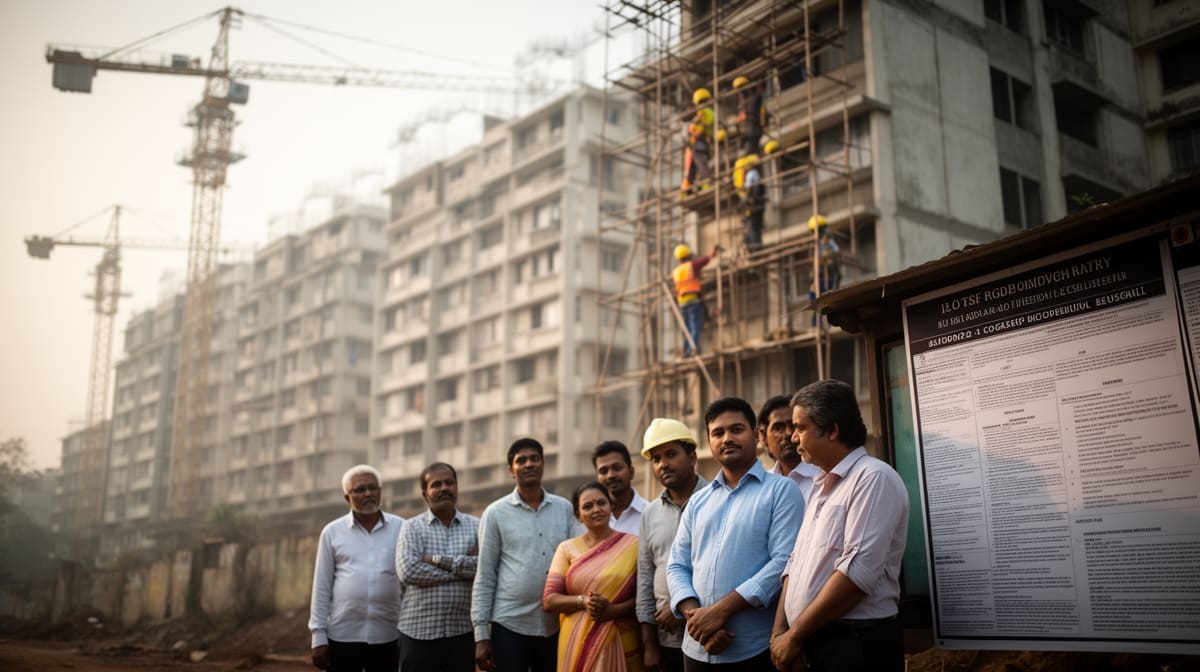
The Bombay High Court has reaffirmed a foundational principle of arbitration law: arbitrators are bound by the express terms of the contract and cannot substitute judicial equity for contractual obligations. This judgment clarifies the limits of arbitral discretion under Section 34 of the Arbitration and Conciliation Act, 1996, and provides critical guidance for practitioners handling redevelopment disputes.
Background & Facts
The Dispute
The dispute arose from a redevelopment project of the New Deepali Co-operative Housing Society in Vile Parle, Mumbai. The Society, facing structural deterioration and a Section 354 notice from the Municipal Corporation, entered into a Development Agreement with Akme Properties in 2016. The agreement provided for compensation to members, including corpus fund/hardship compensation and monthly displacement compensation, contingent on handover of possession and execution of a tripartite agreement for permanent alternate accommodation.
Procedural History
- July 2016: Development Agreement executed between the Society and Akme Properties.
- 2017 - 2018: Majority members signed agreements for alternate accommodation; Petitioners (minority members) refused, citing fraud and misrepresentation in the agreement’s execution.
- March 2018: Bombay HC ordered Petitioners to vacate their flats within 48 hours; building demolished.
- September 2018: Court appointed a sole arbitrator under Section 11 of the Arbitration Act.
- December 2022: Arbitrator issued award denying corpus fund and monthly displacement compensation to Petitioners on grounds of "hardship caused to the developer," while rejecting the developer’s claim for proportionate loss.
- 2025: Petitioners filed Section 34 challenge to the award.
Relief Sought
The Petitioners sought to set aside the arbitrator’s denial of corpus fund/hardship compensation and monthly displacement compensation, arguing that the award violated the express terms of the Development Agreement and impermissibly invoked equitable principles without contractual authorization.
The Legal Issue
The central question was whether an arbitral tribunal, under Section 28(2) of the Arbitration and Conciliation Act, 1996, may deny contractual benefits to a party on grounds of equity or hardship, when the contract contains no forfeiture clause and the tribunal has already rejected the opposing party’s claim for damages.
Arguments Presented
For the Petitioner
Counsel relied on Section 28(2) of the Arbitration Act, which prohibits arbitral tribunals from deciding ex aequo et bono unless expressly authorized. He argued that the arbitrator’s denial of compensation was not based on contractual interpretation but on an ad hoc assessment of fairness, effectively rewriting the agreement. He cited Associated Engineering Co. v. Government of Andhra Pradesh to assert that conscious disregard of contract terms vitiates an award. He further contended that the payment obligations under Clauses 1.4 - 1.5 and 4.1 - 4.3 were triggered by execution of the agreement, not by handover of possession or execution of alternate accommodation agreements.
For the Respondent
Counsel for Akme Properties argued that the Petitioners’ obstruction caused significant delay and financial hardship, justifying the denial of benefits. She contended that the arbitrator’s findings were factual and not subject to re-appreciation under Section 34. She also asserted that the tripartite agreement was a necessary precondition for entitlement to compensation, and that the Petitioners’ refusal to execute it rendered them ineligible.
The Court's Analysis
The Court conducted a meticulous review of the Development Agreement and the arbitrator’s reasoning. It emphasized that the arbitrator had already rejected the developer’s claim for proportionate loss due to insufficient evidence of damages. Yet, the same tribunal denied the Petitioners’ statutory entitlements under the contract on the basis of "hardship caused to the developer" - a contradiction that amounted to indirect relief to the developer.
"The denial of benefits amounts to forfeiting the Petitioner’s right to the payments which forfeiture can take place only under the express terms of the development agreement."
The Court held that Clauses 1.4 - 1.5 and 4.1 - 4.3 were clear, unambiguous, and unconditional. The corpus fund was payable as predetermined compensation for granting redevelopment rights, not as a reward for timely cooperation. Similarly, monthly displacement compensation was triggered upon execution of the agreement, with escalation tied to the issuance of the Occupation Certificate - not the signing of alternate accommodation agreements.
The Court further held that invoking equity to deny contractual rights violated Section 28(2), which explicitly restricts ex aequo et bono adjudication to cases of express party authorization. The arbitrator’s reliance on fairness, without contractual basis, constituted a jurisdictional error.
The Court applied the principle from Gayatri Balasamy v. ISG Novasoft Technologies Ltd., holding that the impugned findings on compensation were severable from the rest of the award, which remained valid. The arbitrator’s rejection of the developer’s claim for loss was unaffected.
The Verdict
The Petitioners succeeded. The Bombay High Court quashed the arbitrator’s denial of corpus fund/hardship compensation and monthly displacement compensation. The Court directed that the Petitioners be paid these benefits on par with other members, with monthly compensation to commence from March 23, 2018, the date of the Court’s vacate order. The award was modified, not set aside in its entirety.
What This Means For Similar Cases
Contractual Terms Trump Equitable Discretion
- Practitioners must argue that any denial of contractual benefits must be grounded in express contractual provisions, not judicial notions of fairness.
- Arbitrators who deny payments based on "hardship" or "conduct" without contractual authorization risk having their awards set aside under Section 34.
- In redevelopment disputes, compensation clauses tied to execution of agreement - not cooperation - are enforceable regardless of subsequent obstruction.
Severability of Illegal Provisions Is Permissible
- Courts may sever unlawful portions of an arbitral award if they are not inseparably intertwined with valid findings.
- This allows parties to preserve valid portions of awards while challenging only the legally infirm parts.
- Practitioners should structure Section 34 petitions to isolate specific illegal findings for targeted challenge.
Clause Drafting Must Be Explicit for Equity-Based Adjustments
- Developers and societies must include explicit forfeiture, penalty, or conditional entitlement clauses if they intend to link compensation to member conduct.
- Absent such clauses, even prolonged obstruction cannot justify withholding statutorily mandated payments.
- Future agreements should specify consequences of non-cooperation to avoid arbitral overreach.