The Himachal Pradesh High Court has clarified that failing to maintain a safe distance from a vehicle ahead, in violation of Rule 23 of the Road Rules Regulations, 1989, constitutes rash driving under Section 279 of the Indian Penal Code, even in the absence of evidence on exact speed. This ruling overturns an acquittal and reinforces that proximate cause, not mere speed, determines criminal negligence in road accidents.
Background & Facts
The Dispute
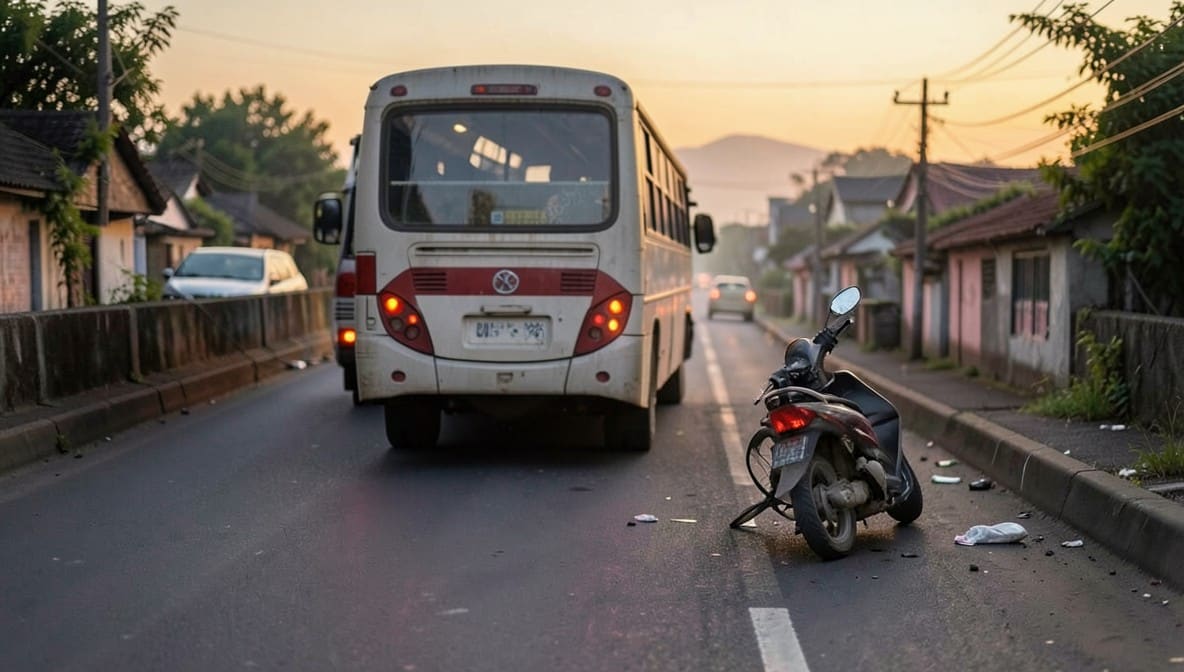
The respondent, Kaman Kumar, was charged with offences under Sections 279, 337, and 338 of the Indian Penal Code (IPC), and Sections 181 and 187 of the Motor Vehicles Act, following a rear-end collision on 01.10.2001 near Bharmoli, District Kangra, Himachal Pradesh. The accident involved a scooter bearing registration No. PB-02H-7398, driven by the respondent, which struck the rear of a stationary bus (HP-38-3632) operated by Suresh Kumar (PW3). The pillion rider on the scooter, Gopal Dass (PW14), sustained injuries and was hospitalized.
Key Facts
- The accident occurred at approximately 3:30 PM on 01.10.2001 on a road 18 feet wide.
- The bus had stopped to allow passengers to disembark.
- The scooter, driven by the respondent, collided with the rear of the bus.
- Gopal Dass (PW14), the pillion rider, sustained simple and grievous injuries.
- The scooter was seized and mechanically examined by Ravinder Singh (PW5), who found no mechanical defect.
- The respondent did not possess a valid driver’s license at the time of the accident.
- The respondent’s statement under Section 313(5) Cr.P.C. admitted that he was driving the scooter and claimed the bus driver suddenly braked.
- The prosecution examined 14 witnesses, including eyewitnesses Lata Devi (PW6) and Baldev Singh (PW12), who stated the scooter was being driven at high speed.
- Dr. Vivek Sood (PW1) and Dr. Rajeev Sehgal (PW2) confirmed injuries consistent with a motor vehicle accident.
- The FIR (Ext.PW9/A) was registered on the same day.
- The site plan (Ext.PW13/A) and photographs (Ext.PH-1 to Ext.PH6) were submitted as evidence.
Procedural History
- 01.10.2001: Accident occurred near Bharmoli.
- 01.10.2001: FIR registered at Police Station, Bharmoli.
- 02.04.2014: Trial Court acquitted the accused of Sections 279, 337, and 338 IPC, but convicted him under Section 181 MV Act.
- 15.05.2026: Judgment delivered by the High Court on appeal.
The Parties' Positions
For the State (Appellant)
- Argued that the Trial Court erred in ignoring Rule 23 of the Road Rules Regulations, 1989.
- Contended that the respondent’s failure to maintain a safe distance was the proximate cause of the accident.
- Asserted that the testimony of PW14 (Gopal Dass) and other eyewitnesses corroborated the prosecution’s version.
- Relied on Nishan Singh v. Oriental Insurance Co. Ltd. and S. Mohammed Hakkim v. National Insurance Co. Ltd. to establish that failure to maintain distance constitutes negligence.
For the Respondent (Accused)
- Argued that the term "high speed" was not quantified and therefore insufficient to prove rash driving.
- Relied on State of Karnataka v. Satish to contend that appellate courts should not interfere with reasonable views of the Trial Court.
- Emphasized that the bus driver’s sudden stop was the primary cause.
Relief Sought
The State sought: (1) setting aside the acquittal under Sections 279, 337, and 338 IPC; (2) conviction of the respondent under Sections 279 and 338 IPC; and (3) sentencing on the newly established convictions.
The Legal Issue
The central question was whether the failure to maintain a safe distance from a vehicle ahead, in violation of Rule 23 of the Road Rules Regulations, 1989, constitutes rash driving under Section 279 of the IPC, even in the absence of evidence on the exact speed of the vehicle.
Arguments Presented
For the Appellant
The State contended that the Trial Court committed a legal error by overlooking Rule 23 of the Road Rules Regulations, which mandates that a driver must maintain sufficient distance to avoid collision if the vehicle ahead stops suddenly. The respondent, by failing to keep such distance, acted negligently. The Supreme Court in Nishan Singh and S. Mohammed Hakkim had held that such conduct amounts to rash driving. The Trial Court’s reliance on the absence of quantified speed was legally irrelevant. The testimony of PW14 and other witnesses confirmed the respondent was driving and failed to react in time. The conviction under Section 181 MV Act for driving without a license did not negate the criminal negligence under IPC.
For the Respondent
The respondent argued that the term "high speed" used by prosecution witnesses was vague and insufficient to establish rashness under Section 279 IPC. He relied on State of Karnataka v. Satish, which cautions appellate courts against disturbing acquittals unless the view taken is perverse. He maintained that the sudden braking by the bus driver was the dominant cause, and the Trial Court’s conclusion that the accused was not guilty of rash driving was reasonable and should be upheld.
The Court's Analysis
The Court emphasized that appeals against acquittals are subject to strict limits under Surendra Singh v. State of Uttarakhand and P. Somaraju v. State of A.P., requiring interference only where the acquittal is patently perverse, based on misreading of evidence, or leads to a manifest miscarriage of justice.
The Court found that the Trial Court erred by focusing on the absence of quantified speed and the bus driver’s inability to see the scooter, while ignoring the clear legal obligation under Rule 23 of the Road Rules Regulations, 1989. The rule does not require proof of speed; it imposes a duty to maintain a safe distance to account for sudden stops.
"The expression ‘sufficient distance’ has not been defined in the Regulations or elsewhere. The thumb rule of sufficient distance is at least a safe distance of two to three seconds gap in ideal conditions to avert collision and to allow the following driver time to respond. The distance of 10-15 ft between the truck and the Maruti car was certainly not a safe distance, for which the driver of the Maruti car must take the blame."
The Court applied this principle from Nishan Singh, noting that the road width (18 feet) and the rear-end nature of the collision strongly indicated the respondent failed to maintain a safe following distance. The respondent himself admitted in his Section 313 statement that he tried to brake but could not avoid the collision, confirming his failure to anticipate the need to stop.
The Court further held that the injuries to Gopal Dass (PW14) were established beyond doubt through medical evidence and eyewitness testimony. The alternative hypothesis of injury from a fall was rejected under Ramakant Rai v. Madan Rai, which affirms that credible eyewitness accounts prevail over speculative medical alternatives.
Regarding Sections 337 and 338 IPC, the Court applied Section 71 of the IPC, which prohibits cumulative punishment for minor and major offences arising from the same transaction. Since Section 338 (causing grievous hurt by negligence) is the aggravated form of Section 337 (causing simple hurt), the respondent could only be convicted under Section 338.
The Court concluded that the Trial Court’s acquittal was legally unsustainable because it failed to apply the correct legal standard under Rule 23. The evidence, viewed holistically, left no reasonable doubt that the respondent’s conduct amounted to rash driving under Section 279 IPC and negligent causing of grievous hurt under Section 338 IPC.
The Verdict
The appeal is partly allowed. The respondent is convicted under Section 279 and Section 338 of the IPC. The acquittal under these sections is set aside. The respondent shall be produced for sentencing on 28.05.2026. The conviction under Section 181 of the Motor Vehicles Act is upheld.
What This Means For Similar Cases
Failure to Maintain Safe Distance Is Rash Driving
- Practitioners must argue that Section 279 IPC is triggered by failure to maintain a safe following distance under Rule 23, irrespective of whether speed is quantified.
- The "thumb rule" of two to three seconds gap, as recognized in Nishan Singh, is now a recognized legal standard in Indian courts.
- Prosecutors should routinely invoke Rule 23 in rear-end collision cases to establish negligence.
Section 71 IPC Bars Cumulative Convictions for Lesser Offences
- In cases involving both simple and grievous hurt from a single act of negligence, only the more serious charge (Section 338) should be pursued.
- Defence counsel should move for acquittal on Section 337 if Section 338 is established, citing Rajesh v. State of M.P.
- Courts must apply Section 71 suo motu to avoid double punishment.
Trial Courts Must Apply Relevant Statutory Rules
- Judges must be alerted to applicable statutory rules (e.g., Road Rules Regulations) during trial.
- Appellate courts may interfere if a Trial Court ignores a statutory provision that directly governs the conduct in question.
- Advocates must specifically draw the Court’s attention to regulatory provisions during arguments.