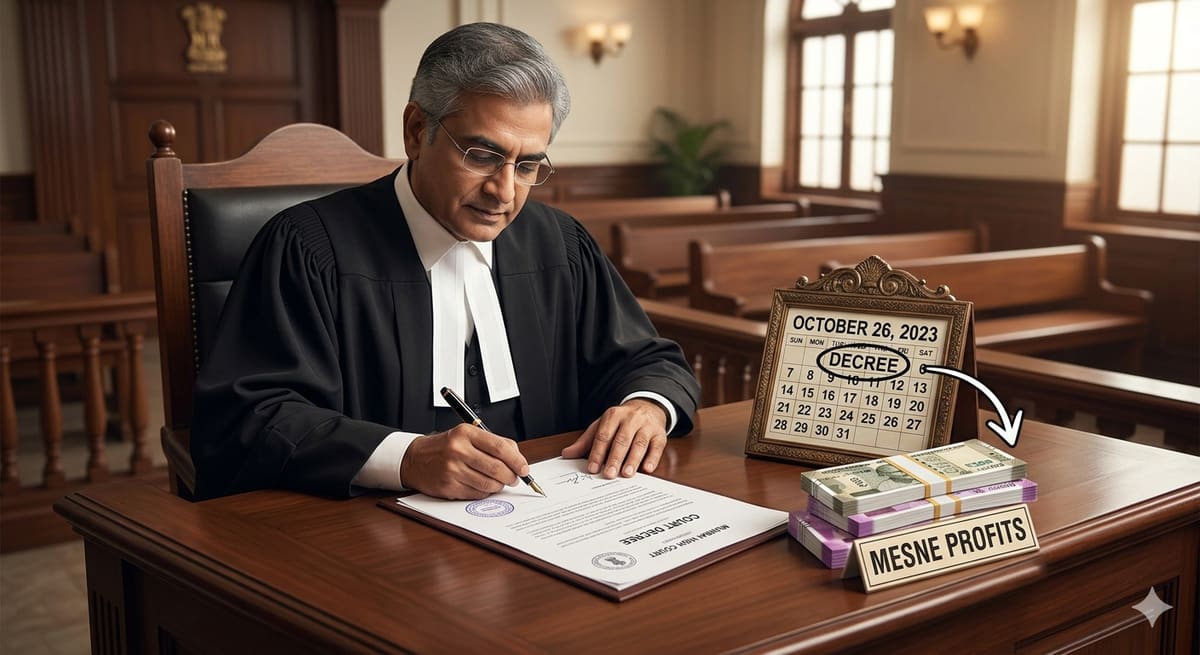
The Bombay High Court has reaffirmed a foundational principle in rent law: the right to claim mesne profits under the Maharashtra Rent Control Act, 1999, arises only upon the passing of a decree for eviction, not from the date the suit is instituted. This clarification resolves longstanding ambiguity for landlords and practitioners navigating recovery claims in tenancy disputes.
Background & Facts
The Dispute
The applicant, Anilkumar S/o Bhaskarrao Walokar, filed suits for eviction against two sets of tenants under the Maharashtra Rent Control Act, 1999. The suits were dismissed by the Small Causes Court. The applicant appealed to the High Court via Civil Revision Applications Nos. 140 of 2018 and 141 of 2018. The High Court, by orders dated 18.02.2025, allowed the revision petitions, set aside the trial court’s dismissal, and directed an inquiry into mesne profits from the date of its own judgment - 18.02.2025.
Key Facts
The applicant is the original landlord and plaintiff in both eviction suits
The non-applicants are tenants occupying premises at Municipal Corporation House No. 307, Bhavsar Chowk, Nagpur
The suits were filed seeking eviction on grounds of non-payment of rent and unauthorized subletting
The Small Causes Court dismissed both suits on 15.03.2017 and 20.04.2017 respectively
The applicant filed Civil Revision Applications before the Bombay High Court on 10.05.2018
The High Court allowed the revisions on 18.02.2025, holding the trial court’s dismissal was erroneous
The High Court’s order directed an inquiry into mesne profits "with effect from 18.02.2025"
Procedural History
15.03.2017: Suit for eviction dismissed by Small Causes Court (Suit No. 123/2016)
20.04.2017: Second suit dismissed by Small Causes Court (Suit No. 189/2016)
10.05.2018: Civil Revision Applications Nos. 140 and 141 of 2018 filed before Bombay High Court
18.02.2025: High Court allowed revisions, set aside trial court orders, directed inquiry into mesne profits from 18.02.2025
29.04.2026: Judgment reserved on review applications
05.05.2026: Judgment pronounced rejecting review applications
Relief Sought
The applicant sought review of the High Court’s 18.02.2025 order, arguing that mesne profits should be calculated from the date of institution of the original suits (2016), not from the date of the revision judgment. The applicant claimed entitlement to mesne profits for the entire period of unlawful occupation since filing.
The Legal Issue
The central question was whether the right to claim mesne profits under the Maharashtra Rent Control Act, 1999, commences from the date of institution of the eviction suit, or only from the date of the decree for eviction.
Arguments Presented
For the Appellant
The applicant’s counsel contended that the High Court’s revision judgment, having set aside the trial court’s erroneous dismissal, should be deemed to relate back to the date of the original suit. He relied on equitable principles and the doctrine of relation back, arguing that the tenant’s possession became unlawful from the moment the suit was filed, and therefore mesne profits should be recoverable from that date.
For the Respondent
The respondents’ counsel relied on Union of India v. Dr. Rustom Sam Boyce and Chander Kali Bai v. Jagdish Singh Thakur, arguing that under rent control statutes, a tenant continues as a statutory tenant even after contractual termination. Possession only becomes unauthorized upon a decree for eviction. Hence, mesne profits are recoverable only from the date of such decree.
The Court's Analysis
The Court examined the nature of tenancy under the Maharashtra Rent Control Act, 1999, and the distinction between contractual and statutory tenancy. It noted that even after termination of the original lease, the tenant retains protection under the Act and cannot be dispossessed without a court decree.
"The possession of the tenant does not become illegal or unauthorized from the date on which the contractual tenancy is terminated. It becomes unauthorized only from the date on which a decree for eviction is passed."
The Court then turned to the Supreme Court’s decision in Chander Kali Bai v. Jagdish Singh Thakur (1977) 4 SCC 402, which directly addressed the same issue: whether mesne profits should be calculated from the trial court’s dismissal date or the appellate court’s decree date. The Supreme Court held unequivocally that mesne profits accrue only from the date of the decree that finally establishes the landlord’s right to possession.
The Court found the facts of the present case indistinguishable from Chander Kali Bai. The revision judgment did not create a new right but corrected an error in the trial court’s order. The legal effect of the revision was to affirm the landlord’s right to possession as of the date of the revision decree, not retroactively from the suit’s filing.
The doctrine of relation back, while applicable in certain procedural contexts, cannot override the substantive legal principle that unlawful possession under rent control laws is determined by judicial decree, not by the filing of a suit.
The Verdict
The review applications were dismissed. The High Court upheld its order dated 18.02.2025, holding that mesne profits are recoverable only from that date onward. The applicant is not entitled to mesne profits for the period between the institution of the suits (2016) and the revision judgment (18.02.2025). No costs were awarded.
What This Means For Similar Cases
Mesne Profits Are Not Retroactive to Suit Filing
Practitioners must advise landlords that claims for mesne profits under rent control statutes cannot be extended beyond the date of the eviction decree
Filing a suit does not establish unlawful possession; only a decree does
Claims for past occupation must be limited to the period after the decree date
Statutory Tenancy Protects Against Retroactive Liability
Tenants retain statutory protection even after contractual termination
Landlords cannot claim damages for occupation prior to judicial eviction
This reinforces the balance struck by rent control laws between landlord rights and tenant security
Revision Judgments Do Not Relate Back Substantively
While revision may correct procedural error, it does not alter the substantive commencement of liability
Courts will not treat revision judgments as if they were the original decree
Practitioners must calculate mesne profits strictly from the date of the final eviction decree, whether from trial, appellate, or revision court