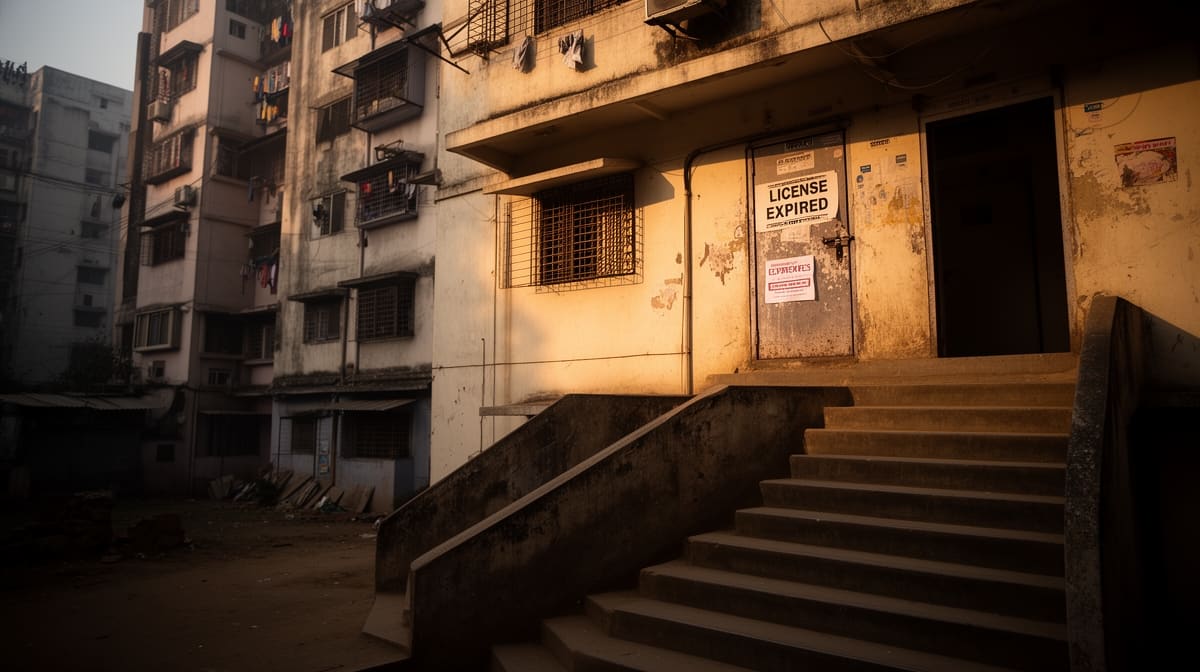
The Bombay High Court has reaffirmed a foundational principle in rent control jurisprudence: entry into premises under a license, even if followed by an Agreement for Sale, does not create tenancy rights. Upon license expiry, the licensee has no legal basis to retain possession, regardless of partial payments made under the sale agreement.
Background & Facts
The Dispute
The petitioner, Gautam Ishwar Mohite (now deceased), entered into a license agreement with the owner of premises in Pune on 08.04.2017, granting him temporary possession for a fixed term ending on 04.03.2018. After the license expired, the petitioner claimed continued possession on the basis of a purported Agreement for Sale dated 28.03.2018, executed during the currency of the license. The agreement stipulated a total consideration of Rs. 40,00,000, of which the petitioner had paid only Rs. 3,00,000 as a token advance.
Key Facts
- License agreement executed on 08.04.2017, valid until 04.03.2018
- Agreement for Sale executed on 28.03.2018, during the subsistence of the license
- Petitioner paid only Rs. 3,00,000 out of Rs. 40,00,000 consideration
- No sale deed was executed; no registration of the Agreement for Sale was produced
- Petitioner continued to occupy the premises after 04.03.2018 without any lawful authority
- Owner initiated proceedings under the Maharashtra Rent Control Act, 1999
Procedural History
- 04.03.2018: License expired; petitioner refused to vacate
- 18.03.2025: Competent Authority under the Maharashtra Rent Control Act passed an order directing eviction of the petitioner
- 14.11.2025: Additional Divisional Commissioner, Pune Division, rejected the petitioner’s revision petition and confirmed the eviction order
- 17.03.2026: Writ Petition No. 3545 of 2026 filed before the Bombay High Court challenging the revision order
Relief Sought
The petitioner sought quashing of the order dated 14.11.2025, restoration of possession, and a declaration that he was a protected tenant under the Maharashtra Rent Control Act, 1999.
The Legal Issue
The central question was whether the execution of an Agreement for Sale during the currency of a license, without registration or full payment, creates a right to continue possession beyond the license’s expiry under the Maharashtra Rent Control Act, 1999.
Arguments Presented
For the Petitioner
The petitioner’s counsel argued that the Agreement for Sale dated 28.03.2018, though unregistered and partially paid, created a contractual obligation that conferred quasi-tenancy rights. She contended that eviction without adjudicating the merits of the sale agreement violated principles of natural justice and equity. Reliance was placed on the doctrine of part performance under Section 53A of the Transfer of Property Act, 1882.
For the Respondent
The Additional Government Pleader argued that the petitioner was a licensee, not a tenant, and that the Maharashtra Rent Control Act applies only to persons holding premises as tenants. The Agreement for Sale was not a lease or tenancy agreement; it was a contract for future transfer of title, which does not confer possessory rights against the licensor. The petitioner’s remedy lay in the civil suit for specific performance, not in challenging eviction under rent control law.
The Court's Analysis
The Court examined the distinction between a license and a tenancy under the Maharashtra Rent Control Act, 1999. It reiterated its consistent jurisprudence that a license grants only a personal, revocable permission to use premises, and does not create any interest in the property. The Court observed:
"Perusal of the said Agreement dated 28 March 2018 would indicate that out of the agreed amount of consideration of Rs.40,00,000/-, the Petitioner has paid only a token amount of Rs.3,00,000/- to the licensor."
The Court held that even if the Agreement for Sale were valid and enforceable, it could not override the express terms of the license. The petitioner’s continued possession after 04.03.2018 was unlawful. The Court noted that the petitioner had already filed a civil suit for specific performance, indicating his awareness that his remedy lay outside the rent control forum. The Competent Authority acted within its jurisdiction in ordering eviction upon license expiry. The Court further clarified that Section 53A of the Transfer of Property Act does not create a tenancy; it only provides a defense against dispossession in a suit for specific performance, and cannot be invoked to resist eviction under rent control law.
The Verdict
The writ petition was rejected. The Court upheld the order dated 14.11.2025 of the Additional Divisional Commissioner, confirming the eviction order dated 18.03.2025. The petitioner was directed to vacate the premises immediately. No monetary relief was granted. The Court affirmed that the petitioner’s rights under the Agreement for Sale must be pursued exclusively through the pending civil suit for specific performance.
What This Means For Similar Cases
Licensee Status Cannot Be Converted to Tenancy by Agreement Alone
- Practitioners must advise clients that an Agreement for Sale executed during a license period does not confer protection under rent control statutes
- Tenancy rights arise only from a lease or tenancy agreement, not from sale agreements or part performance
- Eviction proceedings under the Maharashtra Rent Control Act remain valid against licensees who overstay after license expiry
Civil Remedy Must Be Pursued Separately
- Parties entering into sale agreements on licensed premises must be advised to file suits for specific performance immediately
- Rent control forums are not forums to adjudicate disputes over sale agreements
- Delay in filing civil suits cannot be compensated by invoking rent control protections
Documentation and Payment Are Critical
- Partial payment of consideration (e.g., Rs. 3,00,000 on Rs. 40,00,000) weakens claims under Section 53A of the Transfer of Property Act
- Unregistered agreements for sale cannot be used to claim possessory rights against the owner
- Licensees must vacate upon expiry unless a new tenancy agreement is executed