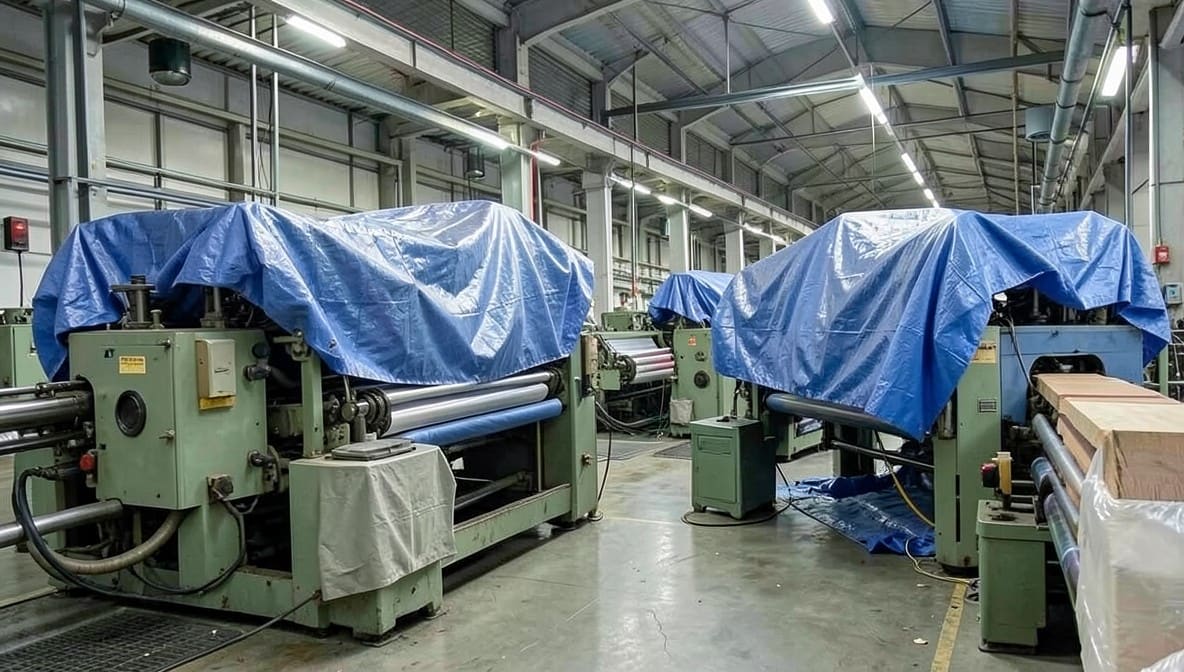
The National Company Law Appellate Tribunal (NCLAT) affirmed an order under Section 66 of the Insolvency and Bankruptcy Code, 2016 (IBC) directing suspended directors to contribute ₹17,23,05,603.50 for fraudulent removal of hypothecated machinery, establishing that fraudulent trading intent under Section 66(1) may be inferred from cumulative circumstantial evidence without requiring direct proof of dishonest intent.
Background & Facts
The Dispute
The appeal arose from an application under Section 66 of the IBC filed by the Resolution Professional (RP) of Santoshi Barrier Film India Pvt. Ltd. (Corporate Debtor) against its suspended directors, Mr. Dinesh Keshawrao Atkare and Mr. Madan Keshawrao Atkare (Appellants). The RP alleged that the Appellants, while in control of the Corporate Debtor, removed two C.I. Flexographic Press Machines financed by Tata Capital Financial Services Limited and Hero Fincorp Limited and replaced them with substantially lower-value Rotogravure Printing Machines to defraud creditors.
Key Facts
- The Corporate Debtor obtained two loans: ₹8,00,00,000 from Tata Capital Financial Services Limited and ₹4,00,00,000 from Hero Fincorp Limited (now Phoenix ARC) for purchasing two C.I. Flexographic Press Machines.
- First machine purchased from Brick and Byte Innovative Products Private Limited vide Invoice No. 107 dated 23.12.2016 for ₹11,50,33,603.50, financed by Tata Capital loan.
- Second machine purchased from Nyles Sales Agencies Private Limited vide Tax Invoice No. NSA/16-17/1182 dated 14.03.2017 for ₹5,72,72,000, financed by Hero Fincorp loan.
- Hypothecation agreements executed on 21.10.2016 (Tata Capital) and 05.01.2017 (Hero Fincorp) in favour of the lenders.
- CIRP commenced on 18.04.2023 pursuant to an application by the RP.
- Possession of assets was taken by the RP on 05.07.2023 under NCLT order dated 08.06.2023 in I.A. (IBC) 2363 of 2023.
- Independent valuers Mangesh Kedkar and Pranav Ambaselkar reported the installed machinery as Rotogravure Printing Machine with fair value of ₹96.9 lakhs and ₹79.04 lakhs respectively.
- The Appellants' own expert, Ankit Goel, did not personally inspect the machinery and based his opinion on photographs.
- Financial Creditors took possession of machinery under Section 13(4) of SARFAESI Act on 19.09.2020 without objecting to machine identity.
Procedural History
- 23.12.2016: Purchase of first C.I. Flexographic Press Machine from Brick and Byte Innovative Products.
- 14.03.2017: Purchase of second C.I. Flexographic Press Machine from Nyles Sales Agencies.
- 21.10.2016 & 05.01.2017: Execution of hypothecation agreements in favour of Financial Creditors.
- 19.09.2020: Financial Creditors took possession of machinery under SARFAESI Act Section 13(4).
- 18.04.2023: Commencement of CIRP.
- 08.06.2023: NCLT Mumbai Bench-I order directing station officer to expand assistance for possession.
- 05.07.2023: RP took possession of assets pursuant to 08.06.2023 order.
- 12.10.2023: Email by Pranav Ambaselkar (valuer appointed by RP) claiming Rotogravure machines found instead of C.I. Flexographic Press.
- 13.09.2023: Valuation report by Pranav Ambaselkar identifying installed machinery as Rotogravure Printing Machine.
- 17.07.2023: Valuation report by Mangesh Kedkar identifying installed machinery as Rotogravure Printing Machine.
- 18.12.2024: Impugned order passed by NCLT Mumbai Bench-I in I.A. No. 479 of 2024 directing Appellants to remit ₹17,23,05,603.50.
- 28.03.2025: Present Company Appeal (AT) (Insolvency) No. 325 of 2025 filed before NCLAT.
- 17.09.2026: Judgment pronounced by NCLAT Division Bench (Arun Baroka, Indevar Pandey, Sharad Kumar Sharma).
Relief Sought
The Appellants sought to set aside the NCLT's order dated 18.12.2024, contending that: (i) the machinery swap allegation was baseless; (ii) Section 66 requires proof of fraudulent intent via series of transactions; (iii) the contribution amount was incorrectly calculated without deducting depreciation and realizable value; (iv) the NCLT lacked jurisdiction due to contradictory findings on machine identity; and (v) the RP's case relied on inadmissible expert reports.
The Legal Issue
The central question was whether the Adjudicating Authority under Section 66 of the IBC could lawfully infer fraudulent trading intent from circumstantial evidence of removal and replacement of hypothecated high-value machinery with substantially lower-value assets, absent direct proof of dishonest intent at the time of the transaction, and whether a single transaction could suffice to trigger Section 66 liability when the cumulative circumstances demonstrated conduct intended to keep assets beyond creditors' reach.
Arguments Presented
For the Appellant
The Appellants contended that the alleged machine swap constituted merely an irregularity, not fraudulent business under Section 66, relying on Renuka Devi v. Regen Powertech (2023 SCC Online NCLAT 4726) to argue that a single fraudulent act does not infer intent to defraud creditors. They asserted the NCLT's order suffered from jurisdictional error as para 22 of the impugned order admitted the Tribunal lacked prerogative to determine machine identity, which was a matter for investigation beyond its scope. The Appellants challenged the ₹17,23,05,603.50 amount as legally and factually incorrect, claiming it ignored depreciation of hypothecated assets and realizable value of machines found at premises. They further argued estoppel barred the Financial Creditors from questioning machine identity after taking possession under SARFAESI Act in 2020 without objection, and that the RP's case originated from a malafide email dated 12.10.2023 by valuer Pranav Ambaselkar, contradicted by supplier affidavit. The Appellants maintained the NCLT's findings were based on contradictory evidence and ignored the principle that negligence cannot be characterized as fraudulent trading.
For the Respondent
The Respondent (RP/Liquidator) submitted that the Corporate Debtor availed ₹12 Crores in loans specifically for purchasing two C.I. Flexographic Press Machines, supported by contemporaneous invoices and dispatch records. They asserted the Appellants, while in control, removed the hypothecated machinery and installed Rotogravure Printing Machines of substantially lower value (₹40 lakhs approx. vs. ₹17.23 crore), constituting fraudulent trading under Section 66. The Respondent emphasized that Section 66(1) requires only intent to defraud creditors or fraudulent purpose, not a series of transactions, and that circumstantial evidence - including removal of financed assets, presence of lower-value machinery, lack of documentation for substituted machinery, and absence of creditor consent - sufficed to infer fraudulent intent. They rejected the Appellants' estoppel argument, stating earlier SARFAESI possession did not preclude examination during insolvency proceedings, and cited Piramal Capital and Housing Finance Ltd. v. 63 Moons Technologies Ltd. (2025) to distinguish Section 66 applications from avoidance proceedings under Section 25(2). The Respondent highlighted the Appellants' failure to handover possession post-CIRP commencement and their reliance on non-statutory expert Ankit Goel who did not inspect machinery, contrasting with IBBI-empaneled valuers whose reports confirmed machine substitution.
The Court's Analysis
The NCLAT began by noting the documentary record established the Corporate Debtor's financed and hypothecated machinery through invoices, dispatch particulars, and hypothecation agreements, negating the Appellants' claim that existence relied solely on oral assertion. The Court rejected the Appellants' jurisdictional challenge, clarifying that while the NCLT correctly acknowledged it could not conduct technical investigations to identify machine models (para 22 impugned order), it was empowered under Section 66 to determine whether business was carried on with intent to defraud creditors based on material before it. The Court held: "The finding of fraudulent conduct can be based upon the cumulative effect of documentary and circumstantial evidence."
Regarding the sufficiency of evidence, the NCLAT found eight cumulative circumstances compelling: (i) original machinery financed and hypothecated with supporting invoices; (ii) machinery hypothecated in favour of Financial Creditors; (iii) suspended Board delayed possession post-CIRP commencement; (iv) possession obtained only via Adjudicating Authority orders with police assistance; (v) inspection records indicated machinery had been removed from premises; (vi) independent valuers identified installed machinery as substantially different Rotogravure type; (vii) no contemporaneous purchase documentation supported alleged substituted machinery; and (viii) no evidence of prior secured creditor consent for substitution. The Court stated: "The expensive machinery which constituted the subject matter of the financing and security interest was required to be available for the benefit of the Corporate Debtor and its creditors. Its disappearance, coupled with the presence of substantially lower-value machinery and the failure of the persons in control... constitutes compelling circumstantial evidence of conduct intended to keep valuable assets beyond the reach of creditors."
On the legal test for Section 66, the NCLAT dismissed reliance on Renuka Devi, explaining that Section 66(1) does not require fraudulent trading to be established through a series of independent transactions; rather, the material inquiry is whether business was carried on with intent to defraud creditors or for fraudulent purpose. The Court affirmed that authorities cited by Appellants did not make direct evidence of fraudulent intent indispensable in every case, holding: "the nature of the enquiry permits the adjudicatory authority to draw a conclusion from the totality of the circumstances." It further clarified the distinction between Section 66 proceedings and avoidance applications under Section 25(2), citing Piramal Capital to note that fraudulent trading applications fall under Chapter VI of the IBC, operating in different situations from Chapter III avoidance applications, with separately circumscribed powers of the Adjudicating Authority.
Addressing the quantum challenge, the NCLAT held that once fraudulent removal was upheld, the direction under Section 66 aimed to restore the Corporate Debtor's assets to the extent determined by the Adjudicating Authority, and the Appellants failed to demonstrate the ₹17,23,05,603.50 amount was arbitrary or unsupported by record. The Court rejected depreciation and realizable value arguments, stating: "The plea regarding depreciation and realizable value, in the circumstances of the present case, does not dislodge the substantive finding that the financed and hypothecated machinery was removed and that the Corporate Debtor's asset position was thereby depleted." Finally, the NCLAT affirmed that the insolvency process cannot be rendered ineffective by inability to reconstruct precise removal mechanics, holding: "The adjudicatory determination is based upon the evidence available on record and the cumulative inferences arising therefrom."
The Verdict
The Appellants' appeal was dismissed. The NCLAT affirmed the NCLT's order dated 18.12.2024 in I.A. No. 479 of 2024, upholding the direction for the Appellants to remit ₹17,23,05,603.50 to the assets of the Corporate Debtor under Section 66 of the IBC. Both Appellants were imposed costs of ₹5,00,000 each, to be deposited in the Prime Minister's National Relief Fund. The Liquidator was permitted to continue liquidation proceedings in accordance with the Code and the Adjudicating Authority's orders.
What This Means For Similar Cases
Circumstantial Evidence Suffices for Fraudulent Trading Findings
Practitioners must now recognize that Section 66 IBC liability can be established through cumulative circumstantial evidence without requiring direct proof of dishonest intent at the time of transaction. Key evidentiary factors include: removal of financed/hypothecated assets, presence of substantially lower-value substitutes, lack of documentation for substituted assets, absence of creditor consent for asset replacement, and conduct delaying insolvency proceedings. This lowers the evidentiary threshold for Resolution Professionals seeking contributions under Section 66, particularly in cases involving asset diversion where direct intent evidence is unavailable.
Single Transaction Can Trigger Section 66 Liability
The judgment clarifies that Section 66 does not mandate a series of fraudulent transactions; a single transaction involving removal of secured assets to defeat creditor claims can suffice if cumulative circumstances indicate fraudulent purpose. Resolution Professionals should focus on proving the transaction depleted the Corporate Debtor's asset base to creditors' detriment, supported by evidence such as hypothecation records, valuation reports showing value differential, and obstruction of asset access. This expands the scope of Section 66 applications beyond traditional "fraudulent trading" scenarios involving ongoing business misconduct.
Jurisdiction Not Defeated by Identification Challenges
Adjudicating Authorities retain jurisdiction under Section 66 even when unable to technically identify specific machine models, as their role is to assess whether business was conducted with intent to defraud creditors based on available material - not to conduct forensic investigations. Parties cannot evade liability by raising identification disputes; instead, Tribunals may draw inferences from circumstantial evidence like removal of financed assets, presence of lower-value substitutes, and lack of creditor-approved substitution documentation. This prevents debtors from obstructing Section 66 proceedings through technical objections about asset identification.