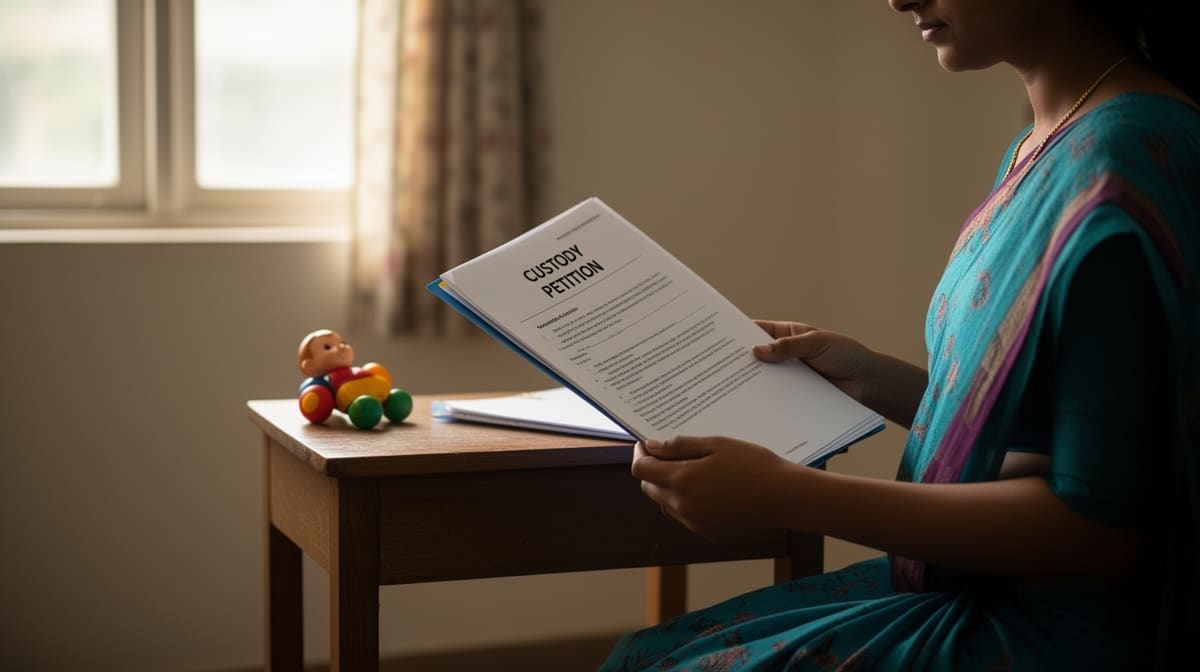
The Madhya Pradesh High Court has redefined the approach to transfer petitions under Section 24 CPC in matrimonial disputes, emphasizing that the welfare of a young child in primary custody supersedes abstract notions of spousal convenience. This ruling establishes a new benchmark for jurisdictional transfers where minor children are involved.
Background & Facts
The Dispute
The petitioner, Smt. Hemlata Arya, wife of Shri Manvendra Arya, filed a petition under Section 24 of the Code of Civil Procedure seeking transfer of a divorce suit pending before the Principal Judge, Family Court, Bhopal (RCS HM No. 717/2025), to the Family Court, Tikamgarh. The divorce petition was originally filed by the respondent-husband in Bhopal. Simultaneously, two other proceedings initiated by the wife - under Section 9 of the Hindu Marriage Act and Section 12 of the Protection of Women from Domestic Violence Act - are pending in Tikamgarh.
Key Facts
- The petitioner and respondent are married and have one minor child, born in December 2024
- The child is currently less than one and a half years old
- The petitioner has sole physical custody of the child
- The petitioner resides at her parental home in Tikamgarh
- The petitioner has no independent source of income and depends on her parents for survival
- The distance between Bhopal and Tikamgarh is significant, requiring substantial travel time and expense
- The respondent has not filed a written reply to the transfer petition
- The petitioner argues that traveling to Bhopal for hearings would cause severe hardship, particularly given the child’s age and dependency on her as primary caregiver
Procedural History
- 2025: Divorce petition filed by respondent-husband in Family Court, Bhopal (RCS HM No. 717/2025)
- 2025: Petitioner filed two separate proceedings in Tikamgarh: (i) restitution of conjugal rights under Section 9 HMA; (ii) domestic violence petition under Section 12 PWDVA
- March 2026: Petitioner filed Misc. Civil Case No. 292 of 2026 under Section 24 CPC seeking transfer of the divorce suit to Tikamgarh
- 22.04.2026: Case reserved for order
- 29.04.2026: Judgment pronounced
Relief Sought
The petitioner sought transfer of RCS HM No. 717/2025 from the Family Court, Bhopal, to the Family Court, Tikamgarh, on grounds of hardship, child welfare, and avoidance of harassment.
The Legal Issue
The central question was whether the convenience of the wife alone justifies transfer of a matrimonial suit under Section 24 CPC, or whether the best interests of a young child in her custody must be the decisive factor.
Arguments Presented
For the Appellant
Counsel for the petitioner relied on Smt. Harshana Jharia v. Yogesh Kumar Jharia (MCC No. 1964/2025), which had previously prioritized the wife’s convenience in transfer petitions. It was argued that the petitioner’s financial dependence, lack of independent residence, and the burden of traveling with an infant under 18 months made attendance at Bhopal hearings impractical and detrimental to the child’s well-being. The petitioner’s role as the sole caregiver was emphasized as a compelling reason for transfer.
For the Respondent
The respondent did not file a written reply. However, through oral submissions, he opposed the transfer, arguing that the petition was an attempt to gain tactical advantage by consolidating proceedings in Tikamgarh. He contended that the wife’s convenience should not override the jurisdictional integrity of the court where the original petition was filed.
The Court's Analysis
The Court acknowledged that earlier judgments, including Smt. Harshana Jharia, had favored transfer based on the wife’s convenience. However, it noted a significant shift in judicial approach reflected in Anindita Das v. Shrijit Das (2006) 9 SCC 197 and Sujata @ Nikki Kulhade v. Abhishek Kulhade (2019 SCC Online MP 6795), where courts cautioned against the misuse of leniency toward wives in transfer applications.
"The traditional concept of prioritizing the wife's convenience in transferring matrimonial cases has taken a shift. The reason for this paradigm shift is the misuse of leniency shown by the Courts to the wives."
Despite this caution, the Court declined to apply the rigid stance of denying transfer solely on the basis of convenience. Instead, it turned to the unique facts of the case: the child’s age, the petitioner’s role as primary caregiver, and the logistical impossibility of transporting an infant across a considerable distance for regular court appearances.
The Court observed that the child, being under 18 months, is entirely dependent on the mother for feeding, hygiene, emotional security, and medical care. Forcing the petitioner to choose between attending court in Bhopal or leaving the child with grandparents constituted an untenable burden. The Court held that such hardship was not merely personal inconvenience but a direct threat to the child’s welfare.
The Court emphasized that Section 24 CPC empowers courts to transfer proceedings in the interest of justice, and the best interests of the child are an integral component of that standard. The jurisdictional convenience of the husband, who initiated the suit, could not override the child’s right to stable, continuous care.
The Verdict
The petition was allowed. The Court ordered the transfer of Civil Suit RCS HM No. 717/2025 from the Family Court, Bhopal, to the Family Court, Tikamgarh. The transfer was directed to be completed within 14 days of the judgment. All future hearings in the divorce suit shall now be conducted before the Family Court, Tikamgarh.
What This Means For Similar Cases
Child’s Custody Overrides Spousal Convenience
- Practitioners must now frame transfer petitions under Section 24 CPC around the child’s age, dependency, and primary caregiver status - not merely the wife’s residence or financial hardship
- A child under two years old in the mother’s custody creates a strong presumption in favor of transfer to the child’s place of residence
- Courts will no longer accept blanket denials of transfer based on past precedents that prioritized spousal convenience alone
Jurisdictional Flexibility for Minor Children
- The principle of "best interests of the child" is now explicitly integrated into Section 24 CPC jurisprudence in matrimonial matters
- Distance alone is not dispositive; the practical impact on the child’s care routine is the decisive factor
- Courts must conduct a fact-specific inquiry into: (a) the child’s age, (b) the caregiver’s ability to travel, (c) availability of alternative care, and (d) impact on the child’s health and development
Strategic Implications for Litigation
- Petitioners should attach: birth certificates, medical records, affidavits of caregiving responsibilities, and travel cost estimates
- Respondents opposing transfer must demonstrate concrete reasons why the child’s welfare would be compromised by transfer - not merely procedural convenience
- Consolidation of proceedings in one forum is now a recognized benefit under Section 24 CPC when it serves the child’s interests