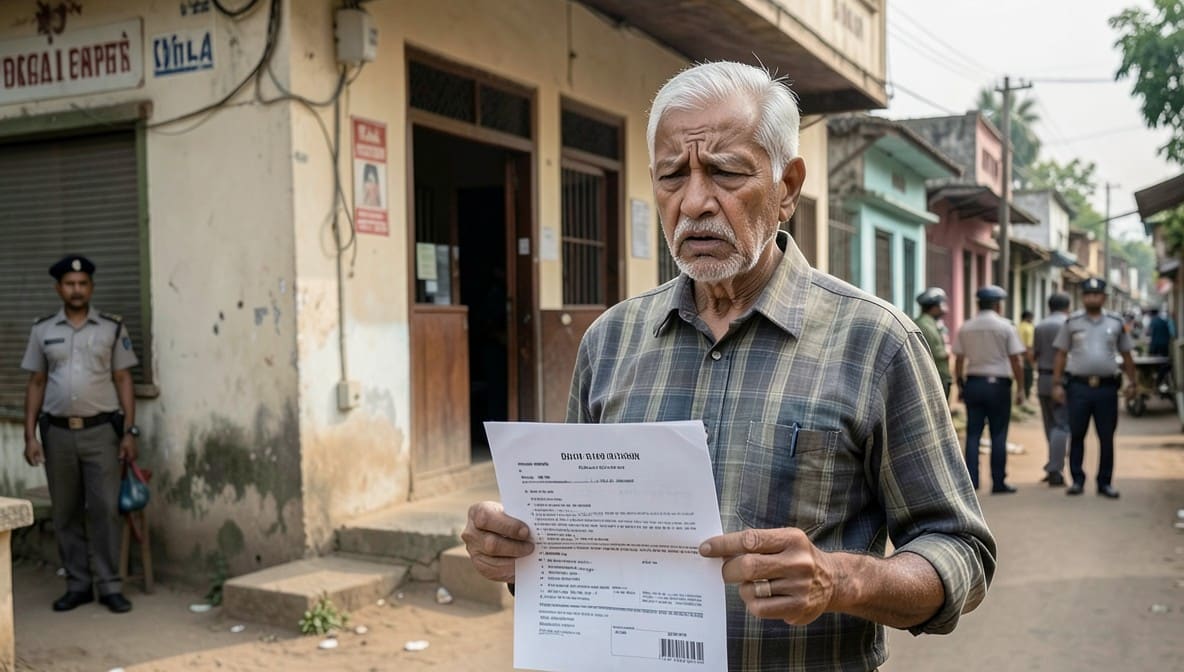
The Allahabad High Court has delivered a significant judgment clarifying the limited scope of the Maintenance and Welfare of Parents and Senior Citizens Act, 2007 in protecting the property rights of senior citizens. The Court held that Section 22 of the Act does not empower authorities to adjudicate general property disputes or declare title deeds void unless the prerequisites of Section 23 are met. This ruling underscores the distinction between preventive welfare measures and adjudicatory powers under the Act, restricting its application to cases where transfers are made under fraudulent conditions.
Background & Facts
The Dispute
The petitioner, Satish Chandra Gupta, a senior citizen, approached the Allahabad High Court seeking round-the-clock police protection for his property (House No. 373, Kasba Rath, District Hamirpur) and restraint orders against private respondents (Respondents No. 6 to 12). He alleged that his father, Bhagwandas, had executed a Will dated 18.08.2004 in favor of the private respondents, who subsequently executed two sale deeds on 17.11.2025 (Annexures 3 & 4). The petitioner claimed these documents were forged and sought their declaration as void under the Act, 2007.
Key Facts
- The petitioner is the son of Bhagwandas, the admitted owner of the disputed property.
- A Will dated 18.08.2004 was allegedly executed by Bhagwandas in favor of private respondents.
- Two sale deeds (Annexures 3 & 4) were executed on 17.11.2025 by the beneficiaries of the Will.
- The petitioner filed representations dated 13.10.2025, 14.11.2025, and 01.02.2026 before the District Magistrate, Hamirpur, seeking protection under Section 22 of the Act, 2007, but no action was taken.
- The petitioner alleged that the District Level Committee constituted under the Act failed to act on his representations, leading to the registration of the sale deeds.
- The private respondents contended that civil suits inter-se the parties were pending adjudication and that the Act, 2007 had no applicability to the dispute.
Procedural History
- Writ Petition (C No. 4998 of 2026) filed before the Allahabad High Court on 02.07.2026.
- The petitioner sought mandamus directing the District Magistrate and other authorities to provide protection and declare the sale deeds void.
- The private respondents argued that the dispute involved title adjudication, which fell outside the scope of the Act, 2007.
- The Court relied on the Full Bench decision in Omkar Nath Gaur v. District Magistrate (2025 (5) ADJ 788) to determine the scope of Section 23.
Relief Sought
The petitioner sought the following reliefs:
- Mandamus directing Respondents No. 2 to 4 to provide round-the-clock police protection.
- Prohibition restraining Respondents No. 6 to 12 from interfering with his peaceful possession.
- Declaration that the Will and sale deeds were void.
- Time-bound inquiry into the failure of authorities under Section 22 of the Act, 2007.
- Directions to the State Level Committee to take cognizance of his grievance and issue protective orders.
The Legal Issue
The central question was whether Section 22 of the Maintenance and Welfare of Parents and Senior Citizens Act, 2007 empowers authorities to declare title deeds void and direct eviction in disputes involving general property rights, or whether such powers are limited to cases falling under Section 23 of the Act.
Arguments Presented
For the Petitioner
- Section 22(2) of the Act, 2007 obligates the State to provide a comprehensive action plan for the protection of senior citizens' life and property.
- The inaction of authorities in responding to his representations violated this statutory mandate.
- The sale deeds were executed fraudulently, and the authorities failed to prevent this despite his representations.
- Relied on the Division Bench judgment in Shivani Verma v. State of U.P. (2023 (6) ADJ 496) to argue that the Act confers eviction powers on authorities.
For the Respondents
- The Act, 2007 is a social welfare legislation aimed at providing maintenance and protection to senior citizens, not adjudicating title disputes.
- Section 23 applies only where a transfer is made subject to a condition of providing basic amenities, which was not pleaded in this case.
- The Full Bench decision in Omkar Nath Gaur (2025 (5) ADJ 788) overruled Shivani Verma and held that eviction powers are not conferred under the Act except in limited cases under Section 23.
- The dispute involved intricate questions of title, which must be adjudicated by civil courts, not under the Act, 2007.
The Court's Analysis
The Court conducted a detailed examination of the statutory scheme under the Act, 2007, and the Full Bench decision in Omkar Nath Gaur. Key observations included:
-
Scope of Section 22
- Section 22(2) obligates the State to prescribe a comprehensive action plan for the protection of senior citizens' life and property.
- Rule 21 of the Rules, 2014 casts a duty on the District Magistrate to ensure the protection of life and property of senior citizens.
- However, Rule 21 and Rule 22 are preventive and facilitative in nature, not adjudicatory or coercive.
- The District Magistrate is not empowered to declare title deeds void or order evictions under these provisions.
"The duties as provided in Rule 21 and Rule 22 are relating to all such obligations, which are relatable to the various challenges faced by the senior citizens, while interacting with different Government interface, in their day-to-day lives. The endeavor is to make the interaction experience of a senior citizen with the Government Organizations less stressful and more friendly and convenient."
-
Limited Scope of Section 23
- Section 23 provides that a transfer made by a senior citizen subject to a condition of providing basic amenities shall be deemed void if the transferee fails to comply.
- The three prerequisites for invoking Section 23 are:
- (i) A transfer by a senior citizen by way of gift or otherwise after the commencement of the Act;
- (ii) The transfer is subject to a condition that the transferee shall provide basic amenities and physical needs;
- (iii) The transferee refuses or fails to provide such amenities.
- The petitioner did not plead that the sale deeds were executed subject to such a condition, rendering Section 23 inapplicable.
"For invoking the powers treating conveyance/document of transfer of title to be non est and void, certain pre-requisites are to be satisfied viz: (i) a transfer is made by a senior citizen by way of a gift or otherwise after the commencement of this Act of this property; (ii) such a transfer is subject to the condition that the transferee would provide the basic amenities and for basic physical needs to the transferror; (iii) despite the said stipulation, the transferee refuses or fails to provide such amenities and physical needs, so promised."
-
Full Bench Decision in Omkar Nath Gaur
- The Full Bench answered four reference questions, including:
- Whether the Maintenance Tribunal can pass an order of eviction under Sections 7, 8, and 9 of the Act.
- Whether the District Magistrate has eviction powers under Section 21 and Rules 21 & 22.
- The Full Bench held that:
- The Tribunal/Appellate Tribunal cannot order eviction except in cases covered by Section 23.
- The District Magistrate has no power to order eviction under Section 21 or Rules 21 & 22.
- Section 23 is a standalone provision, and only if its prerequisites are met can the Tribunal declare a transfer void and restore possession to the senior citizen.
- The Full Bench overruled Shivani Verma and upheld Swaraj Varun and Bipraji Singh, subject to the limited exception under Section 23.
"The powers exercised in terms of Section 21 of the Act of 2007 or in terms of Rule 21 and 22 of the Rules of 2014 cannot include passing of an order of eviction except as explained above, where Section 23 of the Act of 2007 applies."
- The Full Bench answered four reference questions, including:
-
Jurisdictional Limits of the Act
- The Act, 2007 is a social welfare legislation aimed at preventive and facilitative measures, not adjudicatory powers.
- Section 27 bars civil courts from granting injunctions in matters covered by the Act, but does not confer new adjudicatory powers on authorities.
- Title disputes must be adjudicated by civil courts, not under the summary procedure of the Act, 2007.
"The traditional forums and courts are free to proceed with the matters in accordance with law which are not covered by the matters which are within the ambit and jurisdiction of Maintenance Tribunal, Appellate Tribunal in terms of the Act of 2007."
The Verdict
The Court dismissed the writ petition with easy costs, holding that:
- The Act, 2007 does not empower authorities to adjudicate general property disputes or declare title deeds void unless Section 23 is attracted.
- The petitioner failed to plead the prerequisites of Section 23, rendering the Act inapplicable to his case.
- The dispute involved intricate questions of title, which must be resolved by civil courts through full-fledged trials.
- The Full Bench decision in Omkar Nath Gaur was affirmed, and the judgment in Shivani Verma was overruled.
- The parties were left at liberty to approach competent civil courts for redressal of their grievances.
What This Means For Similar Cases
Section 23 Is the Only Window for Property Protection
- Practitioners must ensure that petitions under the Act, 2007 strictly plead the three prerequisites of Section 23.
- The transfer must be subject to a condition of providing basic amenities.
- The transferee must have failed or refused to provide such amenities.
- The burden of proof lies on the senior citizen to establish these conditions.
- General property disputes, even involving senior citizens, cannot be adjudicated under the Act unless Section 23 is invoked.
No Eviction Powers Under Section 21 or Rules 21 & 22
- District Magistrates and Tribunals cannot order evictions under Section 21 or Rules 21 & 22.
- Eviction is permissible only as a consequential relief where a transfer is declared void under Section 23.
- Civil courts retain exclusive jurisdiction over title disputes and possession matters not covered by Section 23.
Preventive Measures, Not Adjudicatory Powers
- The Act, 2007 is preventive and facilitative, not adjudicatory.
- Rule 21 casts a duty on the District Magistrate to ensure protection of senior citizens' life and property.
- Rule 22 mandates police authorities to take preventive steps, such as maintaining lists of senior citizens and conducting regular visits.
- No coercive powers (e.g., injunctions, evictions) are conferred under these provisions.
- Senior citizens must rely on civil courts for remedial relief in property disputes.