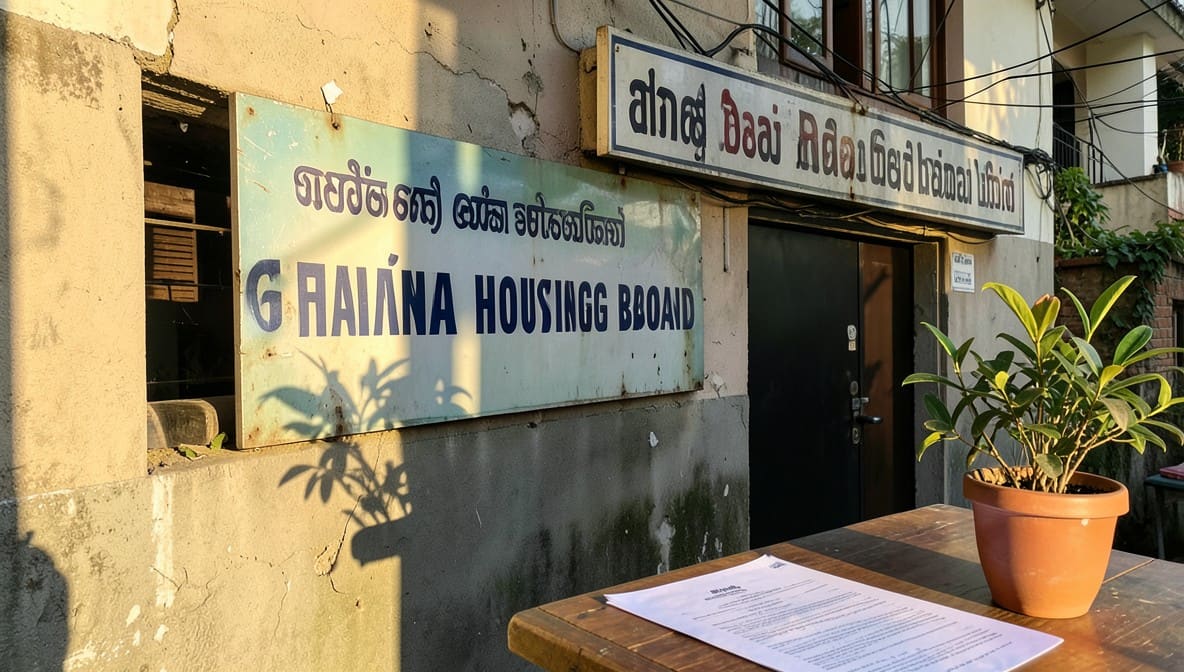
The Madras High Court has reaffirmed that agreements to sell properties allotted by statutory housing bodies, in violation of statutory conditions, are void ab initio and unenforceable under the Indian Contract Act. This judgment clarifies the limits of equitable relief in cases where parties circumvent public policy protections embedded in housing allotment schemes.
Background & Facts
The Dispute
The plaintiff, Rajeswari, filed a suit for specific performance of an agreement of sale dated 03.08.2006, entered into with the late Janagaraj, an allottee of a residential unit allotted by the Tamil Nadu Housing Board. The plaintiff claimed to have paid Rs.5,00,000 as advance and sought completion of the sale. Janagaraj died on 26.08.2006, before the balance payment could be made. The defendants, his legal heirs, refused to perform the agreement. The plaintiff issued a legal notice on 27.06.2007, to which the defendants responded on 09.07.2007, denying the validity of the agreement.
Key Facts
- The suit property was allotted to Janagaraj by the Tamil Nadu Housing Board under an allotment order dated 15.07.1991
- The allotment was governed by a lease-cum-sale agreement (Ex.B8), which contained Clause 12(ii) prohibiting assignment, sub-letting, or parting with possession without prior written permission of the Board
- The agreement of sale (Ex.A1) dated 03.08.2006 was executed without any such permission
- The plaintiff alleged payment of Rs.5,00,000 as advance, supported only by oral testimony
- The plaintiff further claimed to have deposited Rs.3,50,000 with the Tamil Nadu Housing Board on behalf of Janagaraj, but produced no documentary proof
- The agreement was challenged on grounds of non-compliance with the Tamil Nadu State Housing Board Act, 1981, and public policy
Procedural History
- 03.08.2006: Agreement of sale (Ex.A1) executed between plaintiff and Janagaraj
- 26.08.2006: Death of Janagaraj
- 27.06.2007: Legal notice issued by plaintiff
- 09.07.2007: Defendants’ reply disputing the agreement
- 07.12.2011: Trial Court (First Additional Sub Judge, Coimbatore) decreed suit for specific performance in O.S. No.458 of 2011
- 26.04.2013: First Appellate Court (First Additional District Judge, Coimbatore) set aside specific performance but granted refund of Rs.5,00,000 with interest in A.S. No.19 of 2013
- 09.03.2022: Madras High Court dismissed the Second Appeal (S.A. No.437 of 2014)
- 06.11.2023: Supreme Court set aside the High Court’s judgment and remanded the matter for fresh consideration in SLP (C) No.18381 of 2022
- 17.03.2026: Madras High Court pronounces judgment on remanded appeal
The Parties' Positions
For the Plaintiff (Appellant)
- Argued that the agreement was valid and enforceable
- Contended that the statutory breach was curable under Section 13 of the Specific Relief Act, 1963, after expiry of the five-year restriction
- Asserted readiness and willingness to perform the contract
- Claimed deposit of Rs.3,50,000 with the Housing Board, seeking its refund
For the Defendants (Respondents 1-4)
- Contended that the agreement violated Clause 12(ii) of the lease-cum-sale agreement (Ex.B8)
- Argued that Janagaraj held only a licensee’s interest, not a saleable title
- Denied receipt of Rs.5,00,000 and challenged the authenticity of the agreement
- Asserted that the suit was not maintainable under Section 138 of the Tamil Nadu State Housing Board Act, 1981
For the Fifth Defendant (Tamil Nadu Housing Board)
- Stated it was not a party to the agreement
- Emphasized that any transfer without its prior written permission was void under its statutory conditions
- Denied receipt of Rs.3,50,000 and challenged the plaintiff’s claim for lack of documentary evidence
Relief Sought
The plaintiff sought:
- Specific performance of the agreement dated 03.08.2006
- In the alternative, refund of Rs.5,00,000 with interest
- Refund of Rs.3,50,000 allegedly deposited with the Tamil Nadu Housing Board
- Costs of litigation
The Legal Issue
The central question was whether an agreement of sale for a Tamil Nadu Housing Board property, executed in violation of statutory conditions prohibiting transfer without prior permission, is enforceable under the Specific Relief Act, 1963, or whether it is void ab initio under Section 23 of the Indian Contract Act.
Arguments Presented
For the Appellant/Petitioner
The appellant relied on S. R. Batliboi v. K. R. Patel to argue that technical breaches of statutory conditions are curable under Section 13 of the Specific Relief Act, 1963, particularly after the expiry of the five-year lock-in period. It was contended that the plaintiff had demonstrated readiness and willingness to perform, and that the agreement was a private contract between two parties, not inherently opposed to public policy. The appellant further argued that the First Appellate Court erred in not framing a specific issue on Ex.B8, thereby denying a fair opportunity to contest its applicability.
For the Respondent/State
The respondents contended that the Tamil Nadu State Housing Board Act, 1981, and the lease-cum-sale agreement (Ex.B8) imposed mandatory conditions to ensure housing reached eligible beneficiaries. Any transfer without the Board’s consent violated these statutory provisions and undermined the public purpose of the scheme. They cited State of U.P. v. Rameshwar Prasad to argue that agreements violating statutory prohibitions are void under Section 23 of the Indian Contract Act. The respondents also emphasized that the plaintiff failed to prove payment of Rs.5,00,000 or the alleged deposit of Rs.3,50,000, and did not plead continuous readiness and willingness as mandated by Section 16(c) of the Specific Relief Act and Appendix A, Form No.47 of the CPC.
The Court's Analysis
The Court examined the nature of the Tamil Nadu Housing Board’s allotment scheme and the legal effect of its conditions. It held that the Board is a statutory body whose rules carry the force of law. Clause 12(ii) of Ex.B8, prohibiting transfer without prior written permission, was not a mere contractual term but a statutory condition embedded in the allotment process.
"Any such alienation, effected without the prior written permission of the Housing Board and before fulfilment of the statutory conditions, is plainly prohibited."
The Court applied Section 23 of the Indian Contract Act, which renders agreements void if their object or consideration is forbidden by law or opposed to public policy. It found that the agreement sought to circumvent the very purpose of the Housing Board scheme - to provide affordable housing to eligible persons - and therefore was void ab initio.
The appellant’s reliance on Section 13 of the Specific Relief Act was rejected. The Court distinguished cases involving imperfect title from those involving statutory prohibitions. Here, the parties did not merely acquire a defective title; they engaged in an act expressly forbidden by law. The Court held:
"The deceased defendant and the plaintiff sought to carry out an act forbidden by law. Hence, Ex.A1 agreement is void ab initio, and no relief can be granted on the basis of the said agreement."
The Court also found that the non-framing of a specific issue on Ex.B8 did not prejudice the parties, as both sides had fully argued the point before the First Appellate Court. Further, the plaintiff’s failure to plead and prove continuous readiness and willingness under Section 16(c) of the Specific Relief Act independently barred specific performance.
Regarding the Rs.3,50,000 deposit claim, the Court held that the burden of proof lay squarely on the plaintiff, who produced no bank receipt, acknowledgment, or Board record. In the absence of documentary evidence, the claim was dismissed.
The Verdict
The Second Appeal was dismissed with costs. The judgment and decree dated 26.04.2013 of the First Additional District Judge, Coimbatore, were confirmed. The plaintiff is entitled to the refund of Rs.5,00,000 with interest as decreed by the First Appellate Court. The claim for refund of Rs.3,50,000 deposited with the Tamil Nadu Housing Board was rejected for lack of proof. The decree creating a charge over the suit property remains enforceable in execution. No relief for specific performance was granted.
What This Means For Similar Cases
Statutory Conditions Override Private Agreements
- Practitioners must verify statutory restrictions before advising on property transfers involving government or statutory bodies
- Agreements violating conditions under housing boards, cooperative societies, or public land schemes are void ab initio, regardless of consideration or performance
- Section 13 of the Specific Relief Act does not cure violations of statutory prohibitions - only curable defects in title may be remedied
Documentary Evidence Is Non-Negotiable
- Claims for monetary deposits with statutory authorities require contemporaneous documentary proof
- Oral testimony alone is insufficient to establish payment to public bodies
- Plaintiffs must maintain and produce bank records, receipts, or official acknowledgments for any alleged deposits
Readiness and Willingness Must Be Plead and Proven
- A suit for specific performance under Section 16(c) of the Specific Relief Act requires explicit pleading in the plaint as per Appendix A, Form No.47 of the CPC
- Courts will not infer readiness from conduct; it must be affirmatively pleaded and substantiated
- Failure to plead this element is fatal to the claim, even if the agreement is otherwise valid