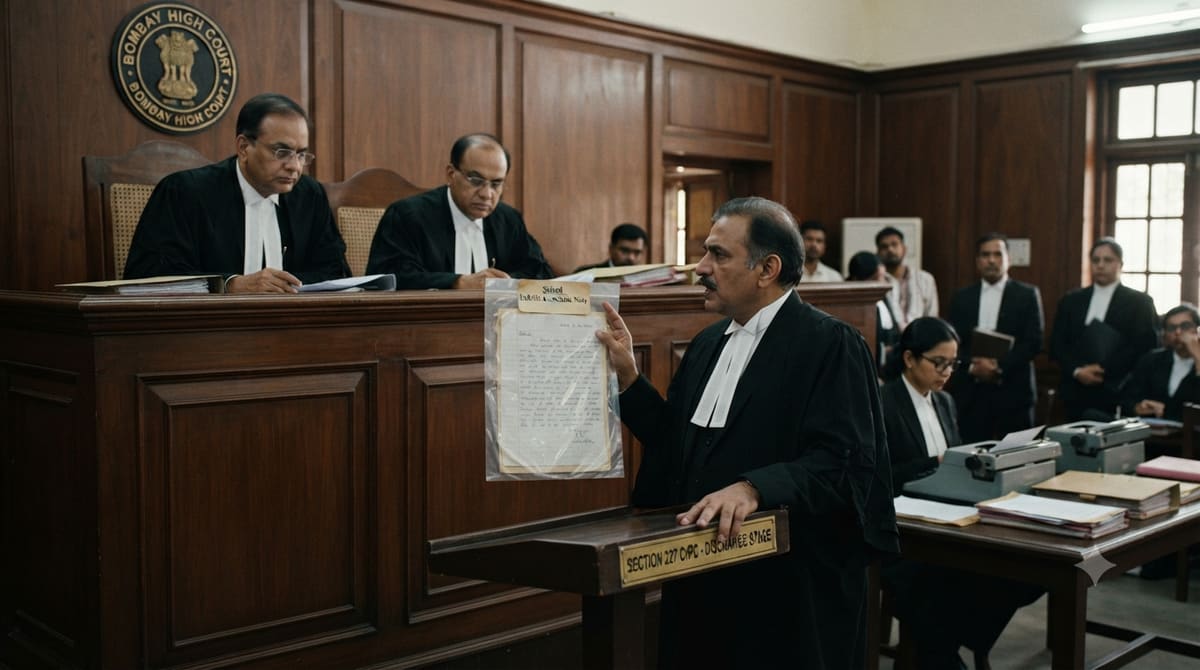
The Madhya Pradesh High Court has reaffirmed that a court rejecting a discharge application under Section 250 of the Bharatiya Nagarik Suraksha Sanhita, 2023, must record a reasoned finding on whether material exists to support the charges. Failure to do so renders the order legally unsustainable.
Background & Facts
The Dispute
The petitioners - Ashok Kumar, Usha, and Pooja - were arrayed as accused in Special Trial No. 21/2025 for offences under Section 80(2) read with Section 3(5) of the Bharatiya Nagarik Suraksha Sanhita, 2023 (BNSS), relating to allegations of dowry harassment leading to the death of the deceased, who was married to Neeraj Dubey. The petitioners, who are the parents-in-law of the deceased, contended they had no involvement in the alleged harassment and were not residing with the married couple.
Key Facts
- The deceased married Neeraj Dubey willingly, according to the petitioners’ submissions
- The married couple resided separately from the petitioners after marriage
- No direct evidence linked the petitioners to any demand for dowry or acts of harassment
- The petitioners filed an application under Section 250 of the BNSS seeking discharge, arguing absence of any material on record to support framing of charges against them
- The application specifically highlighted the lack of evidence connecting them to the alleged offence
Procedural History
- Date of Incident: Not specified in judgment
- Date of FIR: Not specified in judgment
- 02.12.2025: 9th Additional Sessions Judge, Katni, dismissed the petitioners’ application under Section 250 of the BNSS without recording any finding on the existence of material against them
- 24.03.2026: Criminal Revision No. 988 of 2026 filed before the High Court of Madhya Pradesh at Jabalpur
- 24.03.2026: Revision dismissed as withdrawn in respect of petitioner no. 1, Neeraj Kumar
The Parties' Positions
For the Petitioners
The petitioners argued that the trial court failed to consider their written submissions and did not record any finding on whether material existed to justify framing charges. They emphasized that the absence of any evidence linking them to the alleged offence rendered the charge sheet legally unsustainable.
For the Respondent/State
The State supported the trial court’s order, contending that the dismissal of the discharge application was within judicial discretion and that the court had implicitly considered the material on record.
Relief Sought
The petitioners sought quashing of the order dated 02.12.2025, and a direction to the trial court to reconsider their discharge application under Section 250 of the BNSS with proper reasoning and consideration of their submissions.
The Legal Issue
The central question was whether a court dismissing an application under Section 250 of the BNSS is obligated to record a reasoned finding on the existence of material against the accused, or whether a mechanical dismissal without analysis suffices.
Arguments Presented
For the Petitioner
Counsel for the petitioners relied on the Supreme Court’s ruling in Kranti Associates Private Limited v. Masood Ahmed Khan (2010) 9 SCC 496, which held that judicial orders must be "reasoned and speaking." They argued that the trial court’s failure to address the petitioners’ specific submissions on lack of material, or to state why the evidence was sufficient to proceed, violated the principles of natural justice and rendered the order non-appealable in substance.
For the Respondent/State
The State’s counsel contended that the trial court had examined the charge sheet and the evidence collected, and that the dismissal of the discharge application was a routine exercise of judicial discretion. They submitted that the absence of explicit reasoning did not invalidate the order, as the court was entitled to infer sufficiency of material from the charge sheet.
The Court's Analysis
The High Court examined the impugned order and found that while the trial court dismissed the discharge application, it did not record any finding on the existence or sufficiency of material against the petitioners. The court noted that the petitioners had made specific submissions regarding their non-involvement, including the fact that the deceased had married willingly and lived separately.
"Perusal of the entire impugned order, especially the second page of it, shows that although the Court has dismissed the application under Section 250 of the BNSS, but no finding has been recorded by the learned Court in respect of availability of any material against said three petitioners regarding the offence in respect of which, charges have been framed against them."
The Court emphasized that Section 250 of the BNSS requires the court to evaluate whether there is "sufficient ground for proceeding" against the accused. This evaluation cannot be a formality. The Supreme Court in Kranti Associates had laid down that judicial orders must be reasoned to ensure transparency, accountability, and meaningful appellate review.
The Court held that a mechanical dismissal without addressing the submissions or recording findings on material violates the constitutional guarantee of fair trial under Article 21 and undermines the procedural safeguards embedded in the BNSS. The trial court’s failure to engage with the petitioners’ arguments rendered the order legally unsustainable.
The Verdict
The criminal revision was allowed. The High Court set aside the order dated 02.12.2025 dismissing the discharge application under Section 250 of the BNSS. The matter was remanded to the trial court to decide the application afresh, with a reasoned and speaking order that specifically addresses the availability of material against the petitioners. The trial court was directed to consider the petitioners’ submissions on their non-involvement and the absence of evidence linking them to the alleged offence.
What This Means For Similar Cases
Reasoned Orders Are Mandatory at Discharge Stage
- Practitioners must now insist that trial courts record explicit findings on whether material exists to support charges under Section 250 BNSS
- A dismissal without reasoning is appealable and liable to be set aside by higher courts
- The burden is on the prosecution to demonstrate material; the court must articulate why the material is sufficient
Discharge Applications Are Not Merely Procedural
- Discharge applications under Section 250 BNSS are substantive safeguards against baseless prosecution
- Courts cannot treat them as routine; failure to analyze submissions invites reversal
- Advocates should cite Kranti Associates to challenge unreasoned discharge orders
Evidentiary Deficiency Must Be Explicitly Addressed
- If the accused raises specific factual defenses (e.g., separation, lack of contact, voluntary marriage), the court must respond to them
- Silence on such submissions constitutes a legal error
- Drafting discharge applications should include clear, point-wise arguments on absence of material