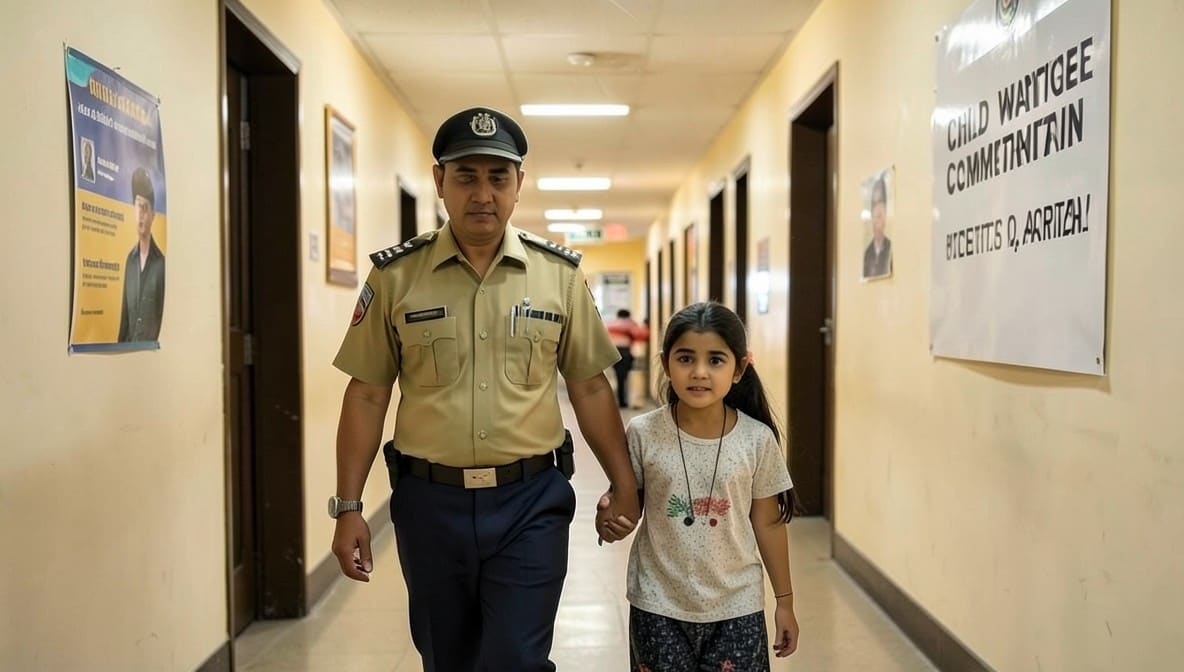
A 15-year-old girl fleeing forced marriage has been granted urgent protection under the Juvenile Justice Act, 2015, as the Punjab and Haryana High Court mandated immediate intervention by the Child Welfare Committee. The judgment reinforces the state’s affirmative duty to safeguard minors from familial coercion, establishing a clear procedural pathway for their safety and legal representation.
Background & Facts
The Dispute
The petitioner, a 15-year-old minor girl, is being pressured by her family members - private respondents - to enter into a marriage against her will with a man eight to ten years her senior. The marriage has been fixed, and despite her objections, she was subjected to coercive conduct by her relatives. Left with no alternative, she fled her home and sought shelter with her neighbour, Rajvinder Kaur, who has been appointed as her next friend in this petition.
Key Facts
- The petitioner is 15 years and 1 month old as of the date of filing.
- The private respondents, her family members, are allegedly exerting undue pressure to solemnize the marriage.
- On 31.03.2026, the petitioner submitted a written representation (Annexure P-2) to the Commissioner of Police, Ludhiana, seeking protection and intervention.
- No substantive action has been taken by the police or other authorities in response to the representation.
- The petitioner fears for her life and liberty due to the perceived influence and clout of her family members.
Procedural History
- 31.03.2026: Petitioner submits representation to Commissioner of Police, Ludhiana.
- 02.04.2026: Writ petition filed under Article 226 of the Constitution before the Punjab and Haryana High Court.
- 02.04.2026: Court hears the matter orally and issues directions.
Relief Sought
The petitioner seeks protection of her life and liberty from forced marriage, direction to the State to ensure her safety, and implementation of statutory safeguards under the Juvenile Justice (Care and Protection of Children) Act, 2015.
The Legal Issue
The central question was whether a minor fleeing forced marriage qualifies as a "child in need of care and protection" under Section 2(14)(vii) and (xii) of the Juvenile Justice (Care and Protection of Children) Act, 2015, and whether the State is obligated to invoke the Child Welfare Committee’s jurisdiction to ensure her safety.
Arguments Presented
For the Petitioner
Learned counsel for the petitioner relied on the precedent set in P...... Minor Through Vikram v. State of Haryana (CRWP-2139-2022), arguing that forced marriage constitutes a form of exploitation and abuse falling squarely within the definition of a child in need of care and protection. The petitioner emphasized the State’s non-feasance in responding to the representation dated 31.03.2026 and the imminent threat to her physical and psychological well-being.
For the Respondent
The Additional Advocate General for Punjab accepted notice on behalf of the State and did not oppose the petitioner’s prayer. He acknowledged the gravity of the situation and agreed that the directions issued in the P...... Minor case should be applied mutatis mutandis.
The Court's Analysis
The Court examined the statutory framework under the Juvenile Justice (Care and Protection of Children) Act, 2015, particularly Section 2(14)(vii), which defines a child in need of care and protection as one "who is found to be working in contravention of any law for the time being in force" or "who is subjected to any form of exploitation or abuse". The Court held that forced marriage of a minor, especially when it involves coercion, threat, and violation of her autonomy, constitutes a clear case of exploitation under this provision.
"The minor in all these cases happen to fall within the definition of child in need of care and protection as provided under section 2(14)(vii) (xii) of Juvenile Justice (Care and Protection of Children) Act, 2015."
The Court further relied on its own earlier judgment in P...... Minor Through Vikram, which had laid down a structured protocol for the protection of minors in similar circumstances. It emphasized that the Child Welfare Committee, constituted under Section 27 of the Act, is the statutorily mandated body to conduct an inquiry under Section 36 and pass orders under Section 37, including interim custody and placement decisions.
The Court rejected any notion that familial ties or cultural norms could override the child’s right to safety and bodily autonomy. It noted that the State’s failure to act on the representation dated 31.03.2026 amounted to a dereliction of its duty under Section 41 of the Act, which mandates immediate protection of the child.
The Verdict
The petition is allowed. The petitioner, through her next friend, is directed to appear before the Commissioner of Police, Ludhiana, within 10 days. Upon her appearance, the Commissioner shall depute a Child Welfare Police Officer to produce her before the Child Welfare Committee within one week. The Committee shall conduct an inquiry under Section 36 and pass an order under Section 37, including interim custody and safety arrangements. The Commissioner shall also consider the representation dated 31.03.2026 and take appropriate steps to neutralize threat perception. The petitioner is not entitled to protection against arrest if found involved in any cognizable offence. All other directions from P...... Minor Through Vikram are binding.
What This Means For Similar Cases
Forced Marriage Triggers Statutory Protection
- Practitioners must treat any report of forced marriage involving a minor as a statutory emergency under Section 2(14)(vii) of the JJ Act, 2015.
- A representation to police or child welfare authorities must be treated as a trigger for mandatory intervention - not discretionary.
Child Welfare Committee Is the Primary Mechanism
- No court or police officer may substitute the Committee’s role; the Committee must be formally invoked within seven days of the child’s production.
- Interim custody, schooling, medical care, and psychological support must be ordered by the Committee as part of its duty under Section 37.
State Inaction Is Not an Option
- Failure to act on representations from minors or their next friends constitutes a violation of Section 41 and may attract contempt proceedings.
- Police must proactively identify and report cases of forced marriage, even without formal complaints, if the child is visibly at risk.