The National Green Tribunal has clarified a critical procedural requirement under the Water (Prevention and Control of Pollution) Act, 1974, holding that oral notice of sample collection suffices if the occupier’s agent is present and raises no objection. This ruling significantly impacts how pollution control boards conduct inspections and enforce environmental compliance.
Background & Facts
The Dispute
The appellant, Johnson Matthey Chemicals India Private Limited, operates a catalyst manufacturing unit at Plot No.2A, Site 2B, Panki Industrial Area, Kanpur Nagar. The respondent, Uttar Pradesh Pollution Control Board (UPPCB), imposed an environmental compensation of Rs. 42 lakhs for a default period of 168 days (11.07.2024 to 26.12.2024) after finding effluent discharge from the appellant’s Effluent Treatment Plant (ETP) to be in violation of prescribed norms.
Key Facts
- The appellant holds valid Consent to Operate (CTO) under the Water Act, Air Act, and Hazardous and Other Wastes Rules, 2016.
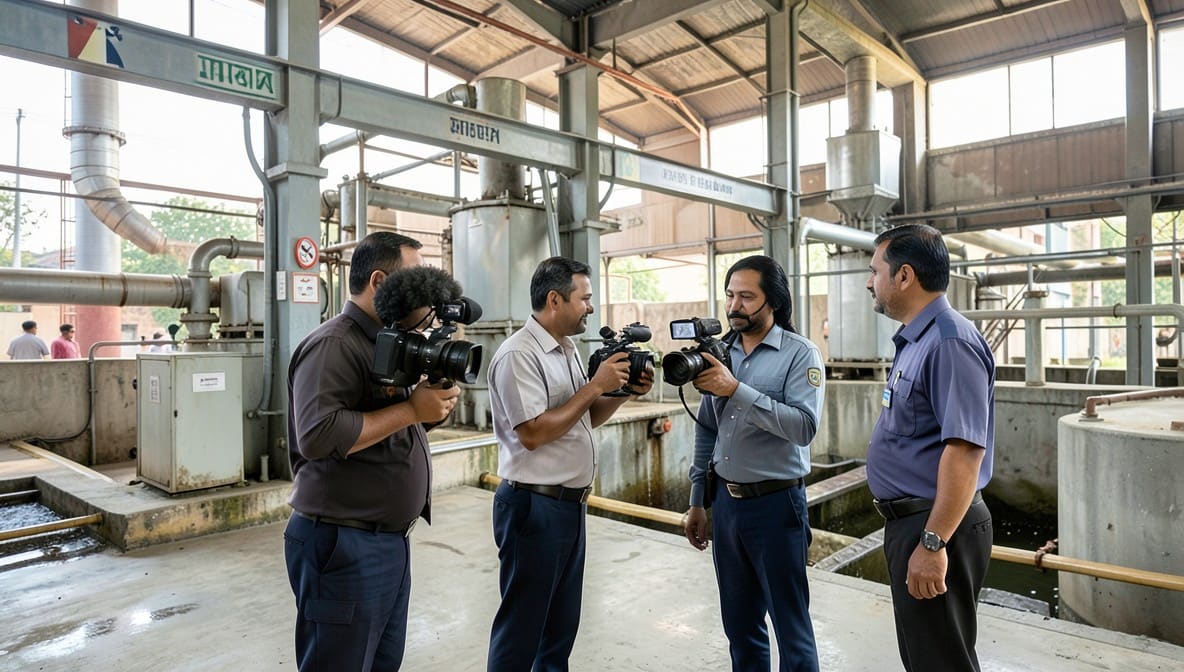
- On 11.07.2024, UPPCB officers conducted an inspection and collected effluent samples from the ETP outlet.
- The sample analysis report, dated 19.07.2024, confirmed exceedance of prescribed discharge norms.
- A show-cause notice was issued on 28.11.2024, to which the appellant replied on 13.12.2024.
- The impugned order imposing compensation was passed on 24.02.2025.
- The appellant had applied for renewal of Consent to Operate (CTE) on 12.12.2024.
- The appellant’s internal test report dated 19.07.2024 disclosed mixing of STP and ETP discharge, indicating operational non-compliance.
Procedural History
- 11.07.2024: Inspection and sample collection by UPPCB officers.
- 19.07.2024: Laboratory analysis report confirms violation of discharge norms.
- 24.07.2024: Inspection report signed by Regional Officer.
- 28.11.2024: Show-cause notice issued by UPPCB.
- 02.12.2024: Appellant requested complete copy of show-cause notice and enclosures.
- 12.12.2024: Appellant applied for CTE renewal.
- 13.12.2024: Appellant filed reply to show-cause notice.
- 09.08.2024: UPPCB Board meeting minutes referenced in impugned order (decision originally taken on 06.01.2022).
- 24.02.2025: UPPCB passed order imposing Rs. 42 lakh environmental compensation.
- 25.02.2025: Closure order issued alongside compensation, later withdrawn on same date.
- 29.03.2025: Appeal filed before NGT under Section 16(c) read with Section 18 of the NGT Act, 2010.
- 07.04.2026: Hearing concluded.
- 29.05.2026: Order pronounced.
Relief Sought
The appellant sought quashing of the impugned order dated 24.02.2025, arguing procedural irregularities in sample collection, delay in issuing show-cause notice, absence of personal hearing, and incorrect calculation of default period. The appellant requested reduction or cancellation of the environmental compensation.
The Legal Issue
The central question was whether Section 21(3)(a) of the Water (Prevention and Control of Pollution) Act, 1974 requires a written notice to be served on the occupier or agent at the time of sample collection, or whether oral intimation, in the presence of the agent and without objection, constitutes sufficient compliance.
Arguments Presented
For the Appellant
Counsel argued that the sample analysis report was inadmissible under Section 21(2) because no written notice in the prescribed Form-XII was served, as required by Section 21(3)(a). He relied on Triveni Engineering and Industries Limited v. State of Uttar Pradesh (2025 SCC Online SC 1877) to assert that strict compliance with procedural formalities is mandatory. He further contended that the delay of over five months between inspection and show-cause notice undermined the fairness of proceedings, and that the reference to the Board’s meeting dated 09.08.2024 was retrospective and invalid. He also claimed that no personal hearing was granted despite a request.
For the Respondent
Counsel for UPPCB countered that while Form-XII is prescribed only for Union Territories, no specific form exists for other states under the Water Rules, 1975. Oral notice was given in the presence of the appellant’s agent, who did not object. The inspection report was signed on 24.07.2024, after receipt of the analysis report, correcting any date discrepancy. The Board’s decision dated 06.01.2022 was in force since 2022 and was properly referenced. The appellant had ample opportunity to reply to the show-cause notice, satisfying natural justice. The compensation period was calculated based on the earliest date of compliance - the CTE application on 12.12.2024.
The Court's Analysis
The Tribunal examined Section 21 of the Water Act in detail. Sub-section (3)(a) mandates that the officer taking the sample must serve a notice “then and there” in such form as may be prescribed. However, the Water (Prevention and Control of Pollution) Rules, 1975 prescribe Form-XII only for Union Territories. No equivalent form exists for states like Uttar Pradesh. The Tribunal held that the absence of a prescribed form does not render the statutory requirement impossible to fulfill.
"In the facts of the present case there is sufficient compliance of Section 21(3)(a) of the Act and sample analysis report of the Board can be relied upon."
The Tribunal emphasized that the agent of the appellant was present during sampling, received oral intimation, and did not object. This constituted substantial compliance with the intent of the provision - to ensure transparency and opportunity for the occupier to witness the process. The Tribunal distinguished Triveni Engineering on factual grounds, noting that case involved wilful absence and failure to follow any form of notice, whereas here, the agent was present and acquiescent.
Regarding the Board’s meeting dated 09.08.2024, the Tribunal accepted the respondent’s submission that the decision was originally taken on 06.01.2022 and circulated to all regional offices. The reference in the impugned order was to an existing, valid policy, not a retrospective rule.
On the issue of personal hearing, the Tribunal held that the opportunity to file a written reply to the show-cause notice, which the appellant exercised, satisfies the principles of natural justice. No statutory provision mandates a personal hearing in such proceedings.
Crucially, the Tribunal found the default period of 168 days (until 26.12.2024) was incorrectly calculated. The appellant’s CTE application on 12.12.2024 constituted the earliest evidence of corrective action. The Tribunal held that the default period must end on this date, reducing it to 154 days.
The Verdict
The appeal was partly allowed. The environmental compensation of Rs. 42 lakhs was reduced to Rs. 38,50,000, calculated at Rs. 25,000 per day for 154 days (11.07.2024 to 12.12.2024). All pending interim applications stood disposed of. The Tribunal upheld the admissibility of the sample analysis report and the validity of the show-cause notice process.
What This Means For Similar Cases
Oral Notice Can Suffice Under Section 21(3)
- Practitioners must now argue that strict written notice is not mandatory if the occupier’s agent is present and does not object to oral intimation.
- Pollution control boards may rely on oral notice in states where no prescribed form exists, provided the process is witnessed and unchallenged.
- Defense strategies in environmental cases must now focus on whether the agent was present and whether any objection was raised at the time of sampling.
Default Period Must Reflect Actual Compliance
- Environmental compensation periods must be calculated from the date of violation to the earliest verifiable date of corrective action.
- Applications for renewal of consent (CTE/CTO) can serve as objective markers for cessation of default.
- Boards cannot arbitrarily extend default periods beyond the date of demonstrable compliance.
Procedural Flexibility in Absence of Prescribed Forms
- Where statutory provisions require a form but none is prescribed, substantial compliance through witness presence and absence of objection suffices.
- Courts will prioritize the intent of the law - transparency and fairness - over technical non-compliance where no prejudice is shown.